Robert Riggs
The hills of Tennessee hold a deadly secret.
A shotgun blast shattered the stillness of the night–sharp, sudden, and final.
For four years, its echo has haunted a grieving family, unanswered and unresolved.
A murder case gone cold.
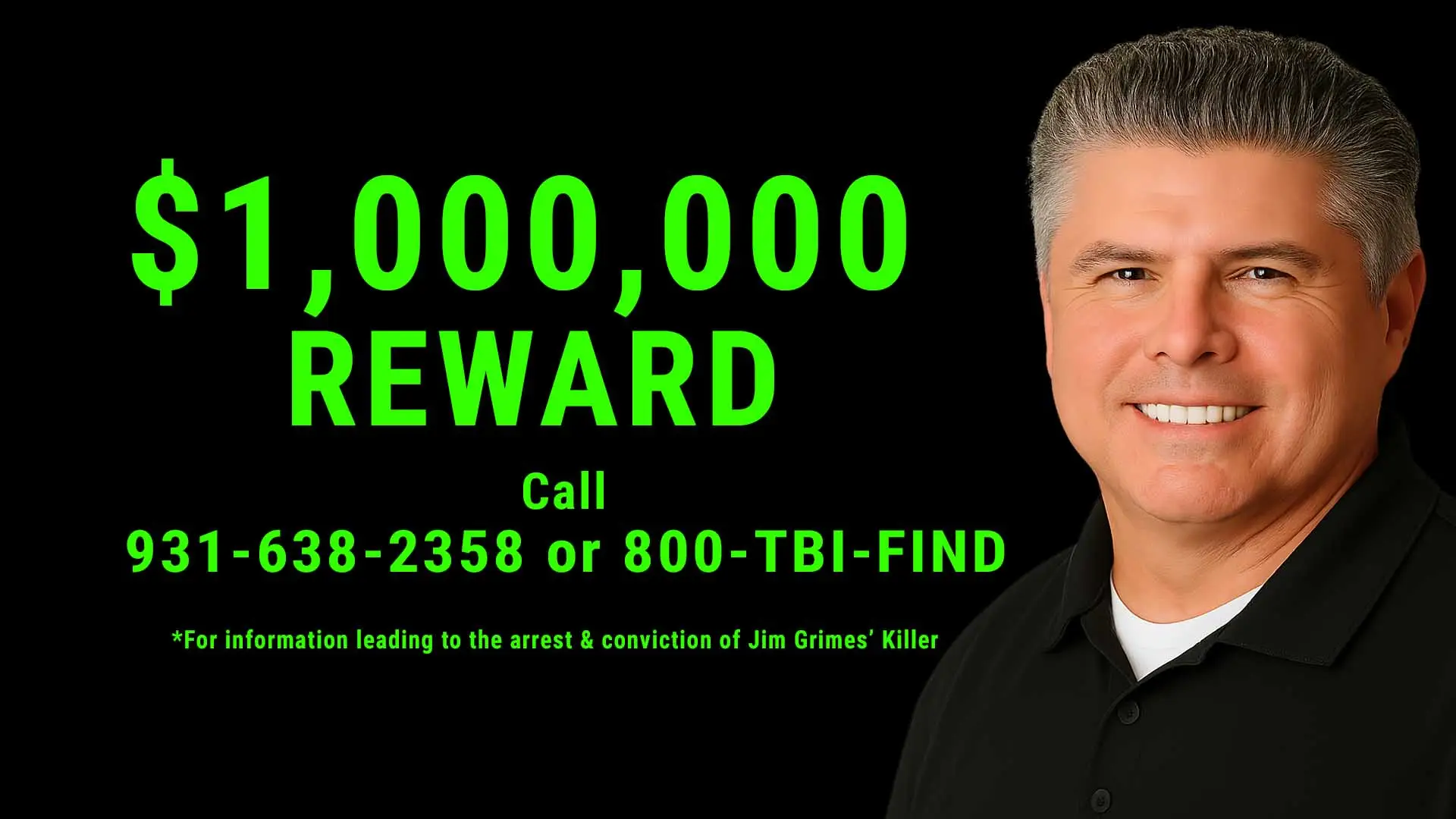
But now there’s a one-million-dollar reward on the table.
Enough to loosen lips in backwoods bars, whispered pillow talk, and jailhouse chatter.
Now, someone might finally talk.
Because secrets don’t stay buried forever–not with a seven-figure reason to come clean.
And a widow determined to see who breaks first.
Dawn Grimes
He was bigger than life. He was just such a loving, joyful, caring man, loved his family, loved God, loved his community, and did everything he can to make things better every day.
Robert Riggs
Dawn Grimes speaks from her late husband’s study, seated beneath a portrait that still watches over the room like he never left.
It is here, surrounded by the reminders of 63-year-old Jim Grimes' presence, that she recalls the night everything changed–April 19, 2021.
Robert Riggs
How do you think the killer or killers did this?
Dawn Grimes
I think that they know the area. I think that they're familiar with the area. I think that they're not a stranger off the street. It's probably somebody with somebody that we know and somebody that knows the area. That's the only thing that makes any sense.
Robert Riggs
The Grimes live in rural Giles County, Tennessee—about an hour’s drive south of Nashville, near the Alabama state line.
It’s a pastoral region defined by rolling hills, dense hardwood forests, and a quiet that feels untouched by time.
Long favored for its seclusion and natural beauty, this corner of Tennessee has increasingly drawn affluent buyers seeking weekend retreats—an escape from the noise and sprawl of the city.
Some of the wealthiest people in the state own farms here devoted to horse riding and hunting.
But even in a place that seems built for peace, violence found its way in.
Dawn Grimes is determined not to be driven out.
Robert Riggs
I think that if this had happened to me here, my wife would have moved. I think a lot of wives might have moved, but you're still here.
Dawn Grimes
I'm here. This was our home. When we bought this house, it was for our grandchildren. At the time, we didn't have any now we have three, and his blood is in this ground, and I won't leave him. I'm not going to run away from who did this, and he wanted to be here. It was important to him, and it's important to me.
Robert Riggs
The Grimes’ two-story red brick home, framed by white columns and a small covered front porch, sits in the 6000 block of Buford Station Road in Lynnville, Tennessee.
At the foot of a long gravel drive, a wrought iron gate stands mounted between stone pillars.
A large black ironwork letter “G” and the Grimes name are fixed to the stone.
A split rail fence wraps the 22-acre property of open pasture and thick woodland edges.
Set back a few hundred feet to the left of the main house, a weathered wooden barn leans into the tree line.
That barn—unassuming, sun-bleached, and utilitarian—is the crime scene of Jim Grimes’ final moments.
Inside it, the family kept a menagerie of animals—a routine of feeding and caretaking that brought Jim out there on the night he was killed.
Dawn Grimes
So we have a very specific routine when we fed, the first thing that you do is you go over, turn the water on so that the trough is filling as you're feeding for the for the animals. And he followed that routine. So this person had to have watched him the entire time that he fed. The very last thing that you do after you go up on the hill, and we were feeding the wild animals, because we like to watch. We had trail cams that we would watch the animals, you know, the wildlife that would come in, the deer and the in, the raccoons, and so he would go up on the hill, and then that was the last thing that he did. He'd come around the barn and he shut the water off. So this person sat there watched this entire routine take place, and when he reached to turn the water off, they were standing in front of him in the dark and shot him.
Robert Riggs
Dawn Grimes arrived home around 8:30 PM suffering from a throbbing headache.
She handled business finances at the couple’s pair of Auto Body Advantage collision repair shops and a mechanical repair garage.
They were swamped by customers who had suffered damage in a recent hailstorm.
Jim Grimes arrived home later from a board meeting of The Well Outreach, a Spring Hill food pantry that serves households in need throughout southern Middle Tennessee.
Dawn Grimes
We typically fed between six 6:30 at the latest that night. I didn't get home until 8:30 I didn't feel good, had a bad headache, had taken a bath. He came home. He said, you know, Have you fed yet? And I said, No, I'm getting ready to go. And he said, just, you don't feel good. Go. Sit down. I'll go feed.
Robert Riggs
Jim Grimes put on a head-mounted flashlight. He headed into the dark, passing a large pond that separated the house from the barn.
Dawn Grimes
So I went back to the bathroom, and I was finishing up,
and I heard a very loud ex, it sounded like an explosion. It was very loud, and I had no idea what it was, and so I picked the phone up. I had my had my phone. I picked my phone up and I called him. My first response. Reaction was, what did he get into? What's he done? What's he got into now? And he didn't answer. And so I walked through and went out where the it's enclosed. Now was just a deck, and I walked outside to the deck, and he had a headlamp that he wore with a flat it was like a flashlight, and I could see that light up on the hill, and I'm still trying to call him, and he's not answering, and he's not answering. So when I got out there, I yelled for him, because I could see his light, and I yelled for him in the light, never moved, and he never answered it. I knew that moment, something was really, something was wrong, but I had no idea what had happened. And so I took off running and got back to the barn. And I got to him, and I could see he was bleeding on his chest, but I'm looking, you know, did something fall off the barn? Did something hit the fence and get him, you know, I'm looking what's happened, and he's, you know, he's looking at me, and he's struggling to breathe.
Robert Riggs
When Lieutenant Shane Hunter—then an investigator with the Giles County Sheriff's Department—rolled up to the scene, one detail stood out immediately.
The barn was clearly visible from the busy front road, meaning the killer had taken a bold risk.
And slipping in from the dense woods behind the barn would have been no easy task.
Robert Riggs
So you feel like the perpetrator had to have been there before?
Lt Shane Hunter
Investigator, Giles County Sheriff’s Department
I think they had to have at least some knowledge of the property. You know, I spent many nights there thereafter, kind of traversing back into the property. And, you know, I got lost several times crossing the property, you know, just, you know. So I think that the person would have had definitely had to have some kind of knowledge of the area. You know, it's not just something you can pull up on Google Maps and get a image of and see all the fences or whatnot.
Robert Riggs
When then-Giles County Sheriff Kyle Helton stepped onto the scene, he felt it—that quiet, unshakable intuition seasoned law officers carry.
Robert Riggs
And when you said that something wasn't right, what? What was it that you had a feeling about?
Sheriff Helton
well, we had, we had a person laying there that had deceased, then no weapon,
no no signs of any any weapons nearby, and a gunshot wound.
Robert Riggs
And no sign of robbery or struggle?
Sheriff Helton
It didn't appear to be, didn't appear to have any struggles.
Robert Riggs
It appeared Jim Grimes had just finished feeding the animals and was reaching to shut off the water when the killer confronted him.
Sheriff’s Investigator Luke Tyson — the lead on the case — believes the gunman had been lying in wait, hidden in the darkness.
Investigator Luke Tyson
The darkest spot on the property was right on that side of the barn. They had lights on the front. There was a floodlight on the back of the barn that kind of lit up towards the wood line. And quite honestly, the darkest spot was right there where those lights didn't get to.
Robert Riggs
Was his wallet, stolen jewelry, anything?
Luke Tyson
He still had his when we searched him. He still had his wallet, his phone. And inside the phone case was, I believe, about 50 bucks. I mean, his phone was still there. He had the SD card that he just changed out from the trail cams that they'd put up to watch wildlife come up, still had his wedding rings on anything he had in his pocket when he went out there was still in his pockets. So it didn’t look like a robbery gone wrong.
Robert Riggs
During my nighttime visit, I walked the woods that back up and flank the barn. The darkness was absolute—no moonlight, no ambient glow—just a wall of shadow pressing in from all sides.
I stumbled through sinkholes, over limbs, never quite sure what was underfoot.
Somewhere out there, a narrow path cut by a tractor’s mower wound through the brush—but I never found it.
Whoever killed Jim Grimes did.
They navigated that rough terrain in the dark, slipped through a maze of electrified fences, and somehow stayed out of sight from the trail cameras Jim had installed to monitor wildlife.
That kind of movement wasn’t luck. The killer knew the terrain.
Investigator Luke Tyson agrees.
Robert Riggs
Well, it sounds like somebody would have to know this existed, and know how to get through the maze of electric fences and everything else. Yes. What do you think?
Investigator Luke Tyson
Definitely, somebody that would have studied the property, known what, where everything was and and also their general idea of their schedules,
Robert Riggs
Any sense, from the evidence you've seen, of a motive of revenge or just a joy killing?
Investigator Luke Tyson
There's really, that's, that's part of what's So frustrating is there's, at this point, there's really no, no idea as to why they would have done this.
Robert Riggs
Lieutenant Shane Hunter says investigators have questioned more than two hundred people in their search for leads—chasing down every tip, rumor, and whisper that might crack the cold case.
Lt. Shane Hunter
When I say 200 that's that's really on the low end side. We've we've probably spoken to just that many people that had an associated with Mr. Grimes. He was a prominent leader in Spring Hill. He was a civic, you know, part of the multiple groups up there. So obviously, he touched many lives. Was a big part of the Boys and Girls Club, just a very, genuinely good person. So he had a lot of contact. So ultimately, you know, when we would go interview somebody, you know, they would say, well, you need to go talk to this person and whatever. So, like I said, easily, 200 people that we've talked to that just have personal contact or knowledge about him throughout, you know, the last four years,
Robert Riggs
Not a person that had a problem to grind with Mr. Grimes, did people that even he'd been dismissed from work, still speak highly of him?
Lt. Shane Hunter
Absolutely, and that's what makes this case so difficult, is that, not that you dismiss any victim, but I've been doing this for 27 years, and this is probably one of the most difficult cases I've worked when it's relating to a victim, because you could not find anybody that had a bad word to say about him you know, genuinely you you'll find somebody that's had some kind of tiff with a person that You know throughout the years, and would say something negative about a victim, but, but that was, what was unusual about Mr. Grimes, was that people that had, he had employed and had terminated, still had nothing but very good things to say about him. You know, they would genuinely say, you know, yeah, you know, I messed up. He had to fire me, but, you know, I still loved him. You know, he was a good man. He was concerned about everybody's family. We try to introduce you to God and religion. And you know, there was one individual that that, obviously, they own a body shop. And Mr. Grimes a scene where somebody had spray painted something inappropriate political purposes, on this person's car, and he found a way to get in contact with them and said, you know, I'll take care of your vehicle. And actually, you know, painted their vehicle for him, you know, just out of his own pocket. So that kind of goes to the fortitude that, you know, Mr. Grimes stood for,
Robert Riggs
The small sheriff’s department has poured thousands of hours into the case, following leads that have stretched far beyond Tennessee, some spanning the country.
It’s the kind of sustained commitment that most big-city departments, burdened by budgets and bureaucracy, could rarely afford to make.
For example, Lieutenant Jeff Perkins focused on a digital trail. He wanted to know: Did the killer have a cell phone on him that night?
In the digital age, it’s a routine yet powerful investigative tool—triangulating signals between cell towers to determine whether a phone had been present at the crime scene.
If the killer left his phone on, even for a moment, it could betray his location.
Lieutenant Jeff Perkins
Because of the area that this particular homicide occurred at it just so happens that the towers actually are in line. You have three towers that are literally a linear alignment. That's no good if we're trying to do data extraction from cell dumps that we could maybe time frame where a phone would be so G lock, or that would be geographical location, if you try and extrapolate that from numbers, well, usually you have a cell tower, and it's got three sides of it, right? So you've got, you've got your ranges, your azimuth, and then you got your sectors, 360 degrees. That's the way it's all broken down. And from that point, if you have a tower here, and maybe a tower eastward or westward, well you could then get through time manipulation, looking through the data, you could see, yeah, the phone was here at one point, pinged off that other tower, and then it pinged back to this particular tower, the primary tower, And then you can do time variances, and it's what we call time difference. And at that point, you could actually track somebody's location. Well, we couldn't do that because of the cell towers that we have in this particular area, trust me, we've gone to every extent you could possibly imagine.
Robert Riggs
Lieutenant Perkins turned to another investigative tactic—one that blended old-fashioned detective work with modern computer coding.
He wrote a custom computer program to analyze the phone numbers of more than six thousand of Jim Grimes’ customers. Just in case one of them had a grudge.
His goal: to determine whether any of them had been near the Grimes property on the night of the murder, using location data as a silent witness.
It was a long shot—and it came up empty.
Robert Riggs
It sounds like it was the perfect scene for a crime?
Lt. Jeff Perkins
Yeah, no question about it. If you think about who would know that the towers or something like that. Couldn't track someone there at that particular night, right? Or that particular area, I don't think anybody would think about that stuff, right? But it just so happens that was one huge negative for us, right? Like you said, also no cameras in the back. The two cameras that were back for you know the trail cams, they weren't exactly pointing in the direction that James was found at. So somebody either would have known they were there, or just by pure luck, they never came across those cameras, because that would have been coming across behind the barn, and that would be east to west, and it would have picked that stuff up. Yeah, it's pretty unusual, though, and to think that no one would hear anything. But again, this look secluded area, right? This is rural, typical Giles County. You've got people that live in spots and you never hear anything.
Robert Riggs
The Giles County Sheriff brought in one of the nation’s foremost experts on unsolved homicides: legendary cold case investigator Joe Kennedy from the Carolinas Cold Case Coalition.
Now retired, Kennedy made his mark as a Special Agent with NCIS, where he founded the federal government’s first cold case unit.
He didn’t just work the toughest cases—he helped write the playbook. I interviewed him in 2023 for a two-part series, and I’ve included the links in the show notes.
Kennedy encouraged me to report on the Grimes case, hoping that renewed attention—and the one-million-dollar reward—might flush out new leads, or shake loose a long-held secret.
As we left the crime scene together, we discussed the case’s complexity.
It was clear: this wasn’t just a random killing. It was calculated. And someone out there knows why.
Joe Kennedy
In my mind, there's probably no more than three or four suspects in this case. It's just getting to that right suspect. And that's the hard part about cold cases, is, how do we narrow down that pool of suspects? And that's the That's the million dollar question, right, in this one.
Joe Kennedy
And you know, this case is very difficult. You know, it's a single shotgun blast of the chest. You know, ammunition is, is not extremely rare. So, you know, that's that's a hard path to travel to try to identify, you know, or link a particular suspect to the ammunition. There's no shotgun shell that's left behind. You know, essentially, this is a crime scene devoid of physical evidence. There's no physical evidence to speak of other than that, you know, the remnants of that shotgun blast. And it's, you know, it does give us some clues, but, but they're not real, viable clues that we can follow to lead us to a particular person.
Robert Riggs
Your experience has shown that most murders occur outdoors. Break that down for me, and are they more difficult to solve outdoors?
Joe Kennedy
Yeah, so you'll, you'll, you'll see that about two thirds of murders are committed outdoors. About 1/3 of murders are committed indoors, of course, just nature itself, sunlight, right exposure to the weather, destroys or degrades DNA at an outdoor crime scene, and you'll find that we have a higher closure rate on indoor crime scenes, somewhat, sometimes upwards, In excess of 10% higher closure rate for indoor murders, and indoor murders are easier to work the evidence of the physical evidence is preserved better. Typically, that requires people to enter and exit locations where maybe there's an ability to track that movement of an individual, whereas outdoor scenes like the one we have here in Giles County, it's much more difficult, you know, to trace the whereabouts and the travels of a particular suspect, both before and after the
murder.
Robert Riggs
I am impressed by a small department that. Few detectives, how much time and resources they put into this, I don't know that you would see that kind of dedication in a big city police department in a case.
Joe Kennedy
Well, I will say this, I was extremely impressed with the effort of the Giles County Sheriff's Department. We initially came out here in March of last year, myself. Craig Ackley, retired FBI agent, just a brilliant investigator. Ed Collins, retired New York State Police, another brilliant investigator. And we all commented on our way back after we had been out here last year that wow, for such a small department, these guys put an impressive investigative product together. And they have, you know, uncovered all the stones that they possibly could have. They've done some very non traditional investigative techniques. And like you said, Robert, you wouldn't see this in a lot of major metropolitan homicide units. So yeah, it's, I'm most impressed with, also the quality of the people. You know, when you have a small Sheriff's Department, the leadership starts at the top of the sheriff and Kyle, you know, he is just, obviously, just a great human being, a man of integrity, and all of his officers, you know, follow that model. You know, whether it's Luke or it's Jeff or it's Shane, you know, these are just great, respectable police officers out doing their job, tireless workers, the sacrifices they've made in this thing. Or, you know, if the public knew all the personal sacrifices these investigators made, they probably wouldn't believe it, because they've missed holidays. They've missed birthdays with their kids, you know, all the things that deaf investigators, homicide detectives, you know, experience in the course of their career. So I would echo what you what you see is that this was this certainly was no stone left unturned in this thing, and I'm confident they're going to solve this case because of the quality of investigators that they have working.
Robert Riggs
But even the most dogged investigation can hit a wall when there’s no forensic evidence, no witnesses, and no clear motive.
That’s where the one-million-dollar reward comes in– designed to pry open locked lips.
The money is there to make silence expensive, and speaking up worth it.
Joe Kennedy says one million dollars is a big incentive to nudge someone on the fringes of the murder to step forward.
Robert Riggs
Well, in your experience, perpetrators don’t keep secrets?
Joe Kennedy
You know, they always tell someone Robert, in the vast majority of successfully closed cold cases, the suspect, for any number of reasons, told someone they did it. It's that first sign of their attempts to cope with what they've done. It's a coping mechanism. They got to get it off the chest. They got to get it off their minds. And so they tell someone that they did it. And so that's my hope, that that reward could maybe encourage someone to come forward that has been told something, because we know that that is one of the investigative steps that has to always be followed with cold cases. Find who they told what they know about that. Find the person that they told that they were involved in the murder.
Robert Riggs
What do you think it is in human nature that they tell I know that sometimes it's bragging to a cellmate. But what's the other thing? Do you find some want to just get it off their chest?
Joe Kennedy
You know, Robert, actually, I find that many suspects want to get it off their chest.
Joe Kennedy
and I don't think this is a planned murder either. I think it's the heat of passion, sudden quarrel, some disagreement. And what you find in those cases is they do tell someone because they did not plan it, and then they don't realize what a heavy burden it is to have murdered someone. We see it with their sleep. Initially, they can't sleep. They have nightmares. It increases their anxiety and their impulsivity. They have a hard time maintaining regular employment. Again, they cope by using alcohol and drugs. Also, they'll move residences quite frequently. So these are some of the keys that we look for in a cold case. You know, where is that life deterioration in the suspect? Now, occasionally, you'll see a suspect's life will actually get better right after the murder. It almost shocks that person into becoming a better person. They'll find religion, they'll, you know, find a significant other, they'll get a job, right? And those, their lives will improve. So I think one of those, one of those, is certainly going to be the case. In this cold case, like most cold cases, is life deterioration or life improvement.
Robert Riggs
For the team pursuing Jim Grimes’ killer, the calendar doesn’t matter. Four years in, their determination hasn’t wavered. This case isn’t just another file—it’s a promise. And they’re not letting it go.
Lieutenant Shane Hunter says he goes to bed thinking about the case and wakes up asking himself. What else can I do? What did I miss? What can I do today to move this case forward?
Robert Riggs
I would think for the killer, knowing how hard the detectives on this case are working, and then, like a Joe Kennedy coming to the table, they ought to be a little bit worried.
Lt Shane Hunter
Absolutely, they know that one day we will knock on their door and ultimately they'll be arrested for this. I don't think this is just the perfect crime that somebody's going to walk scot free for. We're not going to let it happen like that. There's too many people that are dedicated to getting this solved, and ultimately justice will be served.
Robert Riggs
Dawn Grimes refuses to let her husband’s murder fade into memory.
She’s keeping the case alive—loud, visible, and impossible to ignore.
In the latest show of her resolve, a new billboard now towers above the long black banner that runs the length of the fence in front of her home. The words on the banner remain unchanged—“WE WILL NEVER FORGET – WE WILL NEVER GIVE UP”.
But now, above that message, a second one rises higher and louder: a billboard featuring Jim Grimes’ photo and a direct plea for help in bold letters, “I WAS MURDERED HERE ON 4-19-21. HELP ME GET JUSTICE,” it reads, alongside the offer of a $1 million reward for information leading to an arrest and conviction.
The sign’s message is unflinching. So is the family behind it.
Dawn Grimes
Every day you wake up and you live with this, every day not knowing, you know, are they going to come after me? Are they going to come after my children, my grandchildren? Are they going to come after somebody else in the community? If they've done this once, are they going to do it again? You know that that's very unnerving to know that they're still out there every day, and it's the right thing to do, you just you don't do something like this to another human being. So please help us.
Robert Riggs
This is among the most puzzling cases that I have ever covered.
But I can tell you this from my reporting experience: someone besides the killer knows who murdered Jim Grimes.
The reward remains at one million dollars for information leading to the arrest and conviction of the person or persons responsible for killing Jim Grimes.
If you know something, now is the time to come forward. Call 931-638-2358 or 800-TBI-FIND to begin the process of claiming the reward.
And if fear is holding you back, know this: investigators have pledged to protect your identity and your safety.
You’ll find both numbers listed in the show notes.
This is Robert Riggs reporting for the True Crime Reporter® podcast.