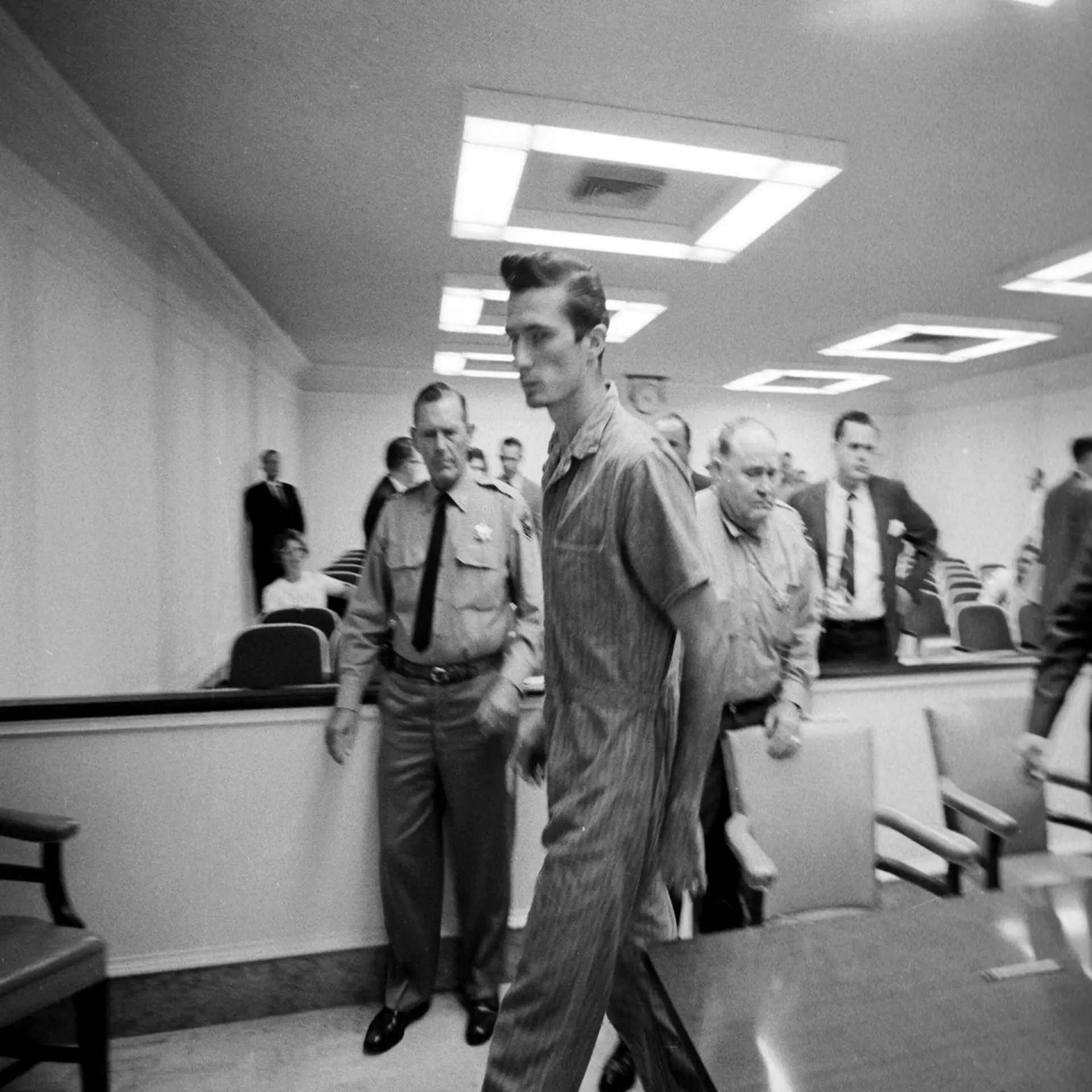
Kenneth McDuff is the only man in Texas history to receive three death sentences.
McDuff received his first death sentence for the broomstick murders in 1966. He was supposed to go to the electric chair.
But I explained in earlier episodes that McDuff’s death sentence was commuted to life when the U.S. Supreme Court struck down the death penalty in 1972.
McDuff became eligible for parole and resumed his killing ways three days after his release from prison in 1989.
McDuff abducted 28-year-old Colleen Reed from an Austin car wash and murdered her shortly after Christmas of 1991.
Two months later, the serial killer abducted 22-year-old Melissa Northrup from a Waco convenience store and murdered the pregnant mother of two children in March of 1992.
Both capital murder trials were moved to different cities because of pretrial publicity.
This episode begins with the first trial in Houston.
Under the glare of intense publicity, Kenneth McDuff went on trial in Houston for the capital murder of 22-year-old Melissa Northrup.
Trouble flared when McDuff scuffled with four deputies. He didn’t like them holding his arm as they escorted him out of the courtroom.
The McLennan County district attorney called U.S. Marshal Parnell McNamara and Falls County sheriff Larry Pamplin to testify.
As you may recall from earlier episodes, Sheriff Pamplin and his father had a rolling gun battle with McDuff in 1966 over the broomstick murders. And pamplin had predicted that bodies would start turning up after McDuff paroled out of prison.
Pamplin knew the monster inside McDuff better than any law officer in Texas.
Pamplin told the da he would take the stand against McDuff armed and ready for the slightest provocation.
I said “There’d be one stipulation.” I said “I am aware of what he did the day before where he jumped four deputies in an elevator.” And I basically told him that I’d be happy to be there but I would be well-armed and if he so much she scratch his ass in the courtroom that I’d killing right there in the court room.
And he said and the judge said...
Sheriff Pamplin
And I told him that he needed to tell the judge what was going on because I was going to take my wife with me to Houston and she would be sitting there on the front row, witnessing everything taking place. And I told her I said “If anything starts just the floor because I will kill him right in the courtroom.” Because too many people had already lost their life because of Kenneth McDuff.
Robert Riggs
And when he saw you, he whispered to his lawyer but it was overheard.
Sheriff Pamplin
He told me that he heard Kenneth McDuff tell his attorney “Get that son of a bitch out of here. He’s just itching to kill me. And he’s the only person that I’m deathly afraid of.”
Robert Riggs
Well, do you kind of wear that as a badge of honor in a sense?
Sheriff Pamplin
That’s the only true statement that I have ever heard that Kenneth McDuff said. And yes, if he had a started a situation in that court room, it would have been over with.
Robert Riggs
During the trial, McDuff came face to face with his two known accomplices, Roy Dale Green and Alva Hank Worley.
Roy Dale Green testified against McDuff in the 1966 murder of three teenagers in Fort Worth. The broomstick murders.
When McDuff spotted him in the courtroom, he told deputies he wanted to be locked in a holding cell with green.
Alva Hank Worley, McDuff’s accomplice in the abduction of Colleen Reed from an Austin car wash testified.
Worley told the jury the grizzly details of how McDuff raped and tortured the 28-year old accountant. You heard his confession in earlier episodes.
Female members of the jury teared up as they listened to the ghastly last hours of Reed’s life.
Against his lawyer’s advice, McDuff took the stand in his own defense.
Author Gary Lavergne and I heard McDuff spin a bizarre tale.
So when he took the stand in the first murder trial in his own defense against the advice of his attorney, he just contemporaneously spun out this yarn of who he was and how he couldn’t have done it. But I sitting there as a reporter and just poking it full of holes like that is the most ridiculous thing I have ever heard but he certainly thought that he would be very persuasive to the jury. He had an ego.
Gary Lavergne
Well, and it’s an ego that the Austin Police Department tried to exploit. When you are dealing at least in my opinion as a writer, a lot of people say, “Well, if he lied to you for five hours, what good was it?” But that’s a wrong attitude to take. When you’re dealing with a McDuff, lies are as important as the truth to him because he is telling you what he wants you to believe. You don’t have to believe it but it’s still valuable.
Robert Riggs
And so, when he took that stand that you witnessed, it was part of his ego to believe that what he says is the truth because he said it. And because he said it, you got to believe it. And that’s why he overruled his own attorneys and took the stand because he felt that if he got up there and he said something, they had to believe it. And of course, they didn’t.
And that ego was such that if you look back at his crimes and the details we know, he had to have an accomplice. Sheriff Pamplin said it was always somebody of a strong muscle and weak mind. But it was like he needed somebody to perform in front of.
Gary Lavergne
Absolutely. It’s not in a perverted sort of way. It’s not fun unless somebody sees it or unless he can talk about it or unless he can shock someone. The young women that he brutalized and the young – and the boys that he killed, well, I mean that wouldn’t have been fun if he had done it all by himself and no one would have seen it. And so, you have a Roy Dale Green or an Alva Hank Worley, weak-willed people who he figured he could control. But what he didn’t figure on is that they would have an ounce of consciousness that he didn’t even have.
Both of these unfortunate – and I’ve gotten into trouble for saying this, because you’re not supposed to use the word stupid but both of those men suffered from what I call in my book, heartbreaking stupidity. And I’ve gotten into trouble for even saying that. But I couldn’t kid myself anymore. That’s what was going on. And McDuff understood that. I mean it’s not like McDuff picked out a high school graduate to bring along. I mean he wanted to impress people with his brutality and anyone with an ounce of intelligence or education would not have been impressed.
McDuff delivered a rambling story to the jury.
Robert Riggs
He scolded his attorney when he tried to interrupt.
McDuff failed to offer up a single defense witness to substantiate his story.
Three decades later Parnell McNamara, now the McLennan County sheriff in Texas. And I discussed McDuff’s testimony.
Parnell McNamara
He really thought he was smarter than everybody.
Parnell McNamara
It was sort of something out of fantasy land. He would jump around from one thing to the other. He was riding a train and then he you know just came up with this off the wall jargon that didn’t really make any sense. And you know he would kind of laugh and I’m not sure how to describe it but it was just totally stupid and at some points kind of in coherent.
Robert Riggs
Yeah.
Parnell McNamara
Just off the wall stuff that he was coming up with where he was, what he did, how he got to Kansas City. It was all just a bunch of BS.
Robert Riggs
There seem to be a physical similarity between all of his victims.
Parnell McNamara
Right. Most all of his victims were for whatever reason brunette and they were small females that he could easily manhandle. Some of them he would be able to pick them up by the throat and get their feet off the ground where they couldn’t fight him.
Robert Riggs
He’s a big man.
Parnell McNamara
He was big man. He was 6’3, 6’4 at one point where he’d close to 270, a big strong guy. And I remember when we put the handcuffs on him they would only click one time. And so, we thought well we may even have to put leg irons on his hands, just a big-boned guy, just a big mean monster.
Robert Riggs
Yeah. He wasn’t fat.
Parnell McNamara
No. No.
Robert Riggs
Just a big – I guess, yeah, maybe he pumped a lot of iron when he was in prison too like they do.
Parnell McNamara
Yeah. Yeah. He was a big strong guy. And he wanted small ladies, small girls that he can manhandle and beat them up, torture them, get control of them.
Robert Riggs
On February 16th of 1993, following a two week trial, an eight woman, four man jury deliberated for just under four hours.
Melissa Northrup’s sister-in-laws, the same ladies that clenched fists and shouted at McDuff when he was brought back to Waco, sat in the front row of the courtroom. They held hands and braced each other to hear the jury’s decision.
McDuff stood with a vacant stare in his cold dark eyes. The judge read the verdict.
McDuff sat down and twiddled his thumbs as the judge polled jury members about their decision.
Outside the courtroom, Brenda Solomon, Melissa Northrup’s mother, told me it had been a painful 11 month ordeal waiting for justice. She dreaded the long appeals process that lay ahead.
I found Northrup’s brother waiting outside the courthouse door for deputies to escort McDuff back to jail.
Sheriff’s deputies clutched McDuff and opened the courthouse door.
McDuff wore a dark suit and tie with a smirk on his face.
So I asked McDuff about his plans for the future. McDuff sarcastically replied.
Kenneth McDuff
I guess I’m going to die. We all do you know.
Robert Riggs
A second trial jury in seguin, Texas sentenced McDuff to die by lethal injection for the abduction and murder of 28-year old Colleen Reed on March first of 1994.
After hearing eight days of testimony, the jury of seven men and five women deliberated for two and half hours.
The verdict came down on the second anniversary of Melissa Northrup’s kidnapping.
McDuff faced testimony from his accomplice, 36-year old Alva Hank Worley.
At the beginning of the trial, Worley threatened to back out.
If he didn’t get a better plea bargain deal.
HIS ATTORNEY TOLD REPORTERS THAT THE EXCON QUOTE, " feels that life is too much punishment for his participation.”
You may want to go back and listen to Worley’s confession in episode 6 and decide if a life sentence was too much punishment.
Because he too raped the young woman and he never lifted a finger to save her from McDuff.
Seven months later, Worley pleaded guilty to a 40-year prison sentence for aggravated sexual assault.
Since then, Worley has come up for parole and he has been denied.
Colleen Reed’s sister, Lori Bible, became a champion of victim’s rights. She held news conferences to press for legislative reforms.
After the verdict, Bible said of McDuff’s sentence, “as long as he is never free again. I don’t want that man ever, ever to hurt another family again.”
Author Gary Lavergne and I covered both of McDuff’s trials.
After studying this crime, talking to him in prison, probably the worst serial killer certainly in Texas history ever, the only man to get three death sentences in Texas and that third one was an insurance policy to make sure if the second one got overturned, he would not ever be out of again.
Gary Lavergne
Well, and the Travis County DA was criticized for that in saying, “How many death penalties do you want?” Well, he had one already. And he got out of it. So it was an insurance policy and it was worth it.
Robert Riggs
But I would add this, he is the only person I know of who has ever had two different death row numbers because he had one death row number in 1966 and then with Furman versus Georgia, he went to life in prison, gets out on parole, gets caught again, gets convicted again, goes back to death row a second time with a different death row number. Now, that maybe – I know of no other example of that, two different death row numbers. I’ve never heard of that.
I do recall in his second trial for murder for Colleen Reed, the District Attorney was sitting next to me, his assistants were trying the case and there was a moment he looked at me and he said, “My God! He is a killing machine.”
Gary Lavergne
And one of the criticisms of my book is that that’s basically what I said about him. And my day job at the time, I’ve just retired a few months ago, but my day job was on the university campus and I’ve been approached by a number of the enlightened on that campus and, “Can’t you see that he is a product of his times?”
Robert Riggs
No, I don’t buy that at all. I want to tell you that just because we don’t understand why someone would take pleasure in doing such unspeakable things, that doesn’t make him crazy. It makes him mean but it doesn’t make him crazy. He knew what he was doing. He understood the pain he was inflicting and he enjoyed it. Now, I don’t understand how anybody can enjoy that but that doesn’t make him crazy. It makes him different from me and you and maybe that’s what makes him a criminal.