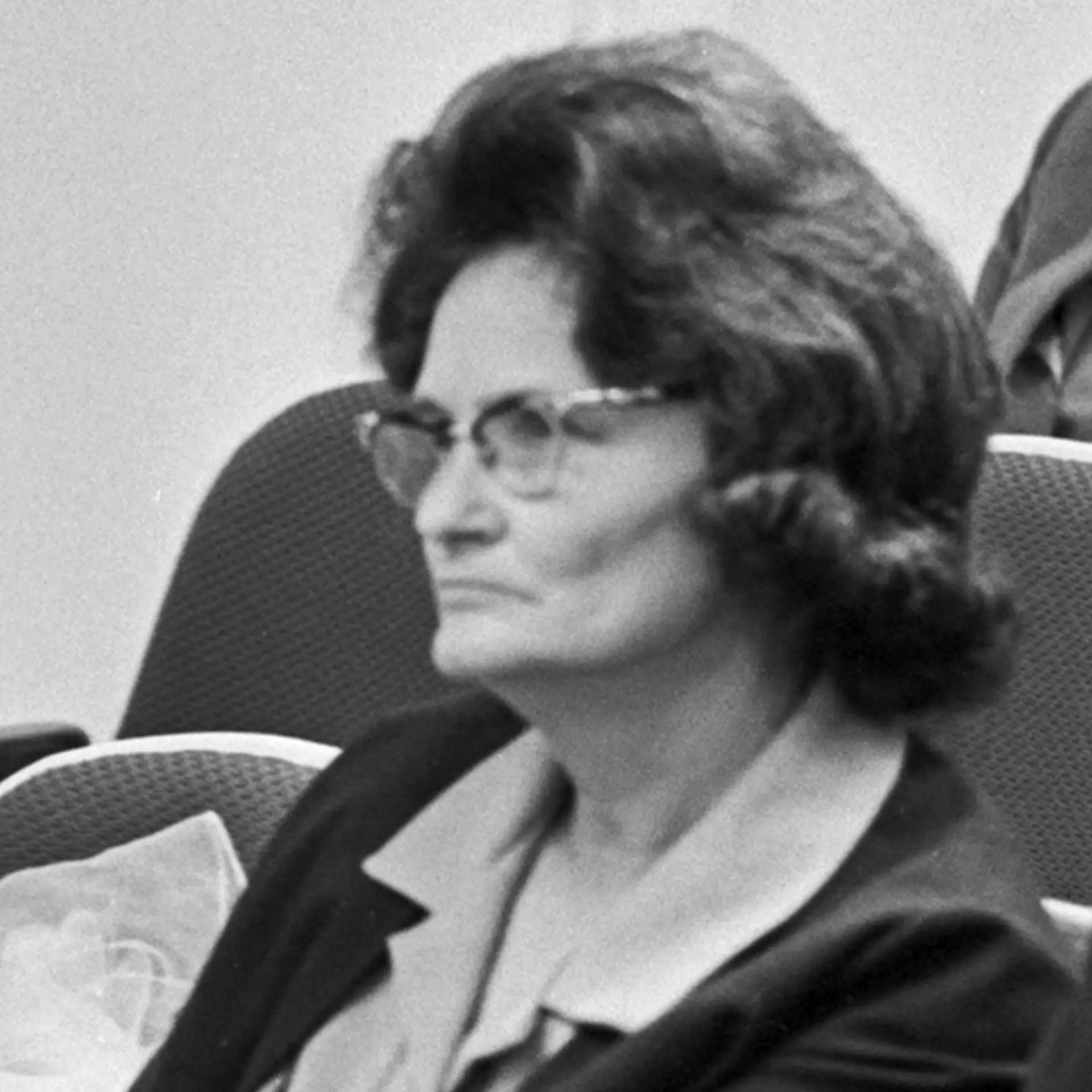
In the last episode, we learned that Kenneth McDuff started leaving a string of victims a few days after walking out of prison on parole.
Local police either missed or ignored clues that could have stopped a killing spree that lasted two and a half years.
The kidnapping of 22-year-old Melissa Northrup from a Waco convenience store spurred a group of aggressive Texas lawmen to form an old-style posse.
U.S. Marshals, a U.S. Attorney, an undercover prison investigator, and a crack deputy sheriff get on the trail of Kenneth McDuff.
All roads lead to his mother, Addie McDuff. Known as the pistol pack’in mama.
The case of Kenneth Allen McDuff raises the age-old question about serial killers. Was McDuff the product of nature or nurture?
Did genetics create this violent, uncaring monster?
Or did McDuff’s home life rob him of every ounce of compassion?
One thing is clear. McDuff’s mother, Addie McDuff known as the pistol packin mama, enabled the psychopath.
Three days after Melissa Northrup vanished in Waco, Addie McDuff, reported that her son was missing.
Kenneth McDuff’s missing persons report landed on the desk of Bell County deputy sheriff Tim Steglich.
Tim: I called Addie McDuff to talk to her about the situation. I asked the general questions, has he ever left before? Knowing in the back of my mind that she either knew where he was or he wasn’t actually missing in the first place. And so, it just kind of progressed from there. I’m looking for a guy that has just jumped parole.
Filing a missing person’s report is an old ploy used by excons to try to throw the law off their trail.
McDuff’s mother reported McDuff missing a few days before he became the marshals prime suspect in the kidnapping of Melissa Northrup.
Remember McDuff wasn’t yet a suspect. Steglich figured McDuff had jumped parole and had asked his mother to file the report to cover it up.
Steglich drove to McDuff’s parents home in Belton. They’re located midway between Waco and Austin--the two cities with unsolved kidnappings.
Steglich encountered the definition of a dysfunctional family.
Tim: They were elderly already. They had a successful business in construction, I believe it was house foundations, which is a bit disturbing after knowing that he was in the concrete business.
Addie McDuff controlled the house. She would tell her husband to shut up when I was interviewing them. And I was having to tiptoe around the Waco and the Austin issues at the time and I am trying to find her son for her, “This is what I’m trying to do. I’m trying to help you.”
And she was evasive. I knew she had been talking to him periodically. And so, she was a terror. And I think he may have been a mama’s boy and very much so, which attributed to some of his traits.
Riggs: Did you feel threatened by her and her presence?
Tim: Not physically, not at all, and certainly not by her husband.
Riggs: Yeah.
Tim: She was a fairly large woman.
Riggs: What would you leave there thinking?
Tim: The bitch knows where he is. And I was getting pretty frustrated with her. She probably did not know exactly where he was but she was not being honest about any of it.
When the marshals started hunting McDuff, steglich went back to his parents house to ask more questions.
His supervisor was concerned that McDuff might be hiding out there waiting to ambush lawmen.
So steglich asked prison investigator John Moriarty to back him up.
Moriarty says Addie McDuff fit the serial killer profile to a t.
Robert Riggs: Domineering.
The next lawmen to knock on Addie McDuff’s door were U.S. Attorney Bill Johnston and U.S. Marshal Parnell McNamara.
McNamara: We had gotten a search warrant for the mother and father’s house on Cedar Creek Road in Bell County, outside of Temple. So, we took Tim Steglich with Bell County SO, a bunch of Marshals down there with us. And we raided the house. And so, she came up to me, we told her we were looking for him because one of our informants had seen some things in the house that led them to believe that he had been there or was there at the time they were there. So, we got search warrant went down there immediately.
She came running up to me and said, “Please whatever you do, don’t hurt junior.” He called him Junior. You know here’s 6 foot 4, 270, been on the death row, multiple murder and he’s called Junior by his mother. And said, “He ain’t done nothing and he ain’t hurt nobody.” And I said, “Are you telling me you don’t believe that he killed those three kids back in 1966?” And she said, “He said he didn’t and I know he didn’t.” And so, I realized right then, she was a big part of the problem.
And so then we met his father who came up during the search warrant and the pickup date he had run the police road block with Brenda Thompson tied up in and got away and then killed her shortly after he got away from the Waco police department was in the drive way. And so, it had a receipt in there that we got where the windshield had been put in by an auto glass place.
Riggs: Where his victim had kicked it out in her struggle.
McNamara: Where his Brenda Thompson had kicked the windshield out when the police saw her tied up in there. So, the father came over and he said that if he did what you all said he did, just go ahead and kill him. Quite the opposite of what the mother said but that was the father’s attitude when we were there. And he was just very matter of fact. If he did what you all said he did then you might as well just go ahead and kill him.
A: He didn’t have much nurture. Well, he had nurture but it was a long time. So McDuff’s mother was mean as a snake, sorely, ornery, rude, unpleasant, never respect. And his father was interesting. His father, I recall when we were in the garage and his father was out there. The father said, “That boy has caused me.” He was talking about Kenneth, “That boy has caused me a million dollars or something like that.” And he said, “When you find him, you can kill him if you want to. This is a matter of fact.”
Now, Mrs. Addie McDuff, the old witch mother said, her great line of the day was, “You don’t frame me like you did the last time.” She was talking about his 66 cases.
R: Serial killing.
B: Right, in Fort Worth, Texas. So she was the big denier and daddy was had had it with him. But they were terrible, terrible human beings and not much different than you would have expected.
R: And I guess along the way, you found he had abused family members and stuff.
B: They were sisters that came forward. Parnell talked to a number of them. He was abusive when he was very young. He had sisters that were in a single digit age that he was sexually abusing. He was a sick freak from when he was very young.
DS: he had no humanity about himself. Talking to his mother, dealing with the sister, he had a sister. She is in the hospital. She is – I forget what operation she was going through. She explained to me after we became – we dropped the barriers that he rolled her on the side and raped her, his own sister, after the operation. This guy had no – he was inhuman.
RR: But Mama thought he did no wrong. Tell us about her. You were dealing with her, Addie.
DS: Addie was a piece of work. Addie loved her son very, very much and he did no wrong. And no matter what you tell her, no matter how you dealt with her, you couldn’t convince her any otherwise – any other ways.
Stoltz resorted to another tactic to get Addie McDuff to cooperate.
Every night his search helicopter shined its spotlight into her house.
Stoltz thought a dose of insomnia might make the pistol packin mama give up her son.
It didn’t work.
So my approach was I say, “Addie, that light that’s shining in there,” and she said, “Yes, I think you are all giving me cancer,” and I said, “OK. You figured us out, Addie. And so every night when that light would hit her, I would call her up and say, “How are you feeling today?”
So again, there was no talking reality to her saying, “Your son needs to come in. He is harming people.” So you just had to play her game.
RR: You’re trying to break her down to give up her son.
DS: Yes, no sleep. That’s what I was trying to do. So we could approach her and talk to her sensibility.
RR: Did it work?
DS: No, it did not.
RR: She was that tough.
DS: She was tough. She was tough.
DS: I think deep down inside, my personal opinion, my personal opinion is that McDuff’s mother was so entwined with this young man. I think there was a different relationship between him and his mother. They were very, very close. The sisters, the other kids seemed like that they had to protect McDuff that no matter what the mother said, no matter what the mother said – no matter what McDuff would do, the mother was always there to protect McDuff and they were – that was a tough – the mother was just – I never met anybody like her. She would stand fast. She was so loyal to that young man. But he was an animal.
Author Gary Lavergne says some of the lawmen confided to him that they were a little bit afraid of Addie McDuff.
Gary: McDuff’s older brother had some problems on the school bus and she is reported to have approached the bus driver with a pistol that she had in her purse and it was believed widely among the people of Rosebud that she just had a pistol in her purse at all times.
And I will say this, and I know you had a lot of other law enforcement people on this program, all of them are people I admire and I’m friends with but each one of them told me in very hushed tones that they were more afraid and a little more careful with her than with him because with McDuff, you knew what you were dealing with. And if he did something, you just shoot him. And who is going to blame you for that? You’re dealing with Kenneth McDuff.
With his mother though and with other members of his family who were just kind of weird, you can’t – you just have to be careful and you don’t know what they are going to do. In many ways, that woman was just believed to be crazy. And how do you deal with someone like that?
Next on true crime reporter, deputy sheriff Tim Steglich breaks the case wide open.
Steglich obtains a confession from McDuff’s accomplice.
It is a journey into darkness.
He is the epitome of evil, just a totally evil person.
Riggs: Tell me about Worley. Why Worley? Why would McDuff want Worley in the car with him as an accomplice?
Tim: He was similar to Roy Dale Green, probably slightly more intelligent but small enough in stature. And that was a big thing with McDuff. If you look at his victims, most of his victims were 5’5 or shorter, thin, unable to fight except for one potential victim. And this was a prostitute in Temple. What happened was I had brought her down in the jail about another matter. She sees a flyer with McDuff’s picture on it lying on a desk and she says, “That’s the one that tried to take me.”
And I said “Holly, are you sure?” And she said, “Yup.” So I took a statement from her. McDuff had pulled up to pick up a prostitute. Holly is about 5’9, 140, 150 pounds and a street person. Don’t – you’re really going to have to be pretty strong to control her. He gets her into the car, things start going south quick because he goes into his abduction mood even though he didn’t actually abduct her. This is the way his, I believe that his mind worked is that, “I got her now. She can’t get out of the car.”
Riggs: And the mood is – what’s the mood he goes into then?
Tim: He is totally in charge. He owns this parcel. This is what I believe goes through his mind, “The person is going to die tonight. I can do whatever I wanted.”
Holly had a different idea. She picks up a high heel and starts wailing on McDuff. He has had enough. He pulls over and she gets out. Now understand this is probably not the first time this happened to her. She didn’t report it. There was no reason to. But after I got to know Holly after a while, if she had known the situation, she would have reported that.