The confession by Kenneth McDuff’s accomplice in the kidnapping of Colleen Reed from an Austin car wash jump-started the manhunt for the serial killer.
Armed with an arrest warrant for murder, the fugitive hunters launched a nationwide dragnet.
The U.S. Marshals Service publicized their nationwide dragnet for Kenneth McDuff on America’s Most Wanted television program.
An employee at a waste disposal company in Kansas City immediately recognized McDuff’s mugshot and called the police.
McDuff had already been busted there in a prostitution sting under the alias Richard Fowler, using a stolen ID.
Parnell McNamara says McDuff worked on a garbage truck by day and hid out in a homeless shelter by night.
McNamara
McNamara: He had been living somewhere up there think a homeless shelter he was on a trash truck. How appropriate is that? You know, a piece of human garbage riding on a trash truck. He was worse than any piece of trash that they had the back, excuse my language, but this is — this guy is just so despicable. And so, anyway, the Kansas City police and the marshals set up on the trash truck and as he made his rounds they arrested him at that point.
McNamara and other lawmen boarded a Marshals Service jet to Kansas City to bring McDuff back to Waco, Texas to stand trial for capital murder.
McNamara: We took a plane load of us with one empty seat for McDuff on the way back and flew into Kansas City that night. We ended up getting to the jail, the county jail at night about midnight. And so, we got McDuff out of the cell and started interrogating him there in the sher— in the county jail.
McNamara: We just started talking to him, asked him where he had been, what he was doing. At that time, he thought all we were up there for was him violating his parole. So, he was acting cocky. He was telling us how he had stabbed people in prison, got a knife fight with a guy and he was showing us — the guy hit his — was holding his knife this way and I was holding mine that way and I had more reach on him and I cut the SOB to shreds. He was bragging about all the stuff that he had done.
McNamara: And so, we were just talking to him and then we ask him, where he was Christmas, because we knew that he had been in Austin on Christmas Day 1991, looking for kids to kidnap with another thug that had already given a statement that he tried — wanted to kidnap two little girls that were on roller skates, Christmas Day. They were skating down the sidewalk on South Congress. So this guy wouldn’t let him do that even though he was a thug and a fighter. He wasn’t a kid killer.
McNamara: Then McDuff goes to a Dairy Queen and those two girls on the phone booth outside and McDuff tells his partner, “We’re going to get these two kids and go.” And that guy would not let him. Hit him in the arms, he said, “McDuff, take off. We’re not getting any kids.” And so, he said McDuff backed up very slowly and watched those kids as far as he could see them down the street. And then four days later on the 29th of December is when he kidnapped Colleen Reed. So, we asked him where he was on Christmas Day. And he said, “I don’t remember.” And we said, “Come on McDuff, everybody remembers where were Christmas Day.”
Riggs: Yeah.
McNamara: And he said, “Not me,” he said with a big old smile. And we said, “Well, let me refresh your memory. How about in Austin, driving around in your tan Thunderbird with so-and-so, looking for little girls to kidnap?” And at that time he backed up. And this is after maybe 45-minute interrogation, maybe an hour and we started hitting him with this “where were you on Christmas Day?” And so, then he lawyered up and that would, that would have been about 2:00 in the morning. And so we had to terminate the…
Riggs: Yes.
McNamara: The interrogation.
On the flight back to Waco, the unemotional McDuff gazed out the window as if nothing was wrong.
The lawmen stared at McDuff. They dwelled on the horrific torture suffered by Colleen Reed.
Parnell McNamara says for a split second he thought about pushing McDuff out of the emergency exit.
McNamara: He was acting like nothing bothered him at all. And I was kind of sitting there by him and I looked at the emergency hatch. And I thought, you know what if I or somebody else turn the latch and kicked him out and let him fall 35,000 feet. It takes 5 to 6 minutes to hit the ground and let him flake about it.
Riggs: Mm-hmm. Mm-hmm.
McNamara: And you know would have done it? No. But did I think about it? Absolutely.
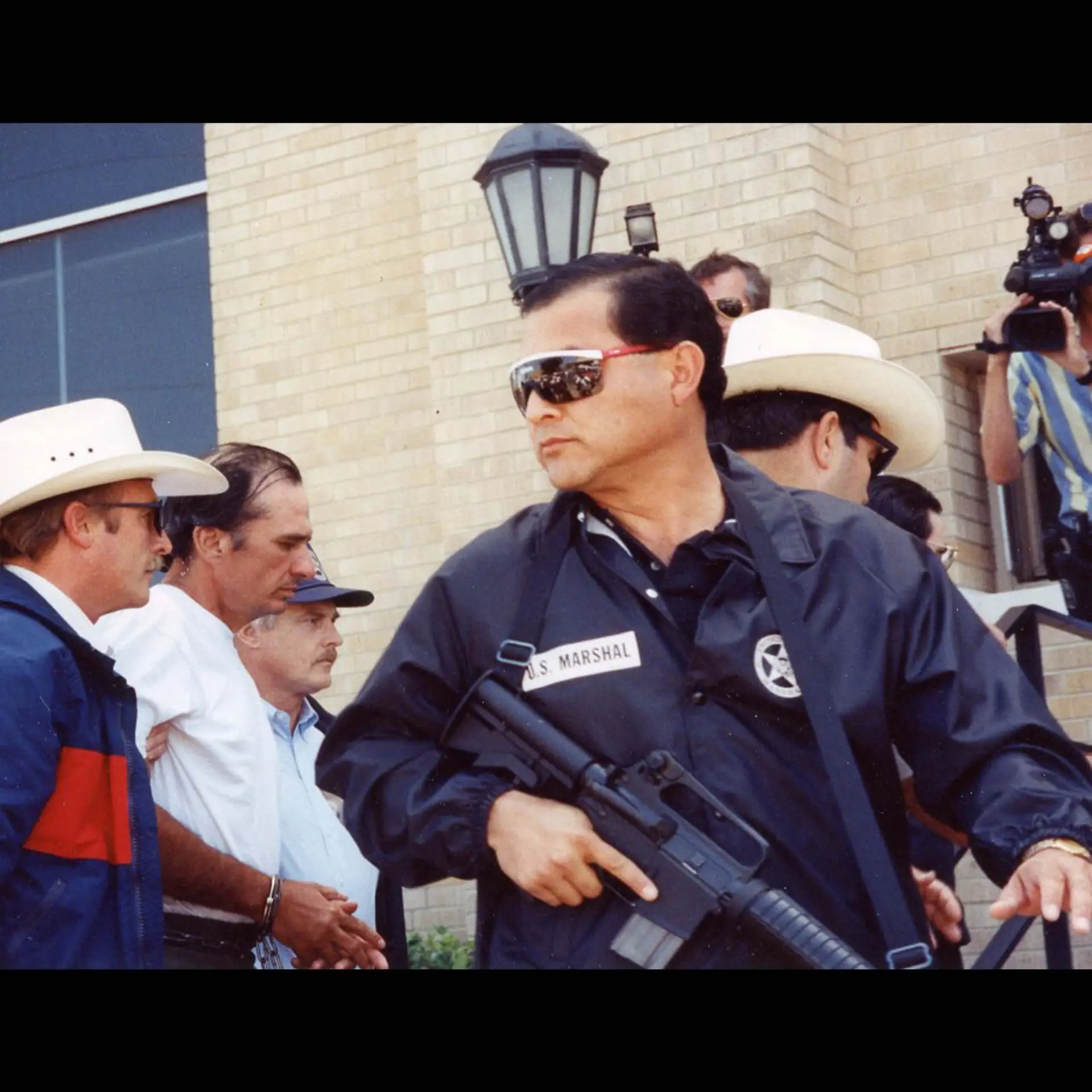
The U.S. Marshals Service jet taxied to a stop at the Waco Regional Airport. The cabin door opened and stairs folded out.
McDuff stepped out wearing a white T-shirt, green Army fatigues, with his wrists handcuffed at the front of his waist.
An angry crowd pressed against a chain-link fence by the tarmac, crying out for old-style hanging-tree justice.
Deputy U.S. Marshal Mike McNamara and inspector U.S. Marshal Dan Carnavale flanked McDuff and held him with a firm grip on each bicep.
McDuff, slightly balding and thinner, with his black hair slicked back, towered six inches above them with a menacing expression.
I shoved out my microphone and asked McDuff if he had killed anyone. He glanced into the TV camera lens and said no.
Parnell McNamara walked behind McDuff.
McNamara: I remember you being there.
Riggs: Yeah and he just shrugs it off like nothing.
McNamara: Oh no, you know.
Riggs: Just nothing.
McNamara: Yeah. It didn’t mean any more to him than going to the store, buying an ice cream.
The marshals put McDuff into the back seat of a sheriff’s cruiser.
Parnell McNamara climbed in to sit beside McDuff.
When McNamara saw the size of the angry crowd that greeted McDuff, he became worried.
McNamara: we had gotten word that morning that there had been threats that had going in to America’s Most Wanted that they were going to kill him before he got to the federal courthouse. So we were on edge, you know. I’ll take a bullet for a lot of people, family and good friends but never a scumbag like this.
McNamara: So, we were afraid that we were going to get shot on the way to the courthouse because of these threats, because so many people want to kill this guy.
McNamara: And so, we had to run almost all the red lights. And we had the sheriffs in front of us, maybe a police unit. But there were probably 10 or 15 police cars in that caravan going to the federal courthouse. So once we got there, that’s where the huge crowd was. And it had — it could have been 100, 150 people or more and they were screaming and cursing this guy. And it was unbelievable. And now, you know this guy that we have been chasing and trying to catch all this time now we had to protect this lowlife SOB from the crowd and get him into the courthouse and get him magistrated.
More than 200 people waited for McDuff’s arrival on the lawn of the federal courthouse in downtown Waco.
As the motorcade’s sirens drew closer and closer, the crowd turned into an angry mob.
Melissa Northrup’s sisters-in-law shook their clenched fists at McDuff.
They screamed at the top of their lungs.
Northrop relatives: “Vengeance is mine, sayeth the Lord. He is going to get you! He is going to get you!”
Bill Johnston also arrived at the federal courthouse in McDuff’s motorcade.
Johnston says the community’s anger about the parole of the deranged sexual killer boiled over.
Bill Johnston
Bill Johnston: Cursing and screaming and then over the top of that at one point, horrible. Gosh! It was terrible. I think a sister of one of his victims began screaming at him. And it was so personal. It was unbelievable. But it was a horrible — it was a shocking scene because we have been out of town and we didn’t know what would have happened. And then when we got back, there was a big crowd but it was really something. It was a little bit dangerous, not in a way for us, but I think someone would have — they would have probably stolen him and killed him had they been able to.
I felt the crowd lunge forward. They wanted to tear Kenneth McDuff limb from limb.
Dan Stoltz worried that shots were going to ring out. And his marshals were in the line of fire.
Dan Stoltz: Well, I hate to tell you this, it wasn’t going to happen on my watch. The Marshals Service gave me the authority to go out and arrest him and then they gave me the authority and the responsibility to once he was arrested and he was in our care custody and control, to protect him. So as much as I hated McDuff and I’m going to tell you I hate him and I don’t hate a lot of people in my life, as much as I despise and hate this guy, we had to protect him at the same time.
After the crowds left the federal courthouse in Waco and I finished my live television news broadcast, Parnell McNamara asked me to come inside to the U.S. Marshals Office.
A somber mood filled the room.
McNamara’s office looked like something you would find in Tombstone in the Old West.
He opened his drawer and pulled out Alva Hank Worley’s confession.
The confession you heard in the previous episode about McDuff’s kidnapping and torture of Colleen Reed.
McNamara looked me straight in the eye and sternly told me, “We’ve done our job. Now you do yours. Find out how this monster got out of prison on parole.”
Parnell McNamara
McNamara: I felt like that the Parole Board was totally responsible and the ones that were involved in selling his parole or taken money to turn him loose, ought to do a lot of time. I felt like they should be in prison. There was a lot of blood on their hands. It made me sick. We interviewed one of his close relatives who told us that they had a family meeting with one of these parole consultants and I commend you to this day for exposing this because we couldn’t expose it. We could catch him, run him down and do all it part but your constant digging into this nasty thing of parole consultants where former Parole Board employees get off the Parole Board and form a company called Parole Consultants.
Waco’s anger subsided. Later that evening, patrons at a local restaurant gave the marshals task force a standing ovation when they walked in for dinner.
McDuff sat alone locked in a cell.
Now it was time to find out as Marshal McNamara said, who had blood on their hands.
Senator Ted Lyon
Senator Ted Lyon: And we found out that the parole system — not only were they putting them in the front and letting them out the back. But the parole board, there were some corrupt people on that board and they were taking money for getting people out. It was just a bad system.
Next on True Crime Reporter, I uncover allegations that McDuff’s family paid a 25-thousand dollar bribe to get him out of prison.
John Moriarty
John Moriarty: And one thing I did learn from working corruption cases too, like you are talking about, the public outcry, it doesn’t matter whether you are Republican or Democrat. If you mess with the boys’ club, stand by because they will come after you. It doesn’t matter. And I experienced that personally.
Riggs: Pressured to back off.
John Moriarty: That’s correct. But you just got to do what’s right.