You’ve read the story of Jesse James
Of how he lived and died:
If you’re still in need
Of something to read
Here’s the story of Bonnie and Clyde
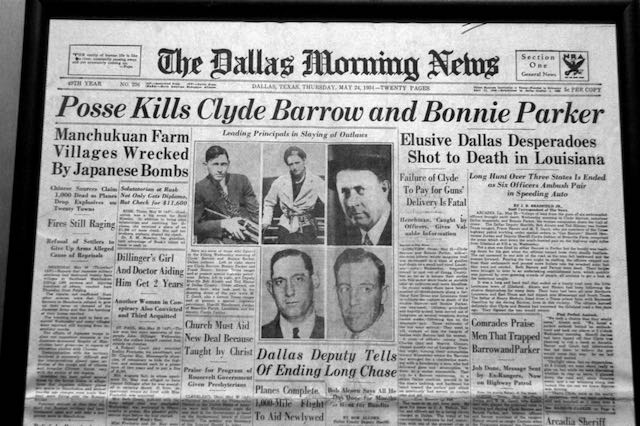
That’s the first stanza of verses that ran in Dallas’s Daily Times Herald on the day that Bonnie and Clyde were killed on May 23, 1934, near Gibsland, Louisiana.
The newspaper said it received the verses from Bonnie Parker several months before with the stipulation that it would run only after their deaths.
Hello, I’m investigative reporter Robert Riggs here to separate fact from fiction about the notorious outlaw lovers from Depression Era Dallas, Bonnie and Clyde.
Bonnie Parker penned that a showdown was coming.
A newsboy once said to his buddy:
“I wish old Clyde would get jumped;
In these awful hard times
We’d make a few dimes
If five or six cops would get bumped.
Clyde Barrow’s remains rested inside the Sparkman-Holz Brand funeral home in downtown Dallas.
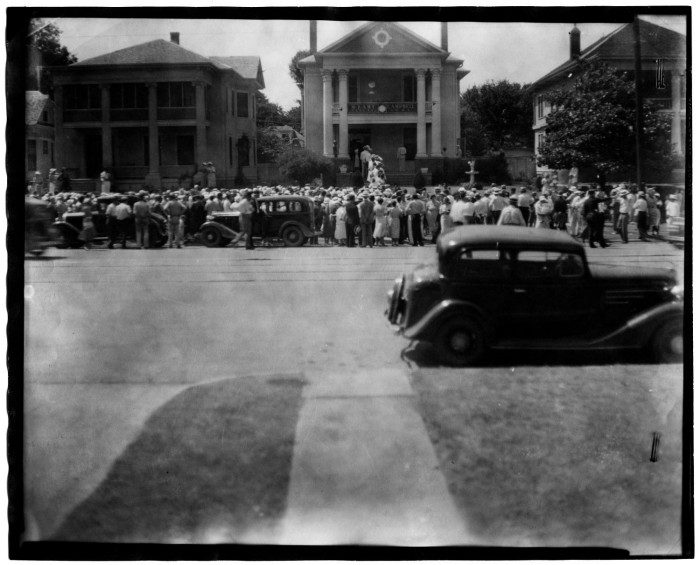
More than ten thousand people shouted and demanded to see Clyde Barrow’s open casket.
The ornate building's two-story brick neoclassical architectural design featured a monumental pedimented portico of six Corinthian columns.
It had been built for A.H. Belo after the Civil War. Belo was a Colonel in the Confederate Army and founded the Dallas Morning News.
Until 2021 it was known as the Belo Mansion and housed the Dallas Bar Association.
The bar renamed it the Arts District Mansion due to the “namesake’s ties to the Confederacy.
At the site of Clyde Barrow’s funeral in May 1934, a rambunctious crowd pulled up flowers and shrubs by the roots and tossed them into the air.
When police couldn’t control the crowd, his family relented and let them inside.
Hundreds of onlookers pushed their way through to see Clyde’s body dressed in a light gray suit.
Some exclaimed that they were glad that the 25-year-old gangster was dead.
So the family shut the funeral home’s doors. The crowd left scuffed, dirty floors littered with cigarette butts. Carpets had been pulled up and left in a pile.
Across town at the McKamy-Campbell funeral home, a similar scene unfolded. Twenty thousand people pressed to get a peek at Bonnie Parker’s body dressed in a silky blue dress.
The throngs crushed the lawn and plowed through a fence.
When the doors opened, five thousand people an hour rambled through, leaving fine carpets destroyed in their wake.
Fifty thousand people viewed the outlaw lovers–that was one-fourth of the population of Dallas in 1934.
You can see the photographs on the True Crime Reporter dot Com website.
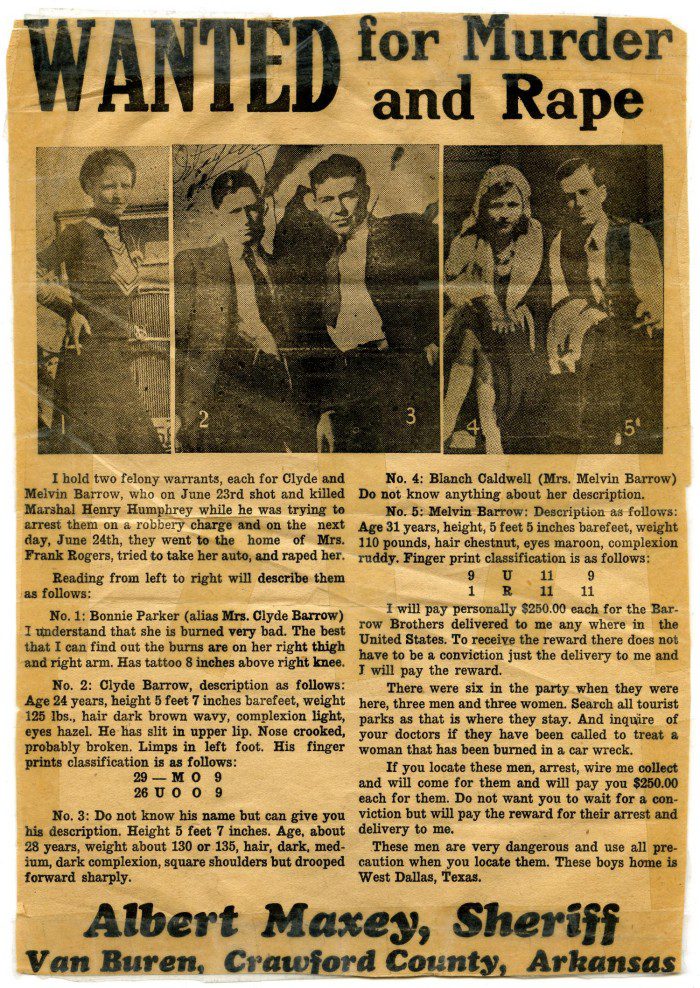
Bonnie and Clyde’s two-year crime spree of robberies and murders across Texas and other states during the Great Depression captivated national attention, embarrassed law enforcement, and terrified communities where they struck.
The outlaw couple competed for headlines with John Dillinger, Baby Face Nelson, and Pretty Boy Floyd.
It was tough times in America. Four out of ten people were out of work.
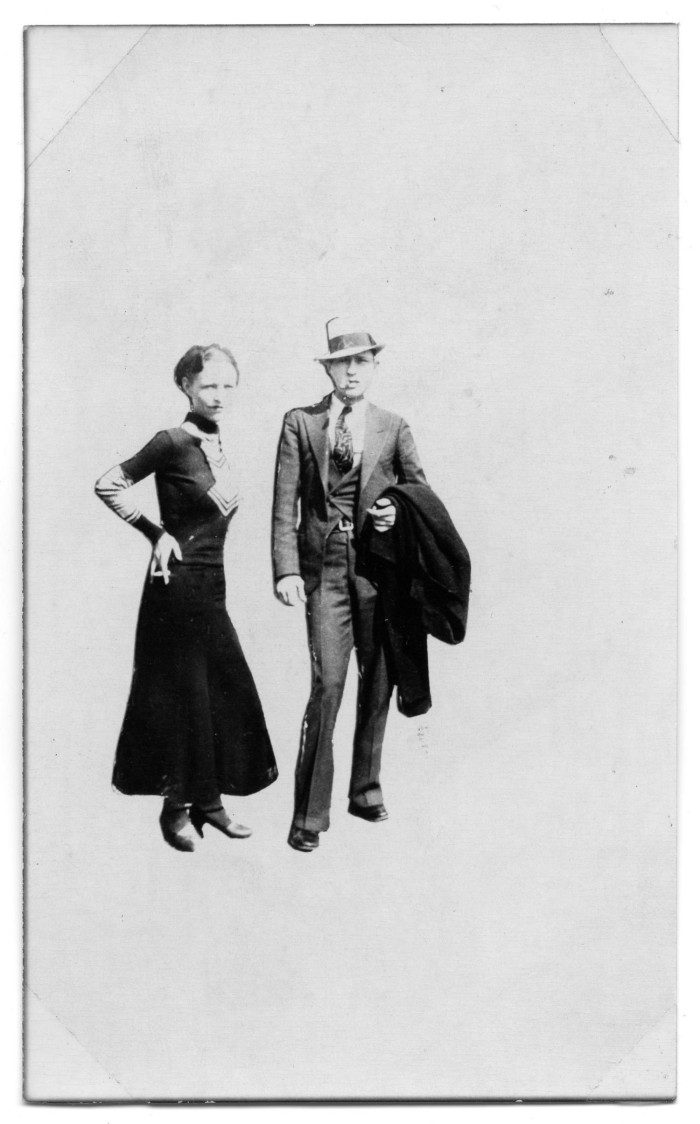
Bonnie and Clyde cut a glamorous image. It was seared into public consciousness when a roll of film left in the gang’s camera was discovered.
Lawmen surprised them during a deadly shootout in Joplin, Missouri, on April Fool's day of 1933.
The gang barely got away.
Police found a purse with a camera inside that the gang used to photograph themselves.
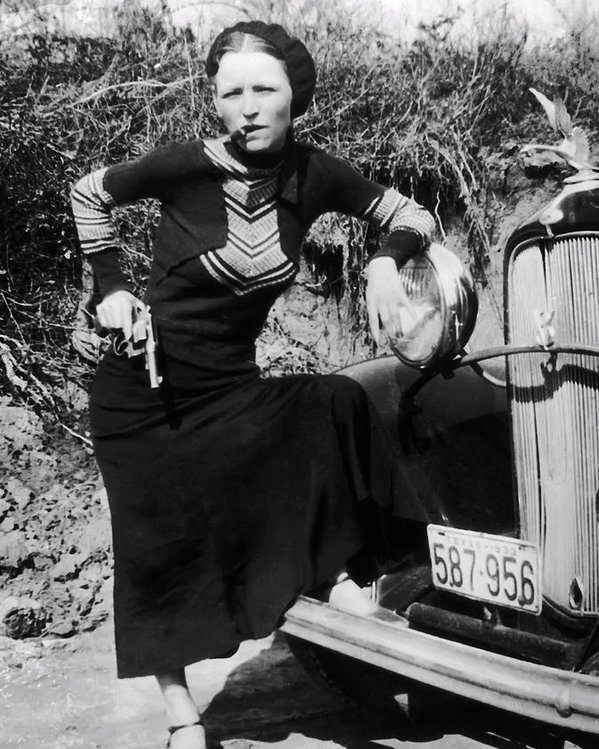
Twenty-two-year-old Bonnie Parker posed with a revolver in her right hand, her left foot on the bumper of a Model A Ford, her left forearm draped over the car’s headlight, chomping a cigar sticking out the right side of her mouth.
Bonnie, who weighed less than ninety-nine pounds, dressed in the fashionable straight flapper silhouette of the time–a slim dress with broad shoulders and a small waist. She topped it off with a beret, with a short modern hairstyle with finger curls tucked beneath it.
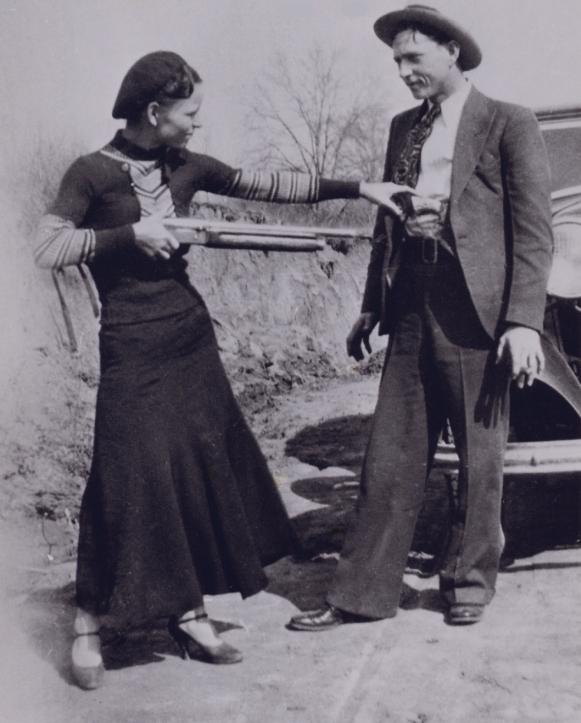
Another black and white photograph depicted Bonnie wearing the same outfit holding a shotgun pressed toward Clyde Barrow’s as she lifted a handgun from his belt.
Clyde showing a slight grin, wore a suit and tie with a fedora tilted back on his head.
Officers on their trail found receipts left behind. One for a green Angora wool dress with a small scarf and matching green belt that cost $6.95, equivalent to $152.62 in 2023.
The clothes left the impression among the Depression-ravaged population that crime did indeed pay.
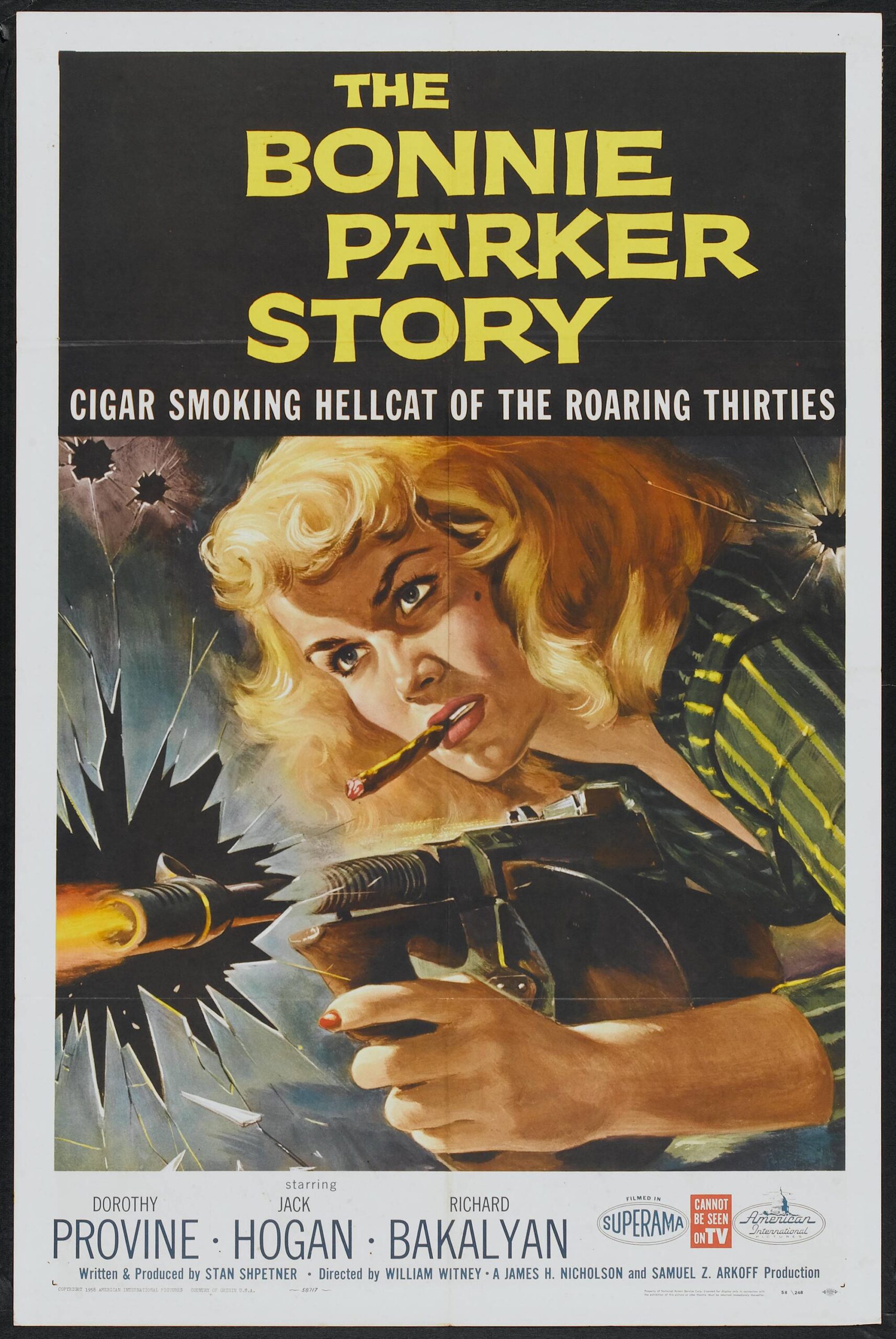
But it was not the romanticized story celebrated in the 1967 blockbuster movie Bonnie and Clyde.
Living on the run was costly. They often slept in their stolen cars. Injured and hungry. Food came from cans or takeout sandwiches purchased at roadside cafes.
Their families would later say their world had become a ‘living hell.”
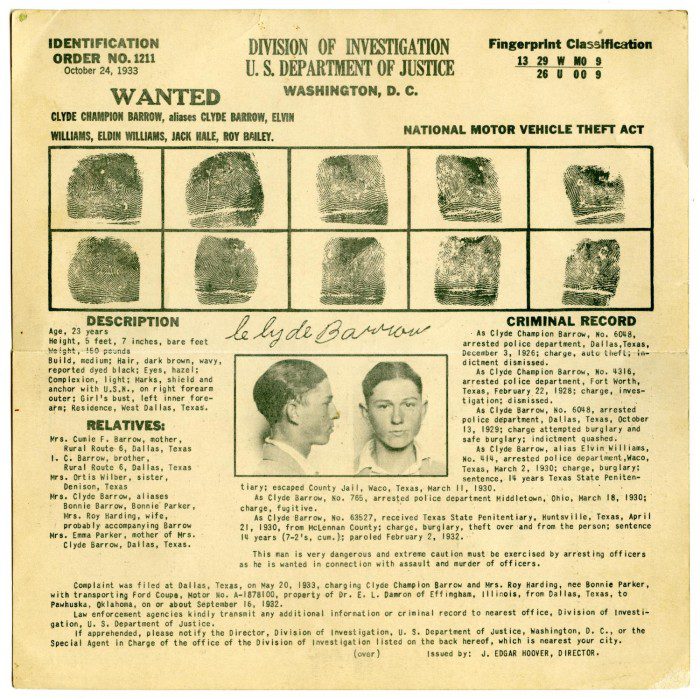
Their crimes attracted national attention and cast a spotlight on the Bureau of Investigation led by J. Edgar Hoover. It raised Hoover’s profile to expand from identifying fingerprints and tracking stolen cars that crossed state lines. Hoover turned the bureau into the FBI to take on a greater role in investigating crimes.
Bonne Parker, a petite blue-eyed blonde with smiling red lips, showed a knack for writing and a flair for drama in school. She told her sister that her name would end up in lights on Broadway.
But there were few opportunities for girls from poverty-stricken West Dallas near the sewage-filled Trinity River bottoms. It was a place where people didn’t lock their doors because there was nothing to steal.
Bonnie Parker married a week before her sixteenth birthday in 1926. She tattooed their names inside hearts on her upper right thigh.
After less than a year of a troubled marriage, her husband was sent to the state penitentiary, never to be seen by her again.
Three years later, she met Clyde Barrow.
Clyde’s family ran a ramshackle gasoline filling station in poverty-stricken West Dallas.
A wood drive-through carport with two hand pumps featured a large advertising sign on its roof for Drink Coca-Cola.
Clyde had a reputation as a car thief, so much so that Dallas police counted him among their “usual” suspects.
Whenever a car was stolen or a house burglarized, Clyde made the trip to downtown police headquarters.
His mother said that he got picked up by the police so many times at work that he couldn’t hold a job and hated the law.
Clyde met Bonnie in 1930 at her brother and sister-in-law’s house in West Dallas.
The two were immediately attracted to each other. Bonnie’s sister found him charming, laughing and joking, with his dark wavy hair and dancing brown eyes and a dimpled that popped out whenever he smiled.
Shortly after they met, the police came to arrest him, Bonnie went crazy, held on to Clyde, and begged the officers to leave him alone.
A couple of months before he met Bonnie, Clyde, his brother Buck and a friend had stolen a car, burglarized a home, and stolen a safe. Their crimes had caught up with them.
While awaiting trial behind bars, Bonnie wrote long dramatic love letters to Clyde. In one she wrote, “I was so blue and mad and discouraged, I just had to cry. I had Maybelline on my eyes, and it began to stream down my face. I put my head down on the steering wheel and sure did boohoo.”
Clyde pleaded guilty in Waco, Texas, to stealing cars and burglarizing a business. Newspapers dubbed him the “schoolboy” for his baby face appearance and slicked-back hair parted down the middle.
But Clyde was not one to be confined behind bars.
During a jail visit, Bonnie slipped a gun hidden in her bra by guards. Clyde and two cellmates used it to break out of jail.
A week later, they were caught a thousand miles away in an Ohio crime spree driving a stolen car.
They had forgotten to change the license plates. A Waco newspaper reported their arrest on a front page headlined, “Baby Thugs Captured.”
The judge sentenced Clyde to fourteen years in the Texas penitentiary. He was sent to the Eastham Prison Farm, where guards meted out severe beatings for disobedience.
Guards used a “bat,” a two-and-a-half-inch wide, two-foot-long leather strap that was oiled and used to whip the bare backs and buttocks of inmates who misbehaved. The state allowed up to twenty lashings.
The prison’s warden defended its use to legislators, saying, “It’s just like using spurs on an old horse. When you’ve got your spurs on, the old horse will do the job.”
On the bus ride to prison, Clyde met Ralph Fults, an Eastham escapee being returned to prison. Fults warned him that guards would kill for two things: escaping and not working fast enough.
Later, Clyde made his presence known when three guards started beating Fults with the butt of a pistol. With Clyde as a witness, the beating stopped.
Clyde Barrow swore that he would get revenge once he got out.
He got his share of beatings for not keeping up in the prison farm’s fields. Inmates called building tenders and trustys would dish out the abuse on behalf of the administration in exchange for favorable treatment.
A vicious building tender singled out Barrow for beatings and sexual assaults, according to Fults. Clyde and another inmate were suspected of taking revenge by stabbing the abusive inmate building tender to death.
Hard time inside Eastham got to Clyde.
He persuaded a fellow inmate to cut off two toes on his left foot with a sharp tool so he could get transferred to the Huntsville Prison Hospital.
After a few weeks, he received parole and hobbled out of prison on crutches.
Ralph Fults, the escapee that Clyde met on the prison bus and later saved from a beating, said prison changed the youngster who had entered two years earlier from “a schoolboy to a rattlesnake.”
Without his two biggest left toes, Clyde would always walk with a limp.
Back in West Dallas, he reunited with Bonnie Parker.
Clyde, Ralph Fults, and another West Dallas excon went back to doing what they knew best and had learned behind bars from career criminals – robbing banks.
And now as we go to break, another stanza from Bonnie Parker:
Now Bonnie and Clyde are the Barrow gang.
I’m sure you all have read
How they rob and steal
And how those that squeal
Are usually found dying or dead.
—------------------
—-----------------
Clyde Barrow favored the Browing automatic rifle or BAR, a weapon from World War I that would spew out twenty bullets in seconds with one pull of its trigger. The gang outgunned law enforcement by arming itself with weapons they stole from National Guard armories.
Depression-era police were understaffed, underpaid, and poorly trained. By the early 1930s, the Dallas police force had dropped to 265 officers. They didn’t have the resources to stake out or tail a suspect. Modern technology and communications equipment did not exist.
Clyde preferred stealing new fast Ford V-8s. In the midst of one of his bloodiest months of killings, Henry Ford received a letter praising the V-8 signed, “Clyde Champion Barrow.”
Although the handwriting was never authenticated, the Henry Ford Museum holds the letter in its collection.
After Clyde released a kidnapped mail carrier, he was celebrated for his softheartedness among people looking for folk heroes in the depths of the Depression.
With Bonnie in tow, Clyde took her to the Eastham prison to relay a message to an inmate that they were planning to break him out.
But, Bonnie and Fults were arrested for car thefts in Kaufman, located East of Dallas.
While they were behind bars, Clyde and an accomplice started a robbery spree and murdered a 61-year-old business owner in Hillsboro, Texas. The Texas governor posted a $250 reward.
After Bonnie’s release from jail in June 1932. The violence escalated.
Over the next eleven months, Bonnie and Clyde’s gang are believed to be responsible for the murder of at least nine law enforcement officers.
A 1933 memo by the US Bureau of Investigation, the predecessor to the FBI, noted that, “Bonnie Parker is a gun-woman, and it was she probably who shot and killed the Fort Worth Deputy Sheriff” in January.
Mid-1933 proved to be a fatal turning point for the gang. Bonnie was severely injured when Clyde crash at breakneck speed in the dark. Battery acid splattered on her leg, badly burning it around and below the knee. Her painful wounds never properly healed.
30-year-old Buck, Clyde's brother, was shot in the head when a posse in Iowa converged on them. Buck died in a coma. His wife Blanche was wounded in her left eye by flying glass.
In the wake of the callous killings, Dallas police and sheriff’s deputies circled the Barrow family filling station four times a day.
Life-size cut outs of Bonnie and Clyde stood in the hall of Dallas police headquarters so officers would know what they looked like.
The run of increasingly violent crimes was approaching an end.
In January 1934, Bonnie and Clyde, with two accomplices, returned to the Eastham Prison Farm to break out a member of the gang.
They hid two pistols and ammunition inside a rubber inner tube on the prison property. Two inmates recovered the pistols while chopping and stacking wood beneath a heavy fog.
They shot two guards mounted on horses with rifles called “high riders.” It was the job of high riders to hang back to prevent an escape.
Clyde sped away with the escapees. The prison break made national news. The New York Times called it “perfectly executed” aided by the “two-gun, cigar-smoking woman” Bonnie Parker, now twenty-three years old, who pounded on the car horn.
33-year-old prison guard Major Joseph Crowson died of a gunshot wound to his stomach.
The murder outraged Texas prison director Lee Simmons. He wanted vengeance for the Eastham breakout and Crowson’s death.
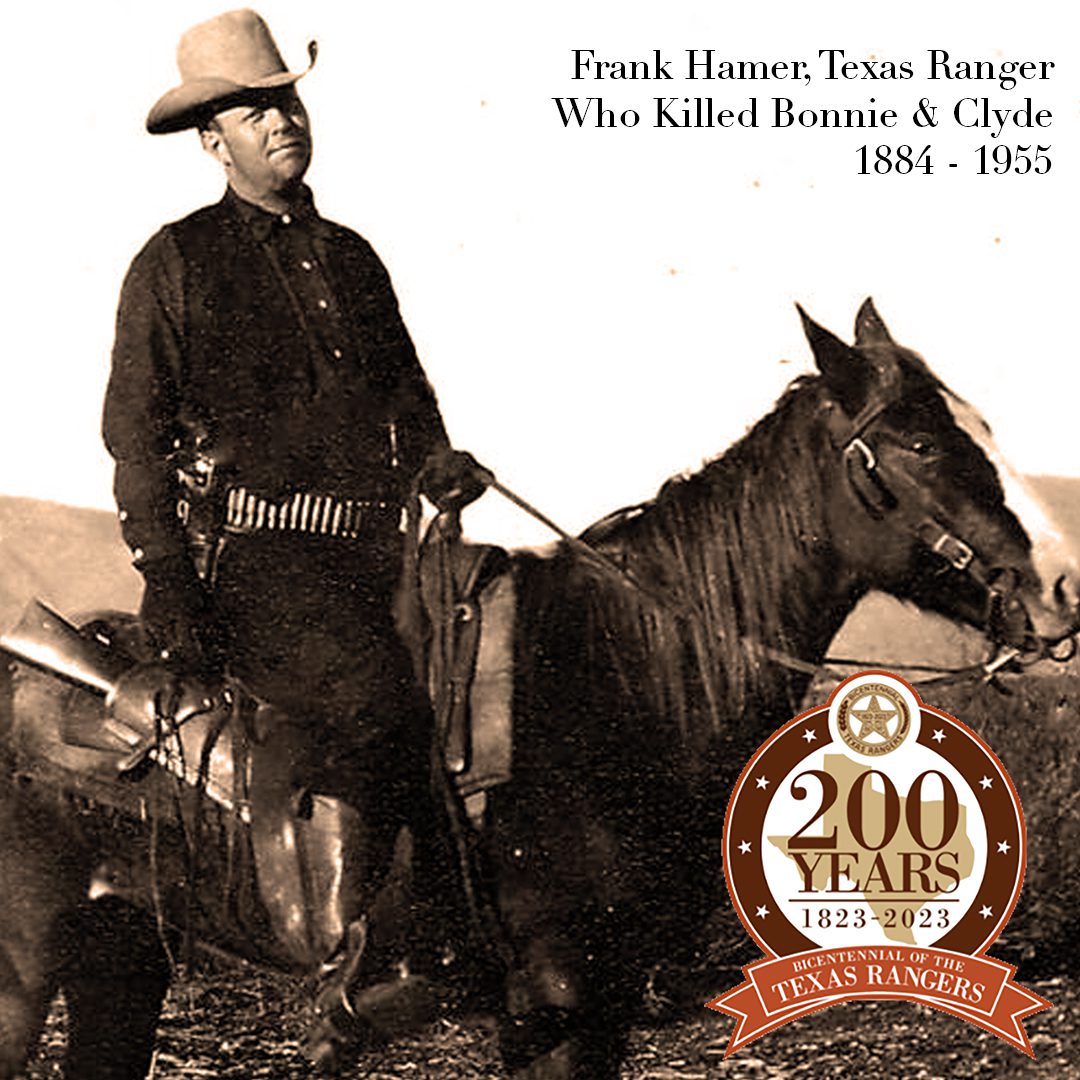
On February 1, 1934, he hired the legendary former Texas Ranger Frank Hamer to track down Bonnie and Clyde.
Just shy of his fiftieth birthday, Hamer had been in more than fifty gunfights and had been called on to control riots and fight the Ku Klux Klan.
Hamer covered more than 1300 miles over the course of a month studying Bonnie and Clyde’s movements.
On April 1st of 1934, the cold-blooded murder of two motorcycle officers in Grapevine, Texas, today a sprawling community located on the north side of DFW International Airport, drew an extreme rebuke from the press. “Where was the Governor, where were the Rangers?” asked the Dallas Dispatch, which called the Barrow gang “more merciless than rattlesnakes.”
A witness believed that Bonnie Parker turned over one of the wounded officers and shot him point blank in the chest. Police reported that a cigar stub was found indented with small teeth marks.
Henry Methvin, an Eastham Prison escapee from Louisiana, participated in the brutal, unprovoked shooting.
In a shootout a week later with police in northeastern Oklahoma, a constable was killed, and a wounded officer taken hostage was later released. He believed Bonnie fired a shotgun during the deadly shootout. Bonnie told him that she was offended by news accounts that she smoked cigars.
Meanwhile, Henry Methvin’s parents cooperated with Ranger Hamer to tip off the fugitive hunters when Bonnie and Clyde were headed to meet Henry there in Louisana.
Six officers armed with shotguns, automatic rifles, and pistols set up an ambush.
Henry’s father pretended that his truck had broken down with a flat tire. Clyde slowed down when he saw him.
One of the officers thought Clyde was about to drive off and fired two shots. One hit Clyde in front of his left ear, likely killing him instantly.
Bonnie screamed. “Like a panther,” Hamer said later.
A volley of gunfire erupted from the lawmen for several minutes.
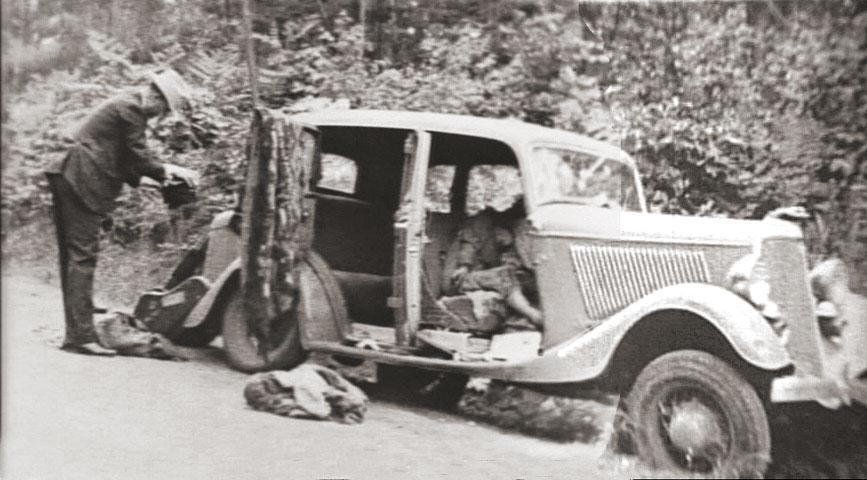
After the smoke cleared, bits of blood and tissue splattered the interior of the car.
Part of Clyde’s skull had been blown off. Part of Bonnie’s right hand was missing.
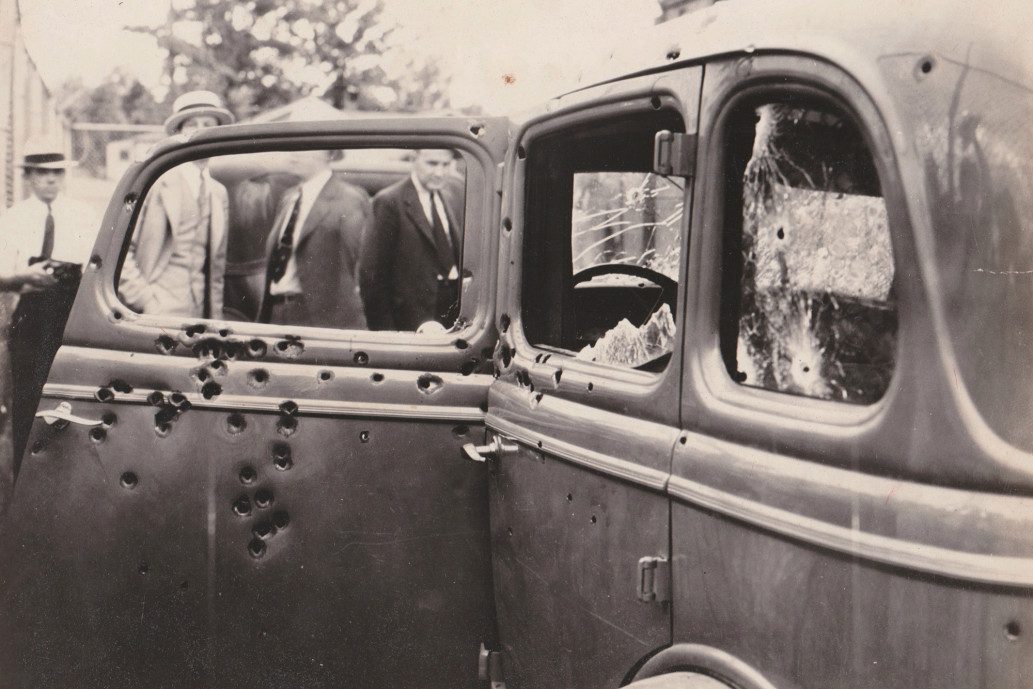
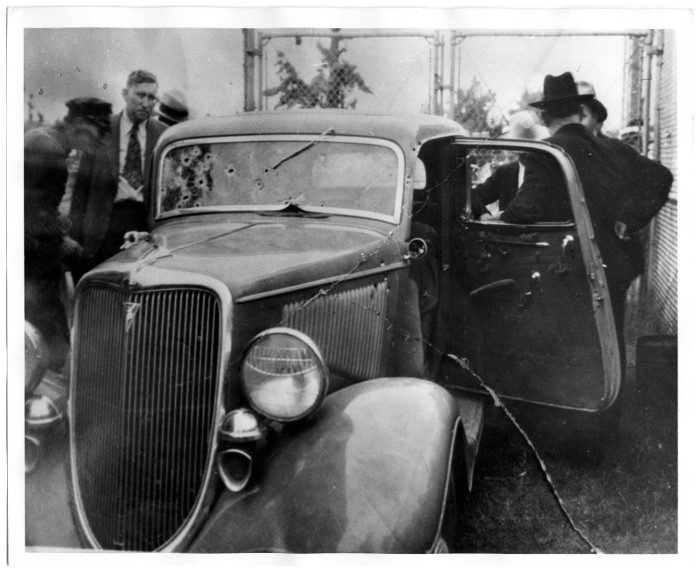
The car was riddled with bullet holes.
Officers found automatic rifles, shotguns, pistols, and a thousand rounds of ammunition inside it. Suitcases of clothing, a makeup case, magazines, 15 license plates, and Clyde’s saxophone surrounded the lifeless bodies.
My late mother recalled seeing the bullet-scarred 1934 Ford Model 40 B Fordor Deluxe Sedan known as the Bonnie and Clyde “death car” on display at the State Fair of Texas when she was a little girl. She said It was surrounded by crowds studying more than 100 bullet holes in its body.
The car is now on display at Whiskey Pete’s Hotel and Casino in Primm, Nevada, where it was reportedly purchased for $250,000.
The number of civilians killed by Bonnie and Clyde’s gang is a matter of some debate and varies depending on different sources.
It is believed that they were responsible for the deaths of at least 13 civilians during their crime spree, including store clerks, gas station attendants, and innocent bystanders.
Some sources suggest that the number could be higher, but there is no definitive answer.
Regardless of the exact number, it is clear that Bonnie and Clyde's criminal activities were violent and dangerous, and they posed a significant threat to public safety during their time as outlaws.
At the end of January 1935, twenty-three people with ties to Bonnie and Clyde and gang members were charged with harboring or assisting criminals, including their mothers.
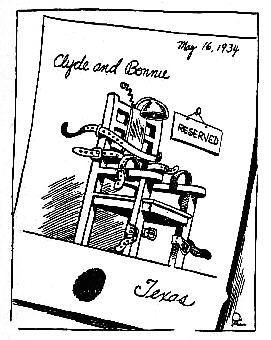
The two killers who shot prison guard Crowson during their escape from the Eastham Prison Farm were executed in the Texas electric chair known as Old Sparky shortly after midnight on May 10, 1935.
Bonnie Parker penned this closing stanza of the verses that she sent to a newspaper before their deaths.
Some day they’ll go down together;
They’ll bury them side by side:
To few it’ll be grief–
To the law a relief–
But it’s death for Bonnie and Clyde.
Bonnie’s burial wish did not come true.
Her mother, Emma Parker, wanted no such thing.
She said, “Clyde had her for two years. Look what he did to her. Now she’s mine. Nobody else has a right to her.”
A final footnote. I found the most accurate source for the outlaw couple’s history, which has been embellished and glorified by Hollywood, to be “Bonnie and Clyde: The Making Of A Legend” by Dallas author Karen Blumenthal.
Mrs. Blumenthal passed away in 2020. Since then, she has received numerous journalism and literary awards.
She wrote, “Romanticized or vilified, criticized or admired, Bonnie and Clyde remain legendary – no longer for who they were, but for who we want them to be.”