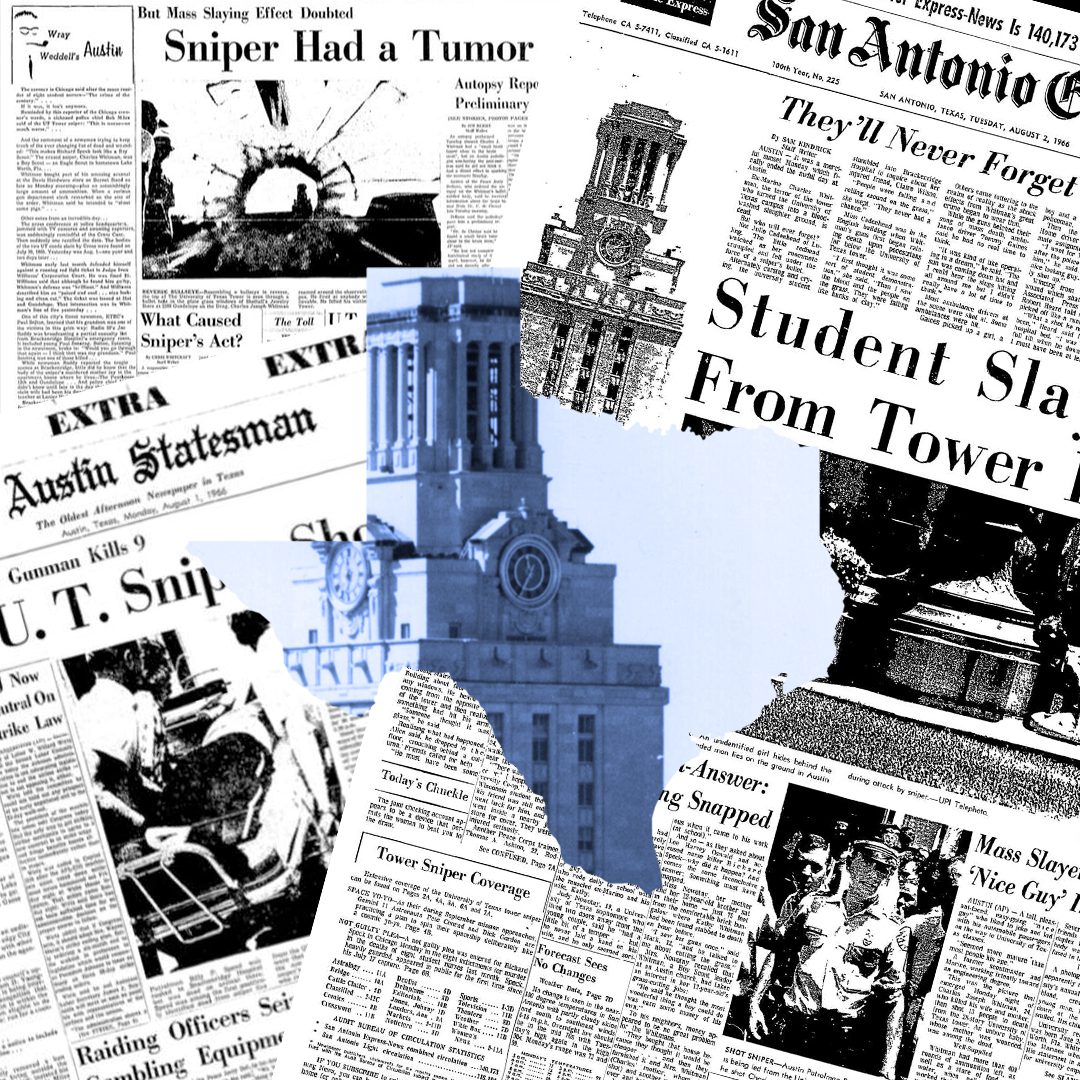
Before Columbine. Before Sandy Hook. Before Virginia Tech. There was the Sniper in the Tower at the University of Texas.
America’s first mass murder and school shooting unfolded on live television in Austin, Texas more than a half-century ago.
This is a True Crime Reporter™ Confidential with me, Robert Riggs, and my cohost former U.S. prosecutor Bill Johnston.
For more than a half-century the question has lingered, “Why did he do it?”
Gary Lavergne, the author of A Sniper in the Tower: The Charles Whitman Murders, is going to address the Whys and the Myths About The Why.
First some background.
In 96 minutes Whitman cut down nearly 50 people with 150 rifle shots from the top of the iconic University of Texas clock tower on August 1, 1966.
the 25-year old architectural engineering major arrived at the tower shortly before noon dressed as a maintenance man.
He politely thanked a receptionist for turning on the elevator stating, “You don’t know how happy that makes me.”
He wheeled a footlocker loaded with firearms and supplies onto the elevator to the 27th floor and then dragged it upstairs to the 30th-floor observation deck.
From his perch there, three hundred feet above the campus, Charles Whitman methodically picked off victims as far as five blocks away.
Hundreds of students, professors, tourists, and store clerks witnessed the killing spree. They crouched behind trees, hid under desks, and took cover in stairwells.
Some of the wounded played dead lying in the open. 17 people died.
In the predawn hours, Whitman had stabbed his mother to death in her apartment and stabbed his wife Kathy to death in bed as she slept.
It stunned the nation. It was beyond comprehension.
“Whitman was blond, good-looking, solidly built. I remember he seemed like a nice, clean-cut, all-American kind of guy,” said Austin newspaper columnist Dave McNeely.
McNeely had met Whitman at his birthday party a few months earlier. The lead guitar player in McNeely’s bad was close friends with Whitman.
Surely, people said Whitman must have been crazy.
If the police had taken Whitman alive, could he have used the insanity defense? Bill will walk us through Texas law later in the podcast.
We have placed links in the show notes to black and white film footage from the shooting and a video of Gary Lavergne following the sniper’s trail to the top of the UT Tower.
Lavergne’s book revealed that Whitman had been thinking about doing this for five years.
In early September of 1961, Whitman was standing on the seventh-floor balcony of the Goodall Wooten dorm, looking at the Tower, when he turned to a friend and said, “You know, that would be a great place to go up with a rifle and shoot people. You could hold off an army for as long as you wanted.” It never occurred to his friend that he might be serious.
Gary Lavergne:
Austin back then bears little resemblance to the Austin that we are familiar with today. For one thing, back then the skyscraper in the city itself was the UT Tower, and today, from a distance, you can barely even notice it or even see it. It was a city that maybe had one quarter of the population that it has today, and in terms of acreage or square miles, it was it was just a fraction of the size that it is today. It wasn't a sprawling place. It was more like an Athens, Georgia, a smaller college town, but still the home of a very large university. And the tower described it. It was 300 feet tall. It was the center of the campus. had a clock tower at the top, and when the University of Texas teams would win in athletics or other endeavors, they they would put. Orange light on it at nine. One of the presidents that I worked for when I worked at the University of Texas used to tell me that he was always amazed at the the power that tower had as a symbol to communicate things, even something as simple as winning a football game. You would think. Well, the University of Texas football wins another game. Well, there's nothing unusual about that, but there was something special about those those victories when you looked up at that iconic tower and it was bathed in this orange light. And I don't, I can't readily think of another symbol of a registered trademark of a university quite like it, where you can literally change colors and project things onto it and off of it. It's it's a very very powerful symbol. And having worked in that building and knowing how old and outdated it in fact is. I just can't help but wonder whether or not that building would have been demolished a long time ago were it not for the fact that it is the UT Tower.
Bill Johnston:
You know, you talked about Austin, how different it is today geographically and obviously with population and so forth. During our discussion about the serial killer Kenneth McDuff in podcasts and now in a show coming up, we've talked about Austin, how relatively innocent it was in the early '90s, almost no violent crime. Going back before that to the mid '60s, I don't know that anybody in Austin. I had an uncle that lived there, locked their door. It was Austin had a town feel, not a city feel, and it seems like part of the shock, part of the shock of this event was That breaking the thick ice of innocence, really, that existed over Austin, and it seemed like after that happened, it almost settled down again. Then we get to McDuff and the yogurt shop.
Robert Riggs:
So, as a as a teenager in Texas in the '60s, I mean, there were two things you real that were etched in your memory. One, where you were when you heard that President John F. Kennedy had been assassinated, and secondly, where you were when you heard what was happening at that tower. And I remember turning on the radio out of one of my good friends; his brother was a student there. People were huddled around transistors radios all over the state, listening to this unfold. So tell what what did Whitman do, and just kind of describe it because I remember stories of you know somebody stepped out of a barber shop to see what was going on and was shot dead.
Gary Lavergne:
Well, just just to give you an idea of for its time and place, I was I was a nine years old growing up in Cajun, Louisiana, and I remember when it happened, and I remember it largely because my father was the chief of police of the little town where I was growing up in, and I remember very vividly his reaction to that, and but to to get to your question directly, the the thing about the the UT Tower story, especially in the context of a place like Austin, is that Austin had seen violence before. It had seen it had even seen mass murder before in the 1880s. There was something called the servant girl annihilator, who some books claim is America's first serial killer, which is probably a stretch. But the point is that this person was called the first Jack the Ripper or the Jack the Ripper of America, whatever. That was in Austin, and that was back in the days of O. Henry when when he lived there. And then you you go a long long stretch of time until there were a few other high-profile murders, but they were high-profile in Austin because Austin wasn't used to these kinds of things. They weren't they weren't used to a whole lot of violence to begin with. You have a very large university, and you have the the seat of state government, which even today are the two larger employees, employers of that area, and what you have is an influx of basically very highly or you know moderately educated people. You have a lot of people coming in and out of town, but. Most of the people were like me. I lived in one of the suburbs, and I took a bus into town. I got on the bus every day, and everybody else looked just like me. You know, most of the time a coat and a tie, and so forth. And here I am riding a bus. That's kind of what Austin was really like. It was a place where you you felt safe, and then those notions are just shaken every, say, 50 to 30 to 50 years. The the major example being the UT Tower shooting in 1966, and then it wasn't until 1991 where you have this combination of the yogurt shop murders and the arrival of Kenneth Macduff. So, between the tower and something like Macduff, you still have nearly a 30-year period, and that's kind of like what Austin is like. You have these long periods; these these very long periods of relative calm in terms of criminal statistics and criminal activities and things like that.
Bill Johnston:
When we talk about this case, someone that may be listening to this that is 18 years old or 38 years old may have no clue what we're talking about. The way people have a short memory, the lack of interest in history that we had a long time ago. But the significance, and we talked just before we went on the air. The significance of this is you described it as help me out the first public mass shooting,
Gary Lavergne:
sure,
Bill Johnston:
and the first school shooting,
Gary Lavergne:
yeah,
Bill Johnston:
in America. That's there was no precedent, there was no pattern for this at the time, was there?
Gary Lavergne:
Well, and and it also happened at a time when television became capable of covering something live. So in many ways this was the first school shooting in which a person targeted strangers and and got up there intending to kill as many people as possible, and much of it was covered live on television, which we had not seen before. The Kennedy assassination was only three years earlier than that, but the assassin assassination itself wasn't covered live on television in the same way that this was. I mean, you you could still see on live television bodies lying on the sidewalks and students running through open fields to rescue wounded people. That was, and I can't think of another example of of something like that before. Another thing that was pointed out to me by a professor at Purdue is that this is also one of the first incidences in which the the general public showed up with their own weapons and actually fired back
Robert Riggs:
yes
Gary Lavergne:
at the at the sniper the perpetrator himself and this professor from Purdue told me said the last time that happened was in in Minnesota when the people of a small town responded to a robbery in progress you know the Jesse James. I think it was the Jesse James gang. You know, and that hadn't happened since 1818 76 or something like that. Yeah.
Robert Riggs:
And in that live television coverage, you could see puffs of smoke, the civilians, the debris flying as the bullets ricochet off the the limestone
Gary Lavergne:
of the tower itself. Yes. Yeah. And those scars are still there. If you take that tower tour today, you can go up there and it's repaired, but it's not repaired so perfectly that you can't see where those bullet holes are. They're they're still there.
Bill Johnston:
For those that don't know enough about it, haven't read your book yet, which they should to really understand the whole story. What was he armed with, more or less, to the extent you recall sitting here, and what did he do, and how long did it last? Just the the there's so much that happened before, but the in the period of time just before and during.
Gary Lavergne:
Well, he spent about 48 hours getting ready and planned very very meticulously. He planned everything down to having rolls of toilet paper available to him in case he needed to do what he had to do while he was up there. His planning, in in my view, it's pretty clear that his planning and what he brought up there. Conclusively means that he intended to be up there a long time, probably a day or at least a couple of days. His arsenal also reflected his planning insofar as he had a number of pistols, which he probably did not use, or more than maybe one or two shots, but he had four rifles, and one of them was a sawed-off 12-gauge shotgun, double barrel, and he sawed off the barrel and the stock, and I'm convinced that he knew that up there in the tower, there were some very narrow hallways, and he intended to, or he planned for, a shootout of some sort, and that would allow him to spin around in all directions in these very narrow hallways. He had also the the deadliest of his arsenal was the six millimeter Remington, a deer rifle, with a four power Leopold scope, and once he had control of the deck itself, he used that for long range shooting. He was a former Marine, but he was a marksman before he became a Marine through training with his father, and he was an avid hunter, and he knew more about guns before he became a marine than many marines know after their hitch. So this is a guy who knew what he was doing, and he planned for it. He brought what he needed up there. He had pieces of rope, which, in my view, probably he figured he might have to tie somebody up. He had two and a half gallons of gasoline. Well, you might need to set the stairs on fire. See, a lot of people have come after me, and they say, "Why did he have all of this stuff up there. Can't you see he was crazy? Well, no, I can take every one of those things he had in that Footlocker up there, and I can tell you why he had it up there. Well, what is he doing with some sandwiches? Well, he plans on being up there long enough to eat. What's crazy about that?
Bill Johnston:
It's just preparation and a and a forethought. Oh,
Gary Lavergne:
absolutely, is what it shows. He he prepared for that. I mean, I I drove from Austin all the way over here today, and he prepared for that better than I prepared for my trip to Dallas. Here, I can tell you that.
Robert Riggs:
So the image we always have of him in anything out online or books is the high school yearbook photo of he's blonde, blue-eyed, and handsome, athletic-looking, and he's always described as the all-American boy just off that photo.
Gary Lavergne:
Yeah,
Robert Riggs:
what really? What was he really, and how does that sort of deceive the public about his sanity,
Gary Lavergne:
the the the all American boy thing came about because after the day after the shooting itself, a university psychiatrist who had seen Whitman described him as you know he had all the characteristics of the all American boy, meaning he was blonde, blue-eyed, crew-cut, former Marine, big, strong, handsome. He was a very, very handsome young fellow, and and people latched onto that. It became a headline. But the the doctor was describing his physical characteristics, but he certainly wasn't describing his behavior because he had a long history of having problems controlling his his temper. It's one of the things that I had to really check carefully before writing my book, and and while I was writing it, is that he could be described as the perfect son, and yet he hated his father with a passion. He's been described as a dutiful husband, and yet the truth is he beat his wife. He's been described as an honor student, and I have a copy of his transcript, and when he at at the time of his death, his grade point average was about 1.9. A lot, none of those things are none of those things are in fact true, and I think it has something to do, frankly, with the power of beauty. He was a big, strong, good-looking kid. That man, I wish I looked like that. And and the power of beauty suggests to you that there's that certain characteristics must come from that, and that includes being smart and being nice and.
Bill Johnston:
And he sounds like a mean jerk.
Gary Lavergne:
Well, he could be. What was very hard, as I mean, he's not like McDuff. I spent three years researching everything Macduff did, and I found not a single moment in that guy's life that he did something charitable for someone else. It's like
Bill Johnston:
saying a shark did something nice in the ocean. All they do is tear things to pieces.
Gary Lavergne:
Oh yeah, I mean I really enjoyed the sting of that jellyfish. You know that that kind of thing. But but that wasn't true of Whitman. Whitman could be charming. He could be nice. He could be a good son. He just wasn't a lot of the time, and I think when people look at that picture you just described, for example, they want to see because I think most of us are basically good people who want to think good things about people whenever we can. Is there is there a bit of a comparison to Bundy, maybe in some in some way, in terms of the initial appearance, the impression you might get from the charming nature that he could exhibit. And not only that, someone like Bundy volunteered at suicide hotlines, and the people who were there with him say he was very effective and very good at what he did. Charles Whitman donated blood. Charles Whitman could do thing nice things for people, but in the end, compare that to his father, who everyone think thought was just the biggest jerk who ever lived, and who was a dangerously surly father, and who got violent, beat his wife, and beat his kids, and things like that. Well, but the father never killed anybody, and that's what's hard for people to, especially dilettante. who don't know what they're talking about, they want to say, "Well, guess what? This was a nice guy who who flipped. He snapped. Surely something turned this nice guy into a fellow who goes up to a tower and kills people, surely it's not because he's a a criminal or a murderer, and and that's been very difficult for me as the author of this book to to deal with for the for the next 35 years.
Robert Riggs:
Well, one thing you've had to deal with was that shortly after this, Texas Governor John Connally, who was in the limousine and shot by in the presidential association of John Kennedy, you know he he had a task force afterwards, and they found that Whitman had a malignant brain tumor, and everybody latched on to the brain tumor made him do it, and they even said one that they thought he would have been dead within a year with a brain tumor. What did you find?
Gary Lavergne:
That there's a to this day that's a an enormous amount of confusion because if if if I had to rewrite Sniper in the Tower, it would pretty much be the version that I have now. But there is one thing I would do differently, and that is that I would have gone a little bit further into whether or not that tumor ever existed, I've had I've had a number after the book came out. I've had a number of people just tell me some of whom were two of whom at least were doctors who were there who to this day well they've passed on now but to this day, till the day they died, they wondered whether or not there was really a tumor there at all. It had something to do with the qualifications of the person who did the autopsy, and whether or not he was qualified to do an autopsy like that to begin with.
Bill Johnston:
What what the mass was, the nature of the mass, whether the mass was malignant, all those things, right?
Gary Lavergne:
To me, though, and I don't want to be dismissive of that. It it doesn't worry me a whole lot because even if that tumor was there, I don't know how anyone can conclude that it could possibly have taken control of him and made him do something against his will. In the end, the best evidence we have is what we did, and we know what he did. Any competent researcher can, through public records, through sworn testimony and statements and so forth, you can reconstruct the 48 hours. Before he went up there, and what we're dealing with is serial decisions in a correct order, leading to the accomplishment of a goal. And the thing about that is that, to me, that alone-I don't care if he had a tumor the size of a basketball-you can have a tumor and still do things in in a planning and thoughtful way, and guess what? You you are a murderer. Okay, and in my view, whether he had a tumor is besides the point. When you look at what he did, there is no evidence of an impairment, certainly not physically because of his ability to aim and shoot, but certainly mentally. I mean, to do what he did required complete, thoughtful decision making.
Bill Johnston:
And you believe that had he survived and gone to trial. If he tried an insanity defense, it would have unlikely resulted in an acquittal.
Gary Lavergne:
I can't. I can't imagine. And I've written this publicly. I can't imagine. First of all, a defense attorney even attempting such a defense because of all the evidence that would come in, you know, for example, you know, well, at 11 o'clock on july 31, you bought some canned meat and other food stuff that was found in the Foot Locker in your at the top of the tower while you're doing all this, why did you buy that? And if he said, "Well, I wanted to have it to be at home, well, okay, then why is it with you at the top of the tower at 11 o'clock on the day of the shooting, or rather, at 1o'clock, you you visited your your wife and your mother, and you took them to lunch at Wyatt's cafeteria. You didn't kill them then. Are you were you under the influence of the of this tumor at that time? And he'd say, Well, no. Well, okay, at 645, you typed. I decided to kill my wife Kathy. Were you under the influence of that tumor? Well, he just decided he was, and he just typed that he was going to kill his wife Kathy. And if he says yes, that's when the tumor kicked in. Well, then you'd point out. Well, wait a minute. A few minutes after that, some friends showed up at your house, and y'all had a nice 30 to 60-minute visit, and you didn't kill them. Why is it? I, you know, this. Can you imagine a defense attorney taking this? Why is it rather that when your tumor had taken over you, you happened to be alone with your mother when you killed her, and you happened to have a large hunting knife when you did that? Oh well, that's the part of the insanity defense. Well, you okay? So you weren't insane after you killed your mother and you went downstairs, and talked to the doorman and told her, "Mama is sick, so don't disturb her. So he's covering up his crime and he's delaying the discovery of her body.
Bill Johnston:
It's calculating.
Gary Lavergne:
It's calculating. I mean, and then he goes from there back to his house, and he the tumors tumors got him again because he kills his wife with, and he happens to have a large hunting knife, and he does all of that, and a few minutes later, he calls his wife's employer and says, "Kathy is sick today. She's throwing up, and she won't be at work today. Well, he knew not to tell her employer that he had just murdered her. Sure. So, and and look,
Robert Riggs:
he didn't want him to come looking for her. The
Gary Lavergne:
sun hasn't even come up. Everything I told you, the sun hasn't even come up on august 1 yet. I could go on for the rest of today, asking people. Okay, well, when Norm Kinney, a mutual friend of ours, who we were we were talking about, former assistant
Bill Johnston:
DA in Dallas County, Texas.
Gary Lavergne:
Yeah, you know, he used to have this thing. He said, "Okay, you're insane. He said, "When, when did you first become insane? He would ask, you know, witnesses and and expert witnesses this. He said, "When did this insanity start? And no one could ever answer that question because. It is a very very shallow defense.
Robert Riggs:
Well, listen in a minute. Let's take a break, but and come back in a minute and address the law in Texas. And if he had been captured, what would have happened? We'll be back in a moment. We're back with Gary Lavern, the author of Sniper in the tower. I mean, it is the definitive work on Charles Whitman and what happened in August of 1966 on the University of Texas campus. And Bill has done some research into the insanity defense and law at the time. And so let's let's suppose that he was captured, and would claim insanity defense because there, frankly, there are a lot of a, I call them apologists in one sense for trying to explain what he did. Bill, how how would that play out?
Gary Lavergne:
And and forgive me, Bill, but I think he would have to have gone to an insanity defense because he couldn't say he was innocent. He couldn't say it was self-defense, and he couldn't say it was an accident. That leaves him with what, Bill?
Bill Johnston:
Right. So we have an example in the same time frame that his trial may have taken place. Let's go to about 65, or pardon me, about a about a year or so later, 6766, That time frame, we have an example of a high-profile case where the shooting was caught on television, where there was no question what happened and who did it, and just as you said, there there was hardly a defense, but oh, let's claim the insanity defense. That case was the case of Jack Ruby, who killed Lee Harvey Oswald, who who killed President Kennedy, and before our show, I read the state's brief on this issue, and I have the state's brief on this issue because my father wrote it for Henry Wade, the district attorney of Dallas at the time. My father and two other gentlemen wrote a very, very long state's brief, and much of it has to do with insanity, and Jack Ruby, who would put now in the place of Charles Whitman, Jack Ruby had a high-profile lawyer, Melvin Belli, out of San Francisco, one of the most prominent attorneys in the United States during those days. And similarly, just as you said, what are they going to do? He's kind of caught red hand that he did it on television. Everybody knew him. I mean, half the people that once he shot, they're like Jack. What are you doing? And so he did plead insanity. And Belli marched in a parade before a Dallas jury. A number of psychiatrists who said an EEG showed in Ruby an irregularity, and that irregularity was something in the nature of an epileptic style anomaly, and that could lead to these manifestations and depression and other things. And they stretched the balloon just as far as they could, and then the Dallas District Attorney's office, a guy known as Jim Bowie, which is a cool name for Texas, A.D. Jim Bowie, who was a friend of my dad's. He, as my father said, fileted the experts with the truth, and then the state called a number of experts, including the Harvard neuroscientists and psychologists, psychiatrists, pardon me, who said no, no, I'm sorry, you know, you can believe this if you want, but this this isn't there's no really cause and effect here, so we have a similar. I mean, couldn't be a more high profile case than that. They actually went to trial. Whitman's case had it gone to trial would have been under the same set of laws in Texas, and the law essentially hasn't changed in Texas. The insanity defense is an affirmative defense in Texas where, if a person can prove or can establish by their evidence, the shifting burden of proof is hard to describe, but if they can establish that due to a serious mental disease or defect, they couldn't have known that their conduct was wrong, and that's so simple that that part of the law is probably the shortest paragraph in all of Texas law did not know his conduct was wrong as a result of a severe mental disease or defect, and that's an affirmative defense they can make. So, for all the reasons we just talked about, under Texas law, the likely result-we don't know what a jury would do-but the likely result would have been the same.
Gary Lavergne:
Well, one of the frustrating things that I've had to deal with since a sniper in the tower came out is I have to most of the time I have to begin with explaining to people that insanity is not a mental illness; it is a legal condition. So when when people say, "Can't you see he's he's insane? and I faced a lot of with a lot of this with the Macduff book, Gary, can't you see he's crazy? You have no argument from me about whether or not these people are crazy. Yes, they're crazy, but they-that doesn't mean they're insane.
Robert Riggs:
Let me interject right there a little sidebar because we're doing the television show "Freed to Kill" about McDuff based on our podcast, and we found Bob Schieffer, the famous CBS newsman, who was a police beat reporter back in 1966 when McDuff was charged and convicted of murdering three teenagers, but he went with the sheriff to pick up McDuff. This is a just a couple of weeks after the tower shooting. It's all over the radio and in the news, and everybody in the car is talking about it, and McDuff has has been surly and not saying anything. And then suddenly, McDuff, the serial killer, blurts out that guy really must have been crazy. Yeah,
Gary Lavergne:
yeah, my goodness. I mean, and so you you begin with a massive misconception where people equate insanity with a mental illness, and when you when you look at people like McDuff or or Charles Whitman and so forth, for those who don't know the difference between insanity and a true mental illness, then then you you're doing a huge disservice to the people, the millions of people who genuinely battle mental illness on a daily basis. We should not assume that these people will do something awful. We should not assume that they will be violent, much less engage in murder, and certainly not mass murder. So you know, so for most conversations I have with you know what I call civilians, non-lawyers, and non-medical professionals, you have to begin explaining the difference. Insanity. There's a legal definition to insanity, and that definition is not determined by doctors or nurses or medical professionals. That definition, the one you read, came from the legislature of the state of Texas. Politicians decide whether or not there a person is insane through the definitions in their laws. And correct me if I'm wrong, but I think there are some states that don't even have an insanity defense.
Bill Johnston:
Every state's different. They have mitigating factors instead of insanity. And you may recall those that are old enough or have read about it when John Hinckley shot President Reagan. That occurred under the law that existed in the District of Columbia as part of the federal law, and he was, he won that, and the it was not the standard we're reading. It was a very different, if I may say, kind of a mushy standard, a different, difficult to ascertain standard. And there was such an outcry after that that the law was changed. And again, by whom? Politicians, because they they want, and the Supreme Court demands a fair trial, but a trial that's based on understandable factors and laws. So you you've talked about we've been talking about insanity and all this for pretty good while. How long was he up there, and how many people did he shoot?
Gary Lavergne:
He he entered the tower at about 1145 in the morning. He made it. He made his way to the top almost immediately by taking the elevator all the way to the top, and we figured he probably was up there three minutes later, about 1148, and the first phone call to the Austin Police Department took place something like 1152. So from the time he got there to the time he started shooting, it was it was pretty quick. He shot about. 50 people, of whom
Bill Johnston:
hit hit 50 people.
Gary Lavergne:
Hit yes. He was up there about 96 minutes, and and the large majority of the people he killed and wounded were in the first 20 minutes because he had an unobstructed view and there was no return fire and so forth, and and he got and he got tired after a while. It was very hot up there. It was a very hot day. 17 people. Even this is steeped in controversy. In my book, there's 17 people who were who were killed. The last of whom died something like 25 years later of complications from a wound in the kidney, and the Tarrant County coroner ruled it a homicide because it was a direct result. How many bullets
Bill Johnston:
did he fire? How many did he try to kill?
Gary Lavergne:
He well, he fired about 150 rounds of ammunition. He had 700 rounds up there with him, so he he did quite a bit of shooting up there.
Robert Riggs:
And explain how it came to an end.
Gary Lavergne:
Well, in the end, there it's complicated because remember we we started off this program by talking about how this was the first of its kind, in you know, certainly in modern history and so forth. And the Austin Police Department just flat didn't know what to do. They had no planning for this. Everything went wrong, and and this is why it's one of the crimes that has had the largest impact on law enforcement
Robert Riggs:
tactics, SWAT
Gary Lavergne:
teams, and things like that. This helped to push for the formation of those things. So in the end, it took a number of very brave Austin Police Department officers. They had to go up there. They had to confront him, and they end up ambushing him and and just killing him nearly face to face. I mean, it it was it wasn't hand to hand combat, but they were within 20 to 30 feet from him when they finally gunned him down, as opposed to people all over the the tower in this huge circle of people firing back. And how one of the things that amazes me about this story is how, after all of that gunfire from all directions, we know of no one who was wounded with our with friendly fire. I mean,
Robert Riggs:
what is it in the wake of this? More than 50 years later, though, that it's it's so hard for people to accept that maybe he was just no damn good.
Gary Lavergne:
Well, and and you know, there's a lot of places where I'm not very popular because I mean, you guys read my book. I I don't have a lot of patience with people who who just decide to kill other people, and you'd be amazed at how many places that makes me decidedly unenlightened. And but I stand by that. I mean, in the end, we talked about this, and I don't want to belabor the point. But in the in the end, when you look at what he did, I don't know how a reasonable person can conclude that there was anything wrong with him other than he decided he wanted to die, but he wanted to die in a big way, and die doing the thing he could do better than just about anybody else, and that was shoot a gun. He was at least as good a marksman as anyone that I know of then or now in the in the Austin Police Department. In many ways, he was better armed than the police officers that were shooting back at him, and he understood that. He understood what you know, having the the the power of 360 degrees shooting down while other people had to shoot shoot up. He he understood all of that, and in and in the end, I think in his case, it is easy to latch on to something you are a good cause that you are passionate about, and point to him and say, "Look, you see what what this can do. Let me give you examples. You know, the the the pharmacy people at the time latched on to the fact that he took speed. He took. amphetamines and and and things to keep him awake, and when that was made public, they said, "We see the destructive power of drugs, and when people found out that his daddy was just a brute who. Took a belt to his kids, you know. The people who don't like that latched onto that, and they said, "Well, you see, can't you see his daddy beat him as a child? I said, "Well, you know, what do you mean by that? My dad took a whooping to me on a number of occasions, and I know of a lot of people, you know. And then you have things about like mental health and so forth, and whenever I, whenever I start asking questions, you know, I've had people accuse me of not caring about the mentally ill and not caring about child abuse, and not that is all besides the point. I care very deeply about those things, but the danger you run when you unscientifically connect those those things is that you you invite people to label a recovering drug addict. Are we supposed to label them as a potential mass murderer? Are we supposed to do that? Are even even something like a brain tumor. What what are we supposed to do with people who have brain tumors? Or in that case, we're doing a tremendous disservice to people who have challenges and who need to be helped. And you're not going to help them by suspecting them of doing something terrible.
Bill Johnston:
Well, as I think you said in a in an article, look at all of the people that suffered under Stalin and Hitler, and had every reason to be not just bitter but to be tormented and and to be. How many of them became evil murderers? I mean, well, almost none.
Gary Lavergne:
His military service as a marine. Some people have jumped on that. Well, he was a former marine. Well, every law enforcement officer and one civilian who was up there when Whitman was finally cornered and gunned down. The people who brought this to an end-that was like seven of them. Every single one of them was a veteran. So at that moment in time, if you were a veteran, the odds were seven to one that you'd be a police officer, and one to seven that you'd be a committing a crime of any kind.
Robert Riggs:
Well, you know, in covering cases like this, and I'm just going to point to the McDuff case, a serial killer. You know, I've used the word Old Testament evil. Boy, that bothers people. But you know, if you looked at McDuff, cold, calculating, planning, and then what he would do to his victims,
Gary Lavergne:
I was I was belittled by a rhetorical professor or something like that, whatever you call that, for using the word evil at all, and the the title of the article was "Deliver Us from Evil. Well, look, when I use the word evil, I'm using it as an adjective. I I I use the word evil because it is an effective way to say this is a really bad person. I have never used the word evil as a ghost or a possession or a devil, or you know, evil possessed him in some way, kind of like The Exorcist. I've never used the word evil that way, but we should be able to use that word when we want to convey an extreme sense of just evil. He was an evil person. The
Robert Riggs:
book is *The Sniper in the Tower* by Gary Lavergne, and it will give you an understanding and insight in today's events of where mass shootings and mass murder like this has been so become so commonplace, and you know there's still lessons to be learned from it. So, Gary, thank you so much.
Gary Lavergne:
It's my pleasure. It's good to see you guys again. Thank
Bill Johnston:
you for your work on the McDuff case, which was part of the revealing of the depth of depravity of Mcduff, but also the problems in the Texas system, which you and Robert journalistically exposed. Thank you.
Robert Riggs:
Well, thank you for your depth of reporting, of the digging and detail that you do, that you don't, and certainly in the in the crime genre today, you don't see it,
Bill Johnston:
Robert. I got in. I stayed in trouble from time to time with the U.S. Attorney's office and deserved it sometimes, and maybe others didn't. But I got in trouble with some people when we let Gary come down to to the burial site of Brenda was Brenda, wasn't it?
Gary Lavergne:
Brenda Thompson, Brenda
Bill Johnston:
Thompson, the one I found by myself on a Friday afternoon. That's been just
Gary Lavergne:
to show you how things have changed. But you knew more
Bill Johnston:
than any of the rest of us about the case, so I was glad you came down. Well, glad we let you in. And I
Gary Lavergne:
had a laptop with everyone's files digitized, and I could do a lecture. Searches and Bill, I I don't know if you were standing next to me who did this, but I tentatively identified Brenda Thompson because it took her skull out and saw missing teeth, and she was the only one of McDuff's victims that had missing teeth, so it had to be her.
Bill Johnston:
There were some resentful officers and some people in other fields, that thought that's totally inappropriate, but the the storehouse of information was was Gary, and it helped us. Yes. Oh
Gary Lavergne:
yes, I've heard from some of those people. Yeah. Thank you, Gary. Take care.
Robert Riggs:
Gary tells us this is his last interview. He's going to ride off into the sunset on his horse.
Gary Lavergne:
I have almost certainly decided that this will be my swan song. Yeah, I'm retired now, and I'm going to retire from this too.
Bill Johnston:
You made a big difference in the world in the way people understand crime and the way people deal with it. And thank you,
Robert Riggs:
thank you, Gary. Yes,
Gary Lavergne:
sir.
Robert Riggs:
We want to be your favorite true crime podcast, so please recommend us to your friends and leave a review wherever you listen. If you want to receive updates and bonus interviews, join our true crime community at truecrimereporter.com. If you have suggestions or know of a case that we should look into, email us at [email protected]. This podcast is a trademarked and copyrighted news organization based in Dallas, Texas. You can read more about our news [email protected]. Thanks for listening to our journey into darkness.