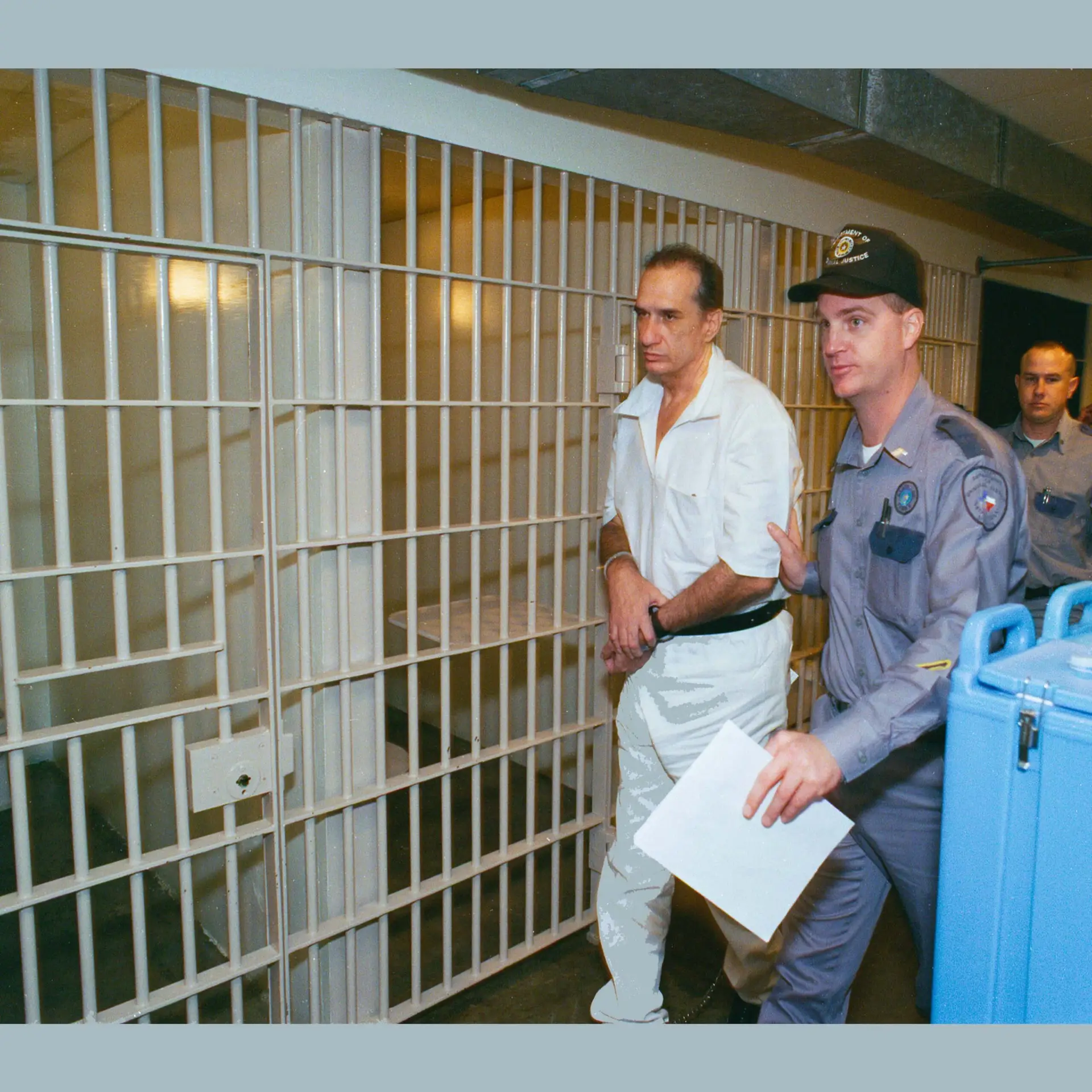
On November 16th, 1998, guards on Texas Death Row at the Ellis prison unit moved serial killer Kenneth McDuff to a new cell.
They put McDuff on death watch 36 hours before his execution.
Every half hour, guards recorded his behavior and mood in a Death Row log. They noted that McDuff was sleepless and intense.
McDuff had confidently expected to receive a stay of execution. But was shocked when he did not.
McDuff told guards that he wanted to be remembered as a notorious serial killer.
Armed guards moved serial killer Kenneth Allen McDuff off Death Row at the Ellis unit on the morning of November 17, 1998.
They locked the 51-year-old killer in a cage inside a prison van and shackled him to restraints. Guards told me that he was docile and joking.
McDuff had tried to smuggle heroin into Death Row to administer his own lethal injection. He wanted to control the end of his life just as he got a rush from controlling the end of his victim’s lives.
The prison gate swung open for the twelve-mile drive south on Farm to Market Road 980 to downtown Huntsville, Texas.
They headed to the Texas State Penitentiary, nicknamed the “Walls Unit”.
The Walls Unit is the site of the Texas death house.
The massive red brick-walled prison opened in 1849.
It’s located a few blocks off the town square and covers 54 acres.
Texas releases all of its prisoners from the Walls Unit. McDuff had walked out of here on parole nine years earlier.
This time he would leave in a pine box made by fellow inmates.
32 years of evading the death penalty for murdering three Fort Worth teenagers was coming to an end.
The Walls Unit’s main entrance leads into a three-story brick administration building with bars on its windows.
Closely trimmed hedges attended to by inmate trustees line the front steps.
An old-style clock with a white face and black hour and second hands is the focal point on the building’s facade.
During executions, all eyes turn to the clock at the stroke of 6 pm Central Standard Time.
Texas law specifies that all executions are to be carried out at or after 6 pm Huntsville time.
At the back entrance to the death house, guards escorted McDuff down a sidewalk lined with yellow roses planted and tended to by inmate trustees.
Inside, guards conducted a cavity search. They locked McDuff in a small holding cell painted white.
It contained a thin mattress that rested on a steel backboard, a metal toilet, and small corner sink. All made by inmates in Texas prison factories.
John Moriarty who had been on McDuff’s case for six years made one last attempt to get McDuff to confess the location of the bodies of more than a dozen other women.
McDuff asked for a cigarette. None of the officers smoked. No one had a lighter.
Moriarty recalls how McDuff pulled out a lighter hidden in his clock.
John Moriarty
these guys know how to – they adjust to the system. They are predators. They – whatever benefits them, they will do. And not getting jammed up, just to give you an example, like when he was in the death house, he was allowed to smoke a cigarette. And I was there when this happened. And he had an item that he had made or somebody had made in the craft shop and nobody had a light – nobody smoked. And so anyway, he reached into this item that he had in his property and pulled out a lighter, which was contraband in the prison system to light the cigarette that he was smoking.
Robert Riggs
On death row?
John Moriarty
In the death chamber.
Robert Riggs
Oh my God!
John Moriarty
And the cells adjacent to the death – but in the death house.
Robert Riggs
Well, it shows you how cunning they are.
John Moriarty
Exactly. They adjust to whatever the environment is and adapt.
Robert Riggs
OUTSIDE THE CELL, TWO TELEPHONES AND A BIBLE SAT ON TOP OF A SMALL TABLE COVERED WITH A WHITE STARCHED TABLECLOTH. MCDUFF’S LAST MEAL WOULD BE served HERE.
He requested: two sixteen ounce t- bone steaks, five fried eggs, vegetables, french fries, coconut pie, and a can of coke cola.
The prison system served McDuff the same meal every inmate received that day. No one gets t-bone steak or special meal requests behind bars in Texas.
Thinking about the hereafter, McDuff told Moriarty that he didn’t want to sing hymns from some hilltop in heaven; he wanted to go someplace he could party.
Outside the Walls Unit, the usual anti-death-penalty protesters with their picket signs were noticeably absent.
John Moriarty witnessed McDuff’s execution and fills in more details.
John Moriarty
There are two viewing rooms and the drug room as well as the actual execution chamber where the condemned is brought in and strapped down. And there’s a large team of individuals, correctional officers that are there that escort the individual. I had, as the Inspector General, I had oversight over the execution process and attended many executions. But the day of the execution, the individual is transported from death row to the death house located at the Walls Unit in Huntsville and brought in to the death chamber which has several cells adjacent to the chamber where they are held.
Robert Riggs
And just like in the movies, they get a last meal request and their ministers are there, the chaplains, and family get to visit with them if they are so inclined. Then minutes before the execution, the condemned is moved to the – into the death chamber. They are strapped down and the IV lines are put in and then just like in the movies, there are the phone calls from the governor’s office and the attorney general’s office in case there are any last minute appeals. And …
That phone didn’t ring.
John Moriarty
Well, even if there’s none, they get a clearance. And actually before they are actually moved out of that cell into the chamber, those phones are active and the warden gets the word that it’s on and it’s moving forward. And so anyway, they got the word just going back. And people always used to ask me, “Well, do you – don’t you – don’t they have to fight a lot of these guys into the chamber?” I know if it was me, I mean I would …
Robert Riggs
Kicking and screaming.
John Moriarty
… I’d be kicking and screaming. But these guys are – I can count on one hand the number of times that they were – people either had to be – one case was an individual had to be fought and put in there. But the other case, I mean I know there was one where the guy said, “My legs just would not carry me.” So they picked him up and put him in there.
Robert Riggs
But anyway …
They are passive.
John Moriarty
They are passive and they – it goes back to believe it or not, looking good to the other boys on death row that you want to go out like a man. And so, they walk in and they lie down. And so – anyway, so he walks in and lies down
Robert Riggs
Shortly after 6 pm five guards escorted McDuff on his final walk through a steel door into the death chamber.
They placed McDuff on his back atop a gurney tightly covered by a white starched sheet.
They strapped him down with six thick, wide, tan colored belts across his ankles, lower legs, thighs, waist, and chest.
Next the guards strapped McDuff’s arms to armrests that swung out at an angle from each side of the gurney. Then, they left the chamber.
The execution team entered from an adjoining room where they operate the lethal injection apparatus.
They inserted iv’s into each of McDuff’s arms. One iv is a backup.
They tightly wrapped the entire length of McDuff’s arms and hands with ace bandages.
This is to prevent the condemned inmate from making an obscene gesture to the victim’s family witnessing the execution.
Guards escorted witnesses separately into two different rooms. One for the condemned family. One for the victim’s family.
McDuff’s daughter from a rape who you heard about concerning bribery allegations in an earlier episode and a nephew were his witnesses.
Family members of four of McDuff’s victims, law officers, and media representatives watched from the other room.
Parnell McNamara, the deputy U.S. Marshal who started the original manhunt for the serial killer describes the scene inside the victim’s viewing room.
Parnell McNamara
Yes. And Mr. and Mrs. Brand, who he had killed her son Robert Brand in 1966. So, it’s a small room. I think it holds maybe 12, 15 people max. And the criminal’s family is on the other side of the wall, you can’t see them. But when we went in there, he was already on the gurney. He was strapped down. And so, I’m on the front row standing next to the glass. And they’ve got this microphone that comes down right in front of their face in case they want to say something. And Mr. and Mrs. Brand were behind me, and I turned around to them and I said, “You all need to be on the front row.” So I moved them and put them in front of me waiting in the execution
Robert Riggs
The prison champlin stood at the foot of the gurney with his hand on McDuff’s right leg.
The prison warden stood at the right side of McDuff’s head.
Moriarty fills in more details.
John Moriarty
The – during the execution, the warden is in there and the chaplain. The chaplain is the only person allowed to touch the inmate and he usually has, and in this case, he did have his hand on his leg. But that’s the scenario. And at that time, the warden has the last words asks him, “Do you have anything you need to say?”
Robert Riggs
The warden gave McDuff two minutes to answer.
A microphone suspended from the ceiling transmits the last words into each of the viewing rooms.
At 6:18 pm McDuff said, I am ready to be released. Release me.
All of us were puzzled by McDuff’s last words. Moriarty explains.
What did that mean in prison terms?
John Moriarty
Well obviously, he spent quite a bit of his life locked up and he just wanted to go. A lot – I don’t want him get out and be free from being locked up. But a lot of guys they say something religious or they have an old saying around the penitentiary that Jesus must certainly live in the penitentiary because everybody finds him when they get there. That’s really true for people that are on death row.
Robert Riggs
But when you’re a sociopath or psychopath, it doesn’t matter to you because it’s all about you.
When McDuff finished his last words, I am ready to be released. Release me.
The execution team released a lethal dose of chemicals into McDuff’s iv.
The serial killer let out a few brief gasps of air and exhaled a long breath. Officials pronounced McDuff dead at 6:26 pm.
Parnell McNamara
McNamara
And he said, “I’m ready to be released. Release me.” And that’s all he said. And so, they basically shot the juice to him and of course, like any execution, he made some sounds and then he expired. They declared him dead and then he turned blue. And Mr. Brand turned around and grabbed me by the arms and he shook me and he said, “I’ve been waiting for this for over 30 years.” He was crying. And I said, “You shouldn’t have to wait 30 years for this.” And so, what a sense of relief and we walked out of there. I knew that dirty, lowlife, scumbag, piece of gutter trash would never hurt anybody else on this earth.
And so, you know they call you after you witness an execution. I don’t know if they still do it but they used to call you and see if you were traumatized. And I said, the – I told them, “Quit calling me. I’m fine, you know. I’m not. I was never traumatized by the execution. I was traumatized by what I found out he did to the victims. That’s what traumatized me. So you don’t need to call me anymore. I’m OK.”
Robert Riggs
Afterward, Brenda Solomon, the mother of Melissa Northrup, told me, quote, my children are going to rest in peace now, and McDuff is going where he needs to go.”
Family members of Robert brand, one of the three teenagers that McDuff murdered in 1966, had waited for 32 years for the execution. Cindy easley, the daughter of Robert brand’s sister, was two years old at the time of his murder. She said her mother was never the same afterwards.
Lori Bible, the sister of Colleen Reed, chose not to witness McDuff’s execution. Afterward she said, “what was important to me was that the death sentence be carried out and that he be executed. And that he never have the opportunity to hurt another person on this earth.”
Darren Moore, the brother of Regina Moore whose mother had confronted McDuff after she disappeared said quote, “it’s finished for him, but it still goes on for all of us.”
Gary Lavergne, the author of Bad Boy from Rosebud: The Murderous Life of Kenneth Allen McDuff, waited outside the Walls Unit during the execution along with other journalists including me.
Gary Lavergne
One of the things about the death penalty is that a lot of times people will say that it gives you closure. And that’s not completely true. It’s true about some things. For example, Colleen Reed’s family, they don’t have to go to any more parole hearings, not for McDuff, maybe for Worley but not for McDuff. So in that respect, the death penalty provided closure. They don’t have to see him again. They don’t have to hear from him again. They don’t have to hear from nuts who contact them, who say that McDuff is really innocent.
Robert Riggs
And all of these families have had to go through that kind of cruelty really. But it doesn’t provide closure in so far as these are not things that you can forget.
Gary Lavergne
Colleen is the one that you remember and miss every Christmas, every Thanksgiving.
And so what I see when I visited those families of those victims and I did for just about all of them, I see pain that lingers I’m sure to this day.
Robert Riggs
And when I think of Colleen, I don’t see the petite, vivacious accountant, excited and all that you heard about, I always see the suffering that I read about in Worley’s confession.
Gary Lavergne
Robert Riggs
In Worley’s confession. And when her body was finally recovered and you see that the skeleton, her remains, I didn’t – it wasn’t my first reaction to say, “Well, she is finally at peace.” That wasn’t my reaction. My reaction was what must her last hours had been like at the hands of that guy?
Sheriff Larry Pamplin also witnessed McDuff’s execution. He still regrets not pulling the trigger when he and his father confronted McDuff at gunpoint in bremond, Texas, when they pursued him for the 1966 murders.
Sheriff Pamplin
Robert Riggs
we’ve got a parole system and it should be fair and honest and these individuals should be incarcerated that are a danger to the society. And McDuff, like I said, there’s no telling how many people he has actually killed.
Parnell and I have sat around and talked about it several times and the best we could come up with somewhere between 22, 25 people. But stop and think how many lives that he has destroyed besides the person that died. I mean the mother, the father, the sisters, the brothers, the aunts, the uncles. It’s just a crying shame that we could not have eliminated the source in Bremond, Texas because my God there’d be a lot more people living.
When news of McDuff’s execution reached his hometown of rosebud, where he was known as the feared town bully and his mother the pistol-packing doting mama, residents felt a sense of relief.
They also made it clear in no uncertain terms rosebud would not be McDuff’s final resting place.
A few days passed. No one from McDuff’s family claimed his body.
Inmates put McDuff’s corpse into a wood casket made by inmates.
A crew of inmates dug McDuff’s grave in the red dirt 22 acre Captain Joe Byrd prison cemetery located a mile from the Walls Unit.
Byrd was a former assistant warden who oversaw maintenance of the cemetery.
Inmates call the cemetery peckerwood hill, a disparaging term for white racist inmates as well as poor white inmates.
A chaplain, according to procedure, said grace. The crew of inmates covered his grave.
And put a nameless headstone in place.
The inscription notes McDuff’s date of execution, November 17, 1998, and an x signifies that the nameless person buried here was executed by the state of Texas, and it contains McDuff’s Death Row number 999055.
McDuff went down in Texas history as the only inmate to have had two Death Row numbers. As well, it's the most sadistic sexual serial killer ever.
Bill Johnston, the former U.S. Attorney who pulled out all the stops to catch McDuff and to find his victim’s bodies, passed on witnessing the execution.
Johnston admits that he is not an advocate for the death penalty. But in the Kenneth McDuff’s case, he believes there was no alternative.
Bill Johnston
You know, I’m not an advocate for the death penalty in every case that it’s available necessarily. That sounds weird from a prosecutor. But I think we have to be so careful about it, but if there is a case where the death penalty could have saved lives, could have prevented a wonderful innocent human being from being tortured and killed, this was the case. And so I think that where the Court of Appeals saw this thing in a way the public saw it was this is a wild, rabid animal that must be put down. And to me, McDuff was more animal than human. He was the worst of humanity and there was no safe thing to do with that thing, that creature, other than kill him.
Robert Riggs
To this day author Gary Lavergne wonders if McDuff could have provided a living specimen for the scientific study of serial killers.
Gary Lavergne
I couldn’t help but wonder, the scientist in me meant that I couldn’t help but wonder if we had not just destroyed the Rosetta Stone of serial killing. What I mean by that is that maybe if we had studied him more carefully, we would have uncovered something that might as remote as that sound, might reveal why these people exist. I don’t know why people like that exist.
Don’t get me wrong. I didn’t shed a tear for Kenneth McDuff and I think the death penalty in this case was justice. But if he – if studying him and that wicked brain of his would have uncovered anything of value, well, it’s not possible now. He is dead and buried in Peckerwood Hill. And I guess that’s where he belongs.
Robert Riggs
And it’s just unthinkable. I, as a seasoned journalist had been to warzones and you name it, I’ve seen all kinds of horrible things happen to people. When I read that Worley confession that was unthinkable. You couldn’t – fiction couldn’t do this.
Gary Lavergne
It’s something you can’t get out of your mind.
Robert Riggs
No, you cannot.
Gary Lavergne
To this day, I think of Colleen. I had a special kind of – I didn’t know Colleen Reed. I’ve come to know her sister, Lori Bible, quite well. It turns out that Colleen Reed and Lori Bible grew up as Cajuns in Louisiana. And we grew up about 40 miles from one another. I didn’t know them. But we grew up. And so, I had a special bond and relationship with Lori Bible because we came from Cajun, Louisiana.
Robert Riggs
And that added to the horror to me because I just can’t imagine a good Cajun girl from Evangeline Parish, Louisiana going through something like that. That’s far into how we grew up and where we were from