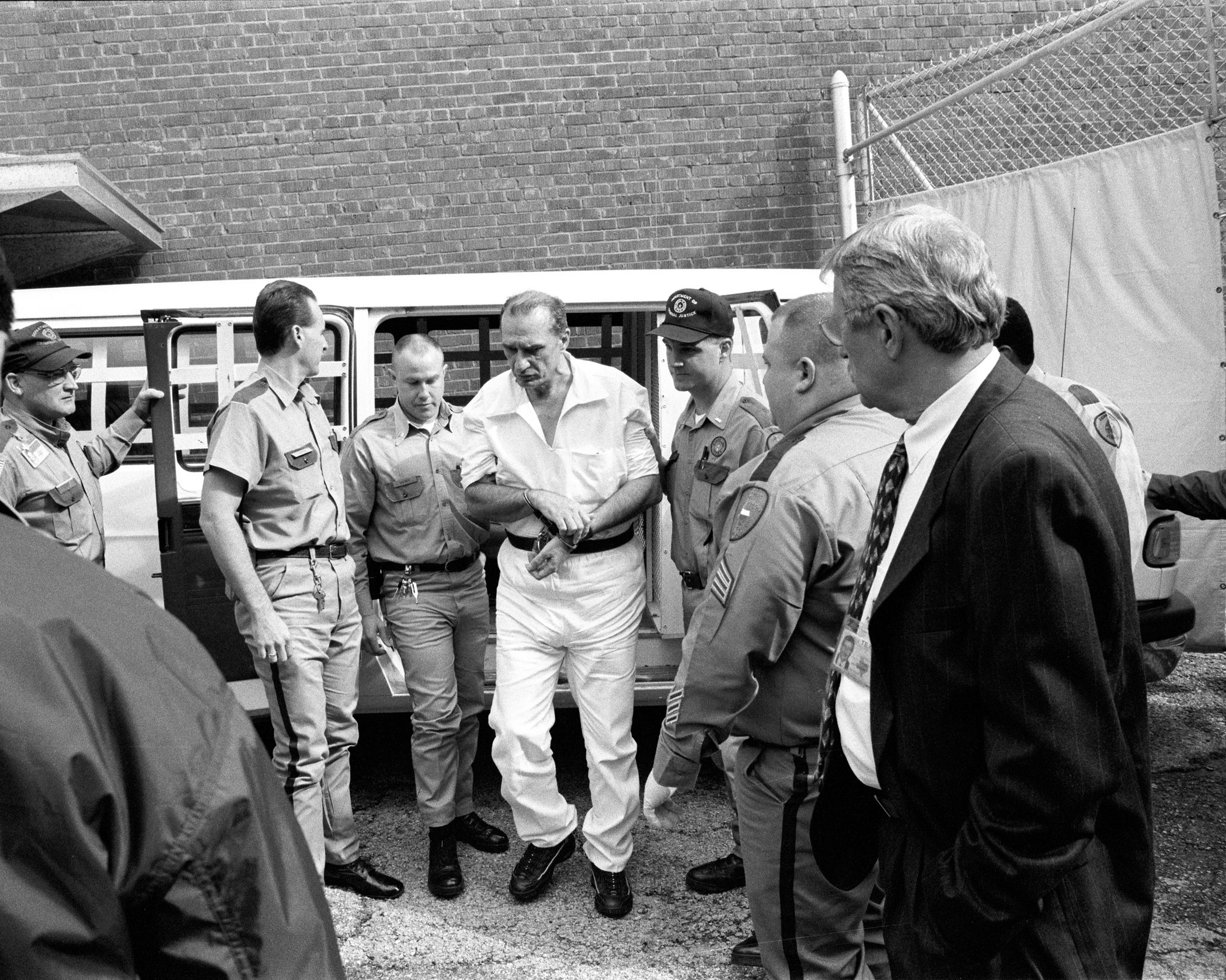
Serial killer Kenneth McDuff held on tightly to three secrets.
Where did he bury the bodies of Brenda Thompson, Regina Moore, and Colleen Reed?
McDuff’s date with the executioner was a few weeks away.
Investigators were desperate for answers.
Author Gary Lavergne went inside Texas Death Row to try to find out.
Lavergne wrote, Bad Boy from Rosebud: The Murderous Life of Kenneth Allen McDuff.
Gary Lavergne
I was never afraid of McDuff because I knew that in the end, McDuff would back down from anyone who looked him dead in the eye and was deadly serious with him. And I made up my mind he was not going to scare me.
I was finishing up A Sniper in the Tower, my first book, and that brought me to the Austin Police Department. I spent a lot of time there and I got to know a lot of the good people out there. And it just so happened that the McDuff story was really popping. And there was a time when McDuff was believed to be willing to talk to writers and journalists. Because of the nature of this guy, he had an ego and even though his own lawyers told him to shut up and not say anything, he couldn’t help himself. He wanted to talk. He wanted to glorify himself.
Robert Riggs
And so, the investigators in the McDuff case even though I wasn’t there for that, said to themselves, “Well, maybe this guy having the ego that he had will open up more to a writer.”
Investigators suspected McDuff kidnapped and murdered more than 15 missing women.
Some bodies had been found but not enough physical evidence to tie McDuff to their murders.
The body of Melissa Northrup, the Waco convenience store clerk, had been found a hundred miles away in a remote corner of Dallas County in a flooded gravel pit.
McDuff’s date with the executioner for her murder was fast approaching.
Time was running out on getting McDuff to disclose where he buried Brenda Thompson, Regina Moore, and Colleen Reed.
Gary Lavergne
At that time, none of the bodies except for Melissa Northrup had been recovered and were missing and they all knew McDuff did it. But at the time, he had not admitted to any of it. And so, maybe there’s a chance, a slight chance but maybe there’s a chance that he would talk to someone who would be willing to write the story.
Robert Riggs
Gary Lavergne went to the Ellis prison unit located 12 miles north of Huntsville.
It’s an old style red brick prison farm of more than 11,000 acres. Inmates raise crops, run a cotton gin, breed cows and horses, and refurbish school buses here.
Inmates wear white pants and shirts and black shoes made by fellow inmates in the Texas prison industry.
Death Row occupied a cell block inside the Ellis unit. Some of its inmates were allowed to work in the Death Row garment factory sewing new grey pants for prison guards.
Guards armed with rifles stood watch in sentry towers mounted with giant spot lights. Three rings of tall chain link fences topped with razor sharp concertina wire circled the prison.
McDuff first arrived here in 1966, a year after the prison opened, to serve his death sentence for the broomstick murders.
McDuff was back where he had already spent more than half of his life. The only man in Texas history convicted of capital murder three different times.
Gary Lavergne
I was never afraid of McDuff because I knew that in the end, McDuff would back down from anyone who looked him dead in the eye and was deadly serious with him. And I made up my mind he was not going to scare me.
Lavergne walked up to the Ellis unit’s front gate. A guard in the sentry tower lowered a bucket attached to a chain. Lavergne placed his driver’s license inside. The guard reeled up the bucket. Checked Lavergne’s identification and lowered it back down.
And I said to myself, “Well, this is one of the largest prison systems in the world and they use a bucket to check your ID.”
Robert Riggs
Like I said it is an old style prison farm.
Inside, Lavergne found McDuff waiting in a prison visitation room.
Lavergne avoided shaking hands with McDuff.
Exchanged a few pleasantries and got down to the interview.
Lavergne could not help fixating on what I always described in my news reports as McDuff’s dead shark like eyes.
Gary Lavergne
He had brown eyes that were not just like the brown eyes that you would see in most people. They were darker and they were piercing. But he only used that gaze, that famous gaze of his if he thought he could intimidate you. And once he – I made it clear I was not afraid of him. And I didn’t say, “MAc, I’m not afraid of you,” or anything like that.
Robert Riggs
Yeah.
Gary Lavergne
I didn’t have to. It bothered him if you returned his gaze and you didn’t flinch. And again, I made a decision that that’s what I was going to do.
I got extraordinary access to him in so far as the deal was and this is prison policy, as long as you can keep him talking and as long as he willing to talk, we will leave you alone, more or less. And so, in the end, I ended up sitting down with him for five hours. I think it’s exactly like 4 hours and 47 minutes. But it was one of the most exhAusting things I have ever done in my life.
Robert Riggs
Was the exhaustion from trying to get him to tell you something of how he would kind of race around in other directions and try to take you off the trail or …?
Gary Lavergne
It was a combination of many things. Number one, I knew who he was and what he had done. So it was – his capacity to do evil things was always in my mind and I don’t know how anybody could even approach him without some consciousness of that.
Robert Riggs
Then secondly, he had been through so many interrogations that he was really good at lying. I’ll give him credit for that. He could spin a story and I didn’t believe any of it because I knew who he was but it was exhAusting just to listen to him go on.
Well, he was a career serial killer, interrogated all of his life on different claims so I guess you would develop some expertise.
Gary Lavergne
Well, I’ve been asked about him and my background is teaching and the word genius I think is an overused term. I think everyone is a genius in some way. He would be a genius when it comes to lying.
Robert Riggs
Wow! That good.
Gary Lavergne
I mean I think all of us by virtue of our individuality have something in us that is exemplary. And as a teacher, I try to find that in every one of my students. But with him, it was just deceit and lying.
Robert Riggs
McDuff didn’t give up the location of any of his victims’ bodies.
He told Lavergne everyone just misunderstood him.
Lavergne asked him why he spent so much time with street walkers’.
McDuff replied that it was hard to get a date after you’ve been on Death Row.
Lavergne left thinking that McDuff was the personification of evil that was complete selfishness.
McDuff was a pathological example of selfishness, complete, total, self-centeredness.
And like I said a few moments ago, he felt that if he said something, you had to believe it because he said it. And because he said it, it was the truth. And that everybody and everything existed for his own personal pleasure. I studied that guy from middle school on through his execution and I never uncovered a single example of him being selfless or charitable. His entire adult life was selfishness and self-gratification.
Investigators tried another tactic.
U.S. Attorney Bill Johnston and U.S. Deputy marshals Parnell and mike McNamara recruited an informant.
A distant cousin paid McDuff a visit on Death Row.
Bill Johnston
She is a cousin, second cousin maybe to McDuff. But a fairly decent person sort of in that world but fairly decent person. I mean a decent person honestly. Had a bad luck of being related to him. And so, she was able to get from McDuff two descriptions.
Robert Riggs
The informant obtained McDuff’s directions to where Regina Moore and Brenda Thompson’s bodies were buried.
Seven years after he murdered Regina Moore, McDuff clearly remembered the exact number of steps to her grave that he dug in a wooded farmland in rural Texas.
Bill Johnston
And it was amazing. I mean it was like, wow! He remembered exactly where it was and he was honest about it so to speak. And so, we had – we got the forensic team out there and they unearthed her. She was skeletal, very, very shallow. And then the other description, Brenda Thompson. He didn’t say that but that’s – he knew it was.
Robert Riggs
But finding the remains of the other victim, Brenda Thompson proved to be a challenge.
They brought in a cadaver dog to search for her scent.
And that dog tramped all across an acre probably of poison ivy vines and thorns and everything. It was so thick, you could barely walk through this place. And the poor dog worked and worked and worked and never hit on anything. And there wasn’t anything of any description that could be seen. There is nothing unique of it anyway. Of course, it had been seven years.
Johnston did not want to give up. He went back to try searching again.
He used a technique he had learned from a civil war researcher from the Smithsonian Institution.
He rushed to a plumbing supply store and bought a fiberglass rod with a brass tip. It’s used to find underground water lines.
Johnston methodically poked the ground with the rod. He felt around for soft spots beneath the topsoil that might cover a grave.
He was about to give up.
and I hit something and it made a scraping sound. It seemed hard and it ended up like a rock or what. I got down on my hands and knees and I spread the dirt away and there was off-white-looking object and I further spread the dirt away and I grabbed it with my fingers and I pulled it and I pulled it out and it looked to me like a human arm bone.
Johnston discovered the skeletal remains of Brenda Thompson hidden in a field thick with poison ivy and vines.
McDuff’s directions were correct. The terrain had changed since her murder seven years earlier.
What do you make that McDuff could remember with great detail where he put a body in a remote area years and years earlier?
Bill Johnston
He gloried in it and relived it I think. And I think it was his mental pornography. I think he – that was his essence.
Robert Riggs
And he used this term, “I’m going to use them up.” What did that mean?
Bill Johnston
You know, what was McDuff thinking? I believe McDuff did want to have over life and death but the torture, they say he was gratified in some fashion by the torture. I don’t really – I don’t understand that. And I don’t know how you get to the bottom of that and figure it out of what was moving him, but to me, I was with McDuff on a few occasions and very close to him. I was a couple of feet away from him for a pretty good while and was speaking with him and his eyes were dead. His eyes had no spark of life, had no humanity in them. There was something wrong with the guy. And I don’t mean psychologically. I mean in his creation.