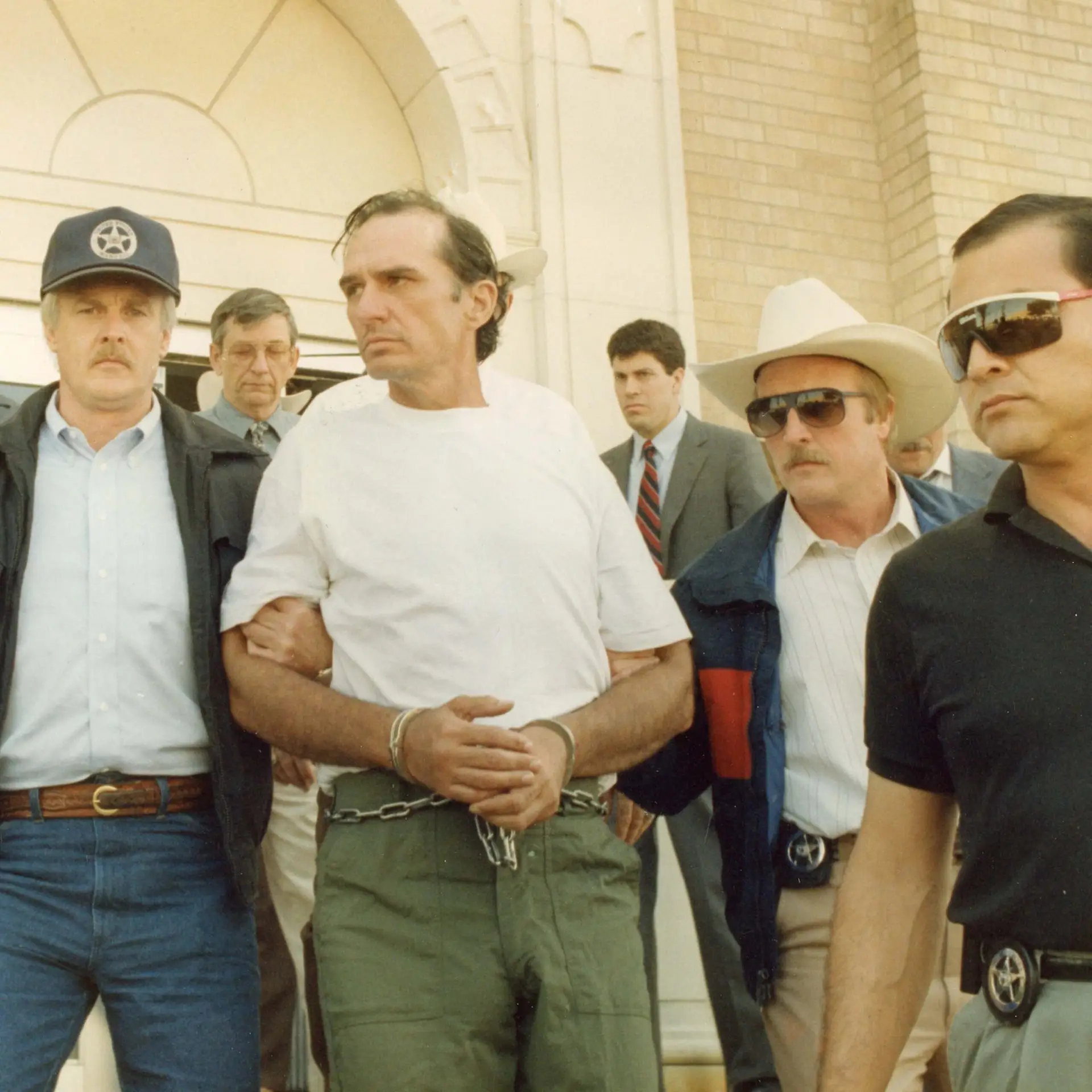
Three decades have passed since the McDuff parole scandal rocked Texas.
In its wake, the legislature passed a slew of tough-on-crime laws named after McDuff as well as crime victims.
Kenneth Allen McDuff is probably one of the nation’s most sadistic sexual serial killers that you had never heard of until this podcast.
Investigators believe McDuff took an awful secret to his nameless prison cemetery grave.
The names and locations of the bodies of his other victims and the names of his other accomplices remain a mystery.
The Kenneth McDuff parole scandal brought sweeping changes to the Texas criminal justice system.
Newly elected governor Ann Richards flushed a corrupt good ole boys network out of the state’s prison and parole systems.
Lawmakers passed sweeping reforms dubbed the McDuff laws.
Senator Ted Lyon led the charge.
Senator Ted Lyon
We rewrote the whole Penal Code in 1992 and it changed that. So all of that came about because of McDuff, Lopez, all those abuses cases and there were others too.
Robert Riggs
As you may recall from the first episode, it was lyon who held hearings into the release of Death Row inmates including Kenneth McDuff and leonardo lopez who executed three sheriff’s deputies in dallas.
Under the McDuff law, a life sentence for capital murder really means life now.
Lyon left the senate in 1993.
Today, his law practice focuses on personal injury cases in mesquite a suburb of dallas.
Three decades after McDuff’s scandalous release and murderous rampage, we sat down together to reflect on the lessons for lawmakers and society.
Ann Richards
Governor of Texas
Senator Ted Lyon
the bottom line is Texas got so much bad press that we were able to convince the next administration.
Robert Riggs
Ann Richards.
Senator Ted Lyon
And Richards and Bob Bullock to increase the size of the Texas prison system way beyond what it was then. We put 120,000 new beds into place over several years and we had the largest drug treatment system, drug treatment beds in the world at that time. Recidivism, which is the rate of people returning to the prison, dropped dramatically and the crime date dropped dramatically, dramatically
Robert Riggs
Ted Lyon
Chairman Senate Criminal Justice Committee
So today with your perspective of this, what would you say to lawmakers today?
Senator Ted Lyon
I would say number one, you need to make sure you have the best drug treatment system in the country because that fuels crime. They don’t have that anymore. It was – all those beds were taken away. That’s number one. That’s number one.
Robert Riggs
Number two, for these people that have these violent crimes, with the serial killers, with these multiple murderers, things of that nature, there’s no way to rehab those people. You have to keep them in prison as long as you can or if you don’t, you’re going to subject other family members to losing their loved ones and it’s going to happen on a regular basis.
Ted Lyon fears the memory and the lessons of the McDuff parole scandal may have faded.
His former experience as a police officer and chairman of the senate criminal justice committee makes him cautious when it comes to the safety of his family.
Senator Ted Lyon
If I had to tell single women and women with young children who were alone or whatever, I would say be very careful. Have a weapon in your home. Have some kind of weapon in your purse. It’s easy to get too like mace or something like that and be ready to use it because there are a lot of evil people in the world and they’re out there still and they’re running – I mean I have grandchildren. I have daughters-in-law. I have a granddaughter that’s 15 and I worry about them all the time. I really do because I know what’s out there. I know.
Robert Riggs
Parnell McNamara, the western style lawman who hunted McDuff, retired from the U.S. Marshals service after serving 33-years.
McLennan County, Texas voters elected McNamara their sheriff in 2012 and returned him to office in 2016.
At the time of our conversation in his Waco office in 2020, the 72-year-old sheriff was running for a third term with a new campaign slogan. “riding herd on the lawless.”
With all of your experience in law enforcement and what you saw in this case, for women who are listening to this, what advice do you have to them about not putting themselves in the path of predator like McDuff or what to do if you do come across?
[Parnell McNamara
First of all, don’t knowingly put yourself in harm’s way. Stay out of bad places. One of the main things is be aware of your surroundings; if something doesn’t look right it’s probably not. Play it safe. And if you’re somewhere where you believe somebody is watching you like a mall or something, don’t walk to your car if there’s people out there around your car in the dark. Go back in the mall. Get security. Be aware of your surroundings. Don’t take an unnecessary chance.
Also, I’m a firm believer in the Second Amendment. Everyone has a right to protect themselves. I think every woman should have a firearm of some kind to protect her or at least pepper spray, some type of weapon that they can use in dire straits if somebody does try to kidnap them or harm them in any way.
You know, one of my frustrations being on television is that I was – because it’s an audience with children in it and there are broadcast standards- we really couldn’t ever tell the public just how heinous and evil the details and what McDuff did and others like him do is really unimaginable to people. And so, people have a certain innocence about this and so they don’t know how bad it is and they don’t even – they don’t believe something bad can happen to them.
Parnell McNamara
Absolutely. Most of the time the public sees this in black and white. They see it in the newspaper. They get the CliffsNotes edition of what happened which is always very sketchy. They don’t get the down and dirty nitty-gritty. They don't get it in full color, usually blood red. And so, what they get is not the way it really was. And not until you stand in a field with some scumbag like Hank Worley telling you details about how they inflicted pain on an innocent person, do you really get the full story and the full picture.
Robert Riggs
Parnell McNamara’s childhood friend, Larry Pamplin, retired after serving 20 years as the Falls County sheriff.
To this day, 30 years later. Pamplin believes McDuff kidnapped dozens of women with help from other accomplices who have never been caught.
Based on what you know of him, you suspect there are other accomplices out there that were never caught because he always needed to have a partner to show off to.
Larry Pamplin: Absolutely. Absolutely. He always liked to have an individual with a strong back and a weak mind and Melissa Northrup case is a prime example. There was never found to be an accomplice involved in that and I will die believing that there was an accomplice there.
How about in terms of more victims that we don’t know about?
Larry Pamplin: Oh, I wouldn’t venture to really guess but I think it would just make you cry if you really knew how many people he had actually killed.
Tim Steglich agrees with pamplin’s assessment. You may recall from earlier episodes that steglich extracted the confession from McDuff’s accomplice in the Colleen Reed murder case.
He retired as a criminal investigator for the bell county sheriff’s department in 2013.
At the time of this podcast, steglich works for the travis county district attorney.
Steglich believes McDuff left a trail of victims and used other accomplices who got away with murder.
And you believe there are a lot of other bodies out there.
Tim Steglich: I do.
Victims of McDuff.
Tim: I do.
What is it about the case that makes you think that? All the officers think that. Some of the officers think that they were other accomplices we don’t know about.
Tim:
That’s likely. That’s likely. He was so good at disposing of the bodies. He went to a lot of trouble. Most serial killers aren’t going to dig a grave. He did not want the bodies found. Some serial killers do. He did want any notoriety. This is what he did for fun and he didn’t want to get caught.
Dan Stoltz, who led the nationwide manhunt for Kenneth McDuff retired from the U.S. Marshals service and became a Texas rancher.
He too believes McDuff took secrets to his unmarked prison grave.
So, everybody I’ve interviewed believed that there are more victims, more women buried out there that we don’t know about and I think here are a lot. And they also think there are accomplices from other murders.
Dan Stoltz I believe so. I believe that he was laughing at us when we put him to death saying, “I’m taking my secrets with me.” I believe so. Yes. There’s no doubt about it that there are other victims out there.
What is – from your experience, what is that gut feeling tells you?
Dan Stoltz
My gut feeling that there are other victims, just by the way he acted. First, he is going to show us a body then he wasn’t going to show us the body. He was still trying to be in control. And my gut feeling in his mannerism was the time that he – right at the end where he says, “Let me free …”
Robert Riggs
Release me.
Dan Stoltz
Release me, there it was.
Robert Riggs
Like he is in control.
Dan Stoltz
Like he was in control. So he took his secrets with him. So …
Robert Riggs
Well, he seems so prolific you have to think there. And had you ever seen one that could just hide the bodies the way he did with burying in remote places?
Dan Stoltz
No. No. No. And that shows me that he has a lot of – had a lot of experience of doing so, which makes me believe that there are more bodies out there because he was able to put those bodies in such remote places without any fear. Even the way he did it, some of it like if he was deer hunting. So …
Robert Riggs
In earlier episodes, you heard from U.S. Attorney Bill Johnston.
Johnston played a pivotal role to launch the McDuff manhunt, helped find the bodies of three of McDuff’s victims before his execution, and prosecuted the parole board chairman who released McDuff.
Johnston left the federal prosecutors' office and opened a private law practice.
What do you say for the future? What do you say that we should always be on the lookout for?
Bill Johnston
We should never forget what happened. And thank goodness you are informing people. I doubt that one in 30 or 40 of 50 Texans right now would even remember or have a gravity of what happened. So most people have already forgotten but it’s important to know what happened because it can absolutely repeat itself and what you look for is, you look for people who shouldn’t be out of prison committing crimes. That’s as simple as it is.
For people that should be in prison committing crimes, after the McDuff, all these McDuff laws are passed and people had a certain larger portion of their senates, everything really tightened down. They had this enormous as you know, enormous prison construction for the prisoners. Every other town in Texas got a prison with them now. That when the case, it was almost solely in Huntsville.
So anyhow, so for many years after that, people serve a high percentage of their sentences even for less and terrible crimes and people for violent crimes served three or four more of the sentences so they are still there. But I can tell you that now, we do see people serving an eighth of their sentence, a tenth of their sentence. I’m not talking violent people with the special findings but it may be the first layer of erosion is what’s happening now that you have people who a jury may say, “You should do 20 years for let’s say a drug crime.” And after a year and a half or two years, they are out. And that’s not what the jury intended and that’s not what people think is happening.
Perhaps, that’s where the erosion begins and then when people’s memories are more faint, they will start letting the violent people out. But all you – again, all you need to look for, it’s supposedly one of the problems with Chicago. I don’t know. That could be that case. But supposedly, one of the problems in Chicago is that they have a very open bail bond system. So someone is arrested for a terrible crime and they are allowed bail. And then people who go to prison don’t stay long and so you have multi-time convicted people committing terrible crimes. That’s what you look for. And you know the system is either corrupt or broken in some fashion.
Robert Riggs
Based on the underbelly of Central Texas where this investigation took you in what you learned of McDuff, what do you say particularly to women that are out alone with their children at a shopping mall or at a convenience store filling up with gas, what is a woman to do?
Bill Johnston
Robert Riggs
You hate to think about this. Someone asked me about an area of Mexico recently and he said, “Is it safe to go there?” And I said, “It’s perfectly safe until you are kidnapped or murdered and then it’s not.” So it’s really not fun for people to think, “Gosh! I can go out to the bars in Dallas until 1:00 in the morning. Nothing is going to happen to me.” And they get home and they are perfectly safe. That was perfectly safe what they just did.
But the problem here is that there are some people out there, I hope there’s not an exact McDuff, but there are people out there that have such a disregard for life that you almost need – you don’t want to be in fear but you want to be prepared because the rabbit in the field doesn’t know there’s a hawk diving on him. It just dives on him and bam! It has it. And there’s nothing you can do.
During the previous episodes, you heard a lot about undercover prison investigator John Moriarty, the tough-talking irish cop from New York City.
Moriarty provided intelligence to hunt down McDuff. He tricked McDuff into drawing a map of where he buried the body of Colleen Reed. He got some basic confessions from McDuff.
He worked on the U.S. Attorney’s grand jury investigation of the parole board chairman, and finally he witnessed McDuff’s execution.
After governor Ann Richards cleaned house, Moriarty rose in the ranks to become the inspector general of the Texas Department of Criminal Justice. And Moriarty graduated from the FBI’s national academy.
On the occasion of Moriarty’s retirement in 2011, a newspaper profile said, “his job description reads like a script for a cop reality show: witness executions to make sure the state’s procedures are followed, supervise the capture of escapees, bust lawmakers for new crimes committed inside the gritty world of prisons.”
At the time of this podcast, Moriarty works as a criminal justice consultant. He specializes in investigating cases in which an inmate dies in custody.
Moriarty understood the mind of Kenneth McDuff as well as violent psychopaths like him better than anyone on this case.
Is there a lesson out the McDuff case that we should not forget?
John Moriarty
The bottom line is that in my opinion, the people that make decisions on who gets released shouldn’t be political appointments. That’s the bottom line. It should be professionals that understand convicts and understand the psychopaths and can’t be compromised, pay him well enough to make those decisions. But when you’re – I had another Parole Board Chairman tell me and it’s, “I believe the best analysis of the parole system is that 20% should never get out, 20% of them, 20% will get out just after serving their little bit of time. It’s that 60% in the middle that we got the problem with. And making an educated decision, not a political decision on the only thing that’s saving the public.”
Robert Riggs
Finally, let’s wrap up with Parnell McNamara. The lawman whose family members have spent more than a century bringing fugitives to justice for the U.S. Marshals service.
By the time their investigation was over, everyone on the case felt a personal attachment to the families of the victims, especially Colleen Reed and Melissa Northrup.
In closing, I asked McNamara how the loss affected their families.
And what did you see it did to these families, the families of victims? You got to know all of them pretty well.
Parnell McNamara
I did and you know after all that happened and was finally over, and it’s not ever over. But I would talk to Colleen’s parents, they lived in Louisiana. I’d call them on Christmas and different holidays just to touch base with them and let them know we didn’t forget about them. They were heartbroken. Lori Bible, Colleen’s sister, just absolutely was devastated and she was so courageous during that whole thing. And we just loved Lori. And we’re able to talk to her again this summer on another thing. And I hadn’t seen Lori and years and years but we got to be very good friends with the Solomon’s who were Melissa Northrup’s parents. And it’s – I don’t know, you just feel a closeness because you were all fighting for the same thing. And that’s justice and to put this guy away forever.
Robert Riggs
And I’ll tell you this that was very, very moving for me. My wife and I gave the Concealed Handgun Class for about eight years. And I would always use the McDuff case as a warning that you don’t have to be in the wrong part of town, you don’t have to be out at midnight, you don’t have to be drunk in a bar, you can be in your own house, you can be washing your car, you can be working at your job and be carried off in the dark by some of these predators. And so I’d always tell the McDuff case as one of several.
So, I’m in the class, we got like 50 people in there, and this young girl walks in, in her 20s. And she’s got two little kids with her. And they’re about four, five years old. And so, I’d tell her, I said, “Come on in, ma’am.” And I just finished the McDuff story and I said, “Can I help you?” because I didn’t know if she wants to sit in on the class or what. And she said, she came up to the front and she said, “I just want to thank you and all the officers that worked so hard to bring Kenneth McDuff to justice because he killed my mother, Melissa Northrup.”
And there was not a dry eye in that class. And I said, “Oh my God.” I said, “I am so sorry.” I don’t know what to say. I was speechless. And I said, “I have not seen you since you were the age of those little children right there.” And she said, “Well, I just wanted you to know, I heard you were giving the class and I want to come by and thank you for doing that.” And I’m telling you, I had tears rolling down my face and everybody in there did. You could hear a pin drop when she said “He killed my mother.”
In closing, we honor the memory of deputy U.S. Marshal mike McNamara, Parnell McNamara’s brother and inspector U.S. Marshal mike carnavale, Dan Stoltz partner.
First a few words from sheriff McNamara about his late brother mike.
Parnell McNamara
Mike was my partner in law enforcement the whole time. He and I hired on with US Marshals in 1970 the same day. And so, Mike was right there by my side every step of the way. I never had to wonder where Mike was. And Mike was also my partner in life. We went to school together, grew up together, drove the same cars and so, I totally trusted Mike to have my back. He was always there.
Robert Riggs
Dan Stoltz remembers the dedication of his late partner, inspector U.S. Marshal mike carnavale. They had each other’s backs while chasing fugitives around the world.
Carnavale suffered from terminal cancer during the McDuff manhunt.
Stoltz says marshal carnavale refused to stop until he slapped handcuffs on the serial killer.
Dan Stoltz
Robert Riggs
Yeah. And there was time that we had to tell him, “Sleep in the back of the car. Go back to the hotel room.” But Mike and I were pretty close.
I mean I’ve seen the two of you everywhere together.
Dan Stoltz
Yeah. We were very close. His cancer didn’t stop him and I didn’t want to be the one to say, “Look Mike, you’re sick. Go back to your district.” Whatever Mike needed, I would have done it. And he wanted to stay working and I think that was the best medicine that he could have.