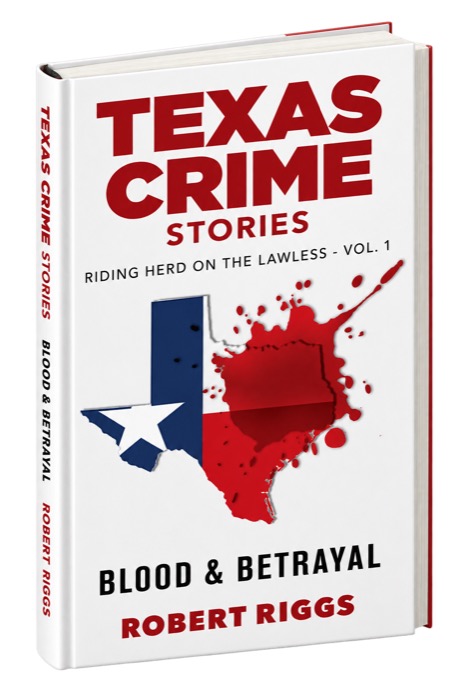
Robert Riggs:
On September 21, 1995, Centerville, Texas, was abuzz with discussions at the local barbershop about the upcoming high school football game featuring the Tigers.
Woody’s Smokehouse, a popular gasoline filling station known for its beef jerky and Texas barbecue, was bustling with activity.
As a mail carrier made his rounds on the Leon County Square, he approached the Probation Department, situated near one of Texas's oldest courthouses, a distinguished example of Renaissance Revival architecture built of red brick in1886.
The postman’s shoulder-style satchel was notably heavier that day, burdened by a cardboard box mailed from Dallas the previous day.
Centerville, a small town of 900 residents, is located midway between Dallas and Houston on Interstate 45.
Rebecca Roland, a Leon County Probation Department clerk, accepted the box that was addressed to her attention. Handling the daily mail, which included opening and sorting the office correspondence, was part of her routine duties.
After opening the cardboard box, Roland could not remove a heavy metal box stuck inside.
She asked the office supervisor to help. He vigorously shook the box and banged it against a desk until the metal box inside finally fell out.
Upon opening the lid, he immediately yelled, "Bomb, Bomb!"
Former federal prosecutor Bill Johnston describes the terrifying moments of what happened next.
Bill Johnston:
And a click took place. And within 30 seconds everyone ran out of that building screaming. It was a double-pipe bomb. Heavy pipe. Heavy screwed in ends on both, double with so called refrigerator switches so when when the lid pops up much like when your refrigerator door opens, the light comes on it creates a circuit they pop.
Robert Riggs:
The pipe bomb did not explode. Experts were baffled by why it failed given its apparent construction.
Police summoned a U.S. Army bomb disposal unit to Centerville, Texas, the county seat founded in 1850.
The Army bomb squad determined that they had a live bomb on their hands.
The switch like the one on a refrigerator door that turns on the light should have set off the bomb when the office supervisor opened the lid of the metal box.
Bill Johnston:
One brave soldier carefully carried this object this box to the middle of the courthouse square. He placed it down. They put sandbags all around it, thousands of pounds of sandbags.
Robert Riggs:
Once the pipe bomb was securely place inside the makeshift sand bag bunker,
disposal technicians fired a .50 caliber round through the pipes to detonate the bomb.
Bill Johnston:
And I had a photo for trial it was a fireball about four feet in diameter. And I had a ATF bomb expert out of Tennessee who said that had that happened in the probation department. It would have killed everyone in there. It would have killed everyone in the bank next door and it would have collapsed the entire part of the block. It was so large and she further said and I cannot tell you why it did not go off. Because everything I saw everything I would have remained in everything I saw on the photos are actually photos of it before it went on. It appeared to be a perfectly put together huge pipe bomb, double pipe bomb.
Robert Riggs:
Investigators discovered that Rebecca Roland, the addressee on the package containing the bomb, had a protective order against her estranged husband for domestic abuse and stalking.
Her husband, Loren Bruce Pierson, had assaulted Roland and her teenage daughter with his crutch. Following the assault, Roland informed Pierson that she was leaving him, prompting Pierson to threaten her with death if she followed through.
The mother and daughter subsequently moved to a nearby mobile home. Pierson continued his harassment by shouting obscene threats and taking potshots at the trailer where Roland resided.
Pierson knew she would be at work on that fateful day, making his plan even more sinister.
Bill Johnston:
It was clever. He was gonna just kill everyone in the office and everyone in the bank, he didn't care. There might be 10 or 15 people killed, but she'd be one of them. He knew she was at work that day. And he was very clever, because he was a suspect in it. We had circumstantial evidence that pointed to it. And you know, we had the packaging of the bomb. We that is to say the paper part. There were no fingerprints on it. There was no evidence of human touching in any way. And a search warrant of his home was done. We, we wrote a search warrant, put the best facts we could together. It was thin. They went to his home. There was no black powder. There was no pipe. There were no tools to make a pipe bomb. It was clean.
Robert Riggs:
As agents approached Pierson’s home to execute the search warrant, he aroused more suspicion by asking if anything had happened to his wife.
The mailing label for the bomb was typed in the widely used Times New Roman font.
During the search, Investigators confiscated Pierson's Packard Bell computer and printer to determine whether he had used them to type the label.
A forensic analysis revealed that the Times New Roman font had been deleted from Pierson’s computer on the very day of the attempted bombing.
Bill Johnston:
He deleted New Times Roman from his computer, so that so that his computer could not have printed the label because he didn't have New Times Roman. Well, that's very clever. But anyway, so that was found. And then the rest of the evidence. I mean, we just didn't have much else we needed something forensically. Besides that, and besides a motive, and besides a few people that knew he had said some things, not saying he's gonna blow her up, but it said some things he might not let her leave him. And but we didn't want him out.
Robert Riggs:
During the search, agents also seized a 30/30 Strum Rifle and a Marlin shotgun from Pierson’s home.
However, Pierson was under a family violence protective order. The order prohibited him from possessing firearms.
Johnston found a legal means to keep Pierson locked up and his estranged wife safe while the investigation continued.
Bill Johnston:
And I remembered that Congress had just passed something called the Violence Against Women Act VAWA. The Violence Against Women Act, right. It was a big deal. We hadn't received any training on it. But I remembered that it existed and I called some people Justice Department. Yeah, it's what do I have to have? Well, you have to have a family violence protective order where the person got notice. Okay, got that. And then they have to be in possession of a firearm. That's it. Yep. So I charged him. He's the first person in the United States charged under the Violence Against Women Act with being a person under a protective order being in possession of a firearm.
Robert Riggs:
With Pierson held behind bars without bond, the forensic investigation by U.S. Postal Inspectors continued.
They discovered his estranged wife’s palm and fingerprints on cardboard inserts that fell out of the package when the pipe bomb was opened at the probation office.
However, Rebecca Roland did not touched the contents of the box at the office; she recognized the inserts as parts of a cardboard box that had been seen in their home.
Despite this circumstantial evidence, investigators still need proof that tied Loran Pierson directly to the bomb.
Bill Johnston:
He had no left no fingerprints on the, on the package. The tape had no it was taped up had no fingerprints, no human hair in it. But when they looked at it, there was a strange thing. It was a appear to be an animal hair. But more like a cattle of hair from cattle. Yeah, this guy didn't have any cattle and didn't live in your cattle. They said it was a animal here with an ovoid body, another one dark ovoid body. So in other words, there were these little blips in what looked like a clear hair of dark ovoids microscopically. And they saw that, but it didn't mean anything to us, again, they said typically found in cattle well, so we talked to them and got them to give us a little information. And I wrote a second search warrant. And we asked permission from the federal judge to vacuum his house. And to take his vacuum if it were still there. And we did both.
Robert Riggs:
During the second search, investigators combed Pierson’s home with a forensic vacuum cleaner and seized the used bags in his vacuum cleaner.
Then, they got a break in the case.
The smoking gun came from an unlikely source: Pierson's dog. A large mutt.
Bill Johnston:
And we got a call one day. And they said did he have a dog, kind of a big mixed breed dog? They did. Just a big, almost Great Dane looking but it wasn't it's been mixed breed. Well, that's it. This is very strange hair. We don't see it. It's not one a million, but it's almost. You vacuumed clear hairs with ovoid bodies that totally match the clear hair with ovoid bodies, the single hair on the tap of the bomb package. And that in some other evidence, we went to trial. And he was convicted and got about 38 years in federal prison.
Robert Riggs:
Did he have a bomb-making experience in his background? So it’s like I knew what he was doing?
Bill Johnston:
No, no, he didn't. He had a brief military career, a brief unsuccessful military career. We did not have luck. I don't remember now why had to do with maybe either where they lived or the type of system we could not backtrack at in that day. It was it was a few years ago, could not backtrack his searches as we can do today. Sure. So whether he, you know, looked at the Anarchist Cookbook or he got some other publication or whether he read about it. Some other fashion, we don't know how he learned to do it. But he built a beautiful bomb. It just didn't work that one time.
Robert Riggs:
In January of 2012, after serving 16 years, Loran Bruce Pierson died inside a federal penitentiary at age 62, bringing a final close to this chilling chapter of small-town Texas crime story.