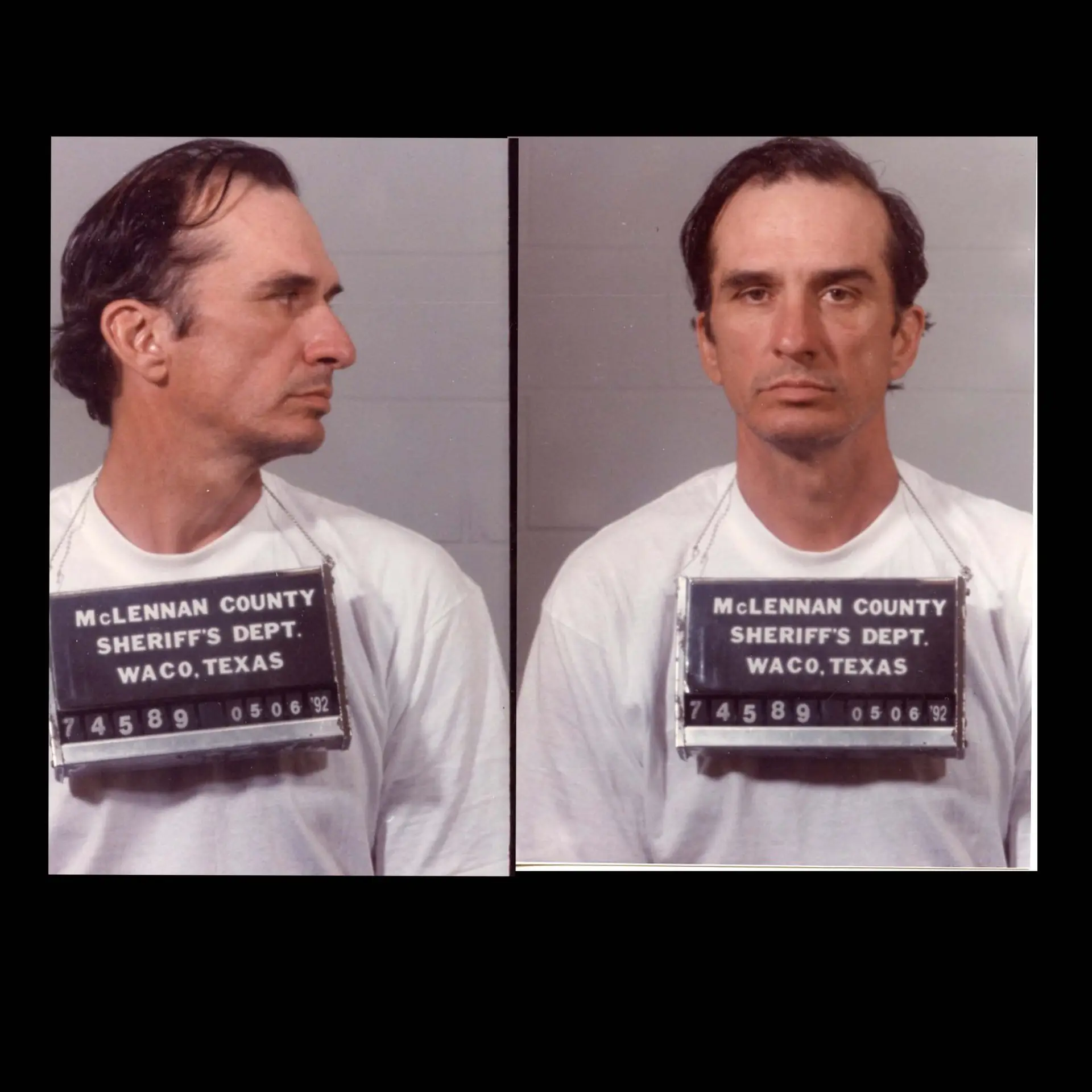
The U.S. Marshals Service task force put Kenneth McDuff behind bars after a two-month manhunt.
Prosecutors charged McDuff with the capital murder of Colleen Reed, who he kidnapped from an Austin car wash, and Melissa Northrup, who he kidnapped from a Waco convenience store.
Northrup’s body, with its wrists and ankles bound with her own shoelaces, was found by a fisherman in a flooded gravel pit three weeks after she disappeared.
Northrup’s mother blamed the Parole Board, saying it had released the devil himself.
Worse yet, my investigation uncovered that they knew it.
McDuff’s confidential prison files held their dirty little secrets.
So why? Why did the Texas parole and prison systems turn a convicted triple killer loose?
Did money grease McDuff’s release from prison? The daughter McDuff called his little gangster says yes.
Triple killer Kenneth McDuff allegedly paid a 25-thousand dollar bribe to get out of prison according to his daughter theresa allen.
In a june 1992 interview, allen told me that McDuff was her biological father from a rape.
Allen said McDuff raped her mother and left her for dead when they were in high school back in Rosebud.
The attack occurred two years before McDuff committed the broomstick murders in 1966.
You may recall from earlier episodes that McDuff’s accomplice in the murder of the three teenagers testified that McDuff proudly claimed to have raped and killed before committing the broomstick murders.
Allen told me that out of a morbid curiosity she visited McDuff in prison for two years up until his release.
McDuff called the attractive blonde his little gangster. He told fellow inmates that he wanted to pimp her out as a las vegas escort once he got out of prison.
Shortly before McDuff’s release on parole in october of 1989, allen says the family discussed paying a 25-thousand dollar bribe.
Allen did not know who paid the bribe, but thought for sure that was the only way a triple killer with McDuff’s record could have gotten out on parole.
That’s John Moriarty. The tough undercover irish cop you heard from in earlier episodes.
Moriarty was the prison investigator who helped the marshal’s hunt down McDuff.
After McDuff’s capture, moriarty investigated his parole and Parole Board chairman James Granberry for U.S. Attorney Bill Johnston and a federal grand jury in Waco.
In earlier episodes, I revealed that Granberry cast the key vote that freed McDuff and you will hear much more about that later in this episode.
Three decades have passed since my investigative reports and moriarty’s federal investigation. We sat down together to compare notes.
Serial killer Kenneth McDuff passed through the revolving door of a corrupt parole and prison system in 1989.
56-thousand excons. Many of them violent, career criminals walked out the door along with McDuff on parole.
Some like McDuff were former death row inmates who had dodged the electric chair.
Most had only served a fraction of their prison sentence.
The Texas Parole Board, appointed by governor bill clements an oil man, secretly opened the floodgates to relieve prison overcrowding.
It spared the governor from the political embarrassment of a federal shutdown and takeover.
It also provided the perfect cover for corruption.
Who’s going to notice a few human sharks pouring out of prison in a tidal wave of violent excons.
Author Gary Lavergne gives the best illustration of McDuff’s journey through this corrupt revolving door system.
Listen to this passage from his book, bad of Rosebud: the murderous life of Kenneth Allen McDuff.
Gary: OK. Robert, this took me three days to write because I wanted to make sure I got it absolutely right. And it’s in the prologue of my book and it goes, “It turns out that from 1965 to 1992, McDuff had been arrested for burglary, sent to prison, paroled, arrested for three brutal murders while on parole, sent back to prison and placed on death row, taken off death row, convicted of a felony while in prison, paroled, arrested for making terroristic threats while on parole, sent back to prison, paroled again, arrested for driving while intoxicated while on parole, put in jail, released from jail, placed on probation, arrested for public intoxication while on parole and probation, arrested for murder while on parole and probation again, and finally put back on death row.”
One sentence, it took me three days to write it because I wanted to make sure everything was absolutely right.
Riggs: And a reasonable person would say that can’t be.
Gary: That’s why it took me three days to write it.
Riggs: I, as a journalist, wanted to know why. How did that happen?
It happened behind the doors of confidential inmate files.
The Parole Board and prison system hid their dirty little secrets from the public under a legal cloak of confidentiality.
State law exempted inmate’s records from public release under the Texas open records act.
So Parole Board members, their staff, and the prison system could do and say whatever they pleased with no fear of getting caught.
They got away with it for years, until I got my hands on Kenneth McDuff’s confidential files.
Parole Board chairman James Granberry who cast the key vote to parole McDuff had claimed that the triple killer was a model inmate.
LISTEN TO THIS PRISON DISCIPLINARY REPORT THAT I FOUND IN MCDUFF’S CONFIDENTIAL FILE. IT STATES, "He chooses not to participate in any educational, vocational or character development programs due to lack of interest. He received a major misconduct report on May 20, 1987 for destruction of state property. He has displayed an unsatisfactory institutional adjustment."
McDuff’s file cataloged allegations of prison drug smuggling and violent threats.
And for the record, no one interviewed in this podcast was my source for McDuff’s files and the files of other violent excons.
Robert Riggs: When you saw the circumstances of his release, a death row was out, were you shocked?
Robert Riggs:
And the Parole Board Chairman in justifying to the public his release would say he was a model prisoner.
My investigation into McDuff’s parole started by getting the Parole Division’s staff directory.
I cross referenced names to home phone numbers listed in the telephone directory. Google search did not exist back in those days.
It was like looking for the proverbial needle in a haystack.
Night after night, I called parole officials and staff at their homes or knocked on their doors.
People usually feel a little more comfortable talking around the kitchen table.
But most of the time the Parole Division staff and board members cursed me, hung up the phone, or slammed the door in my face.
A few staff members, nervously looked around to see if anyone was watching us talk at the front door. They trembled with fear, they were afraid of getting fired just because they opened the door for me.
It was the tell tale sign of a corrupt government institution. An authoritarian regime like you expect to find in russia or iran or china today.
One and only one Parole Board member agreed to talk to me on the record.
Parole Board member Henry Keene of Dallas. Keene had cast the lone vote against McDuff’s release.
He was a fifth generation texan, navy veteran of the korean war, a retired manager at Texas instruments, and an active member of the republican party.
KEENE WHO IS NOW DECEASED TOLD ME IN AN ON CAMERA PRISON INTERVIEW BACK IN MAY OF 1992 THAT McDuff did not deserve to be released on parole after murdering three teenagers in 1966. Twenty years, Keene said was not very much punishment for such a grotesque offense.
Off camera, in a series of long telephone conversations, keene cautiously told me he suspected wrongdoing.
Moriarty’s investigation also ran into the same wall of silence.
.
Robert Riggs: Henry Keene was a Dallas Parole Board Member who was the lone member who voted against McDuff was very suspicious of how he got paroled and all. He had a reputation for integrity. He was helpful to me. But frankly, was scared to death and was helpful but he was scared of Granbury and scared of what might happen. There was a Parole Board Member who had been threatened by inmates on Granbury’s behalf. What was this power that Granbury had?
Robert Riggs: They – I mean they had fear of retribution. Did he have that kind of power?
Robert Riggs: So in my part of my reporting, I found out that in Lubbock, he actually had inmates working for him, burglarizing places, fencing stuff. All these guys he had gotten out on early parole. And along the way, a narcotics detective showed me a picture of the Parole Board Chairman and a nightclub where all the drug dealers hang out and he is sitting with them and prostitutes flashing their gang sign. What do you think when you saw that?
Kenneth McDuff’s confidential files revealed that he was no stranger to bribery.
I found a report about his attempt to bribe a parole commissioner in 1981.
MCDUFF TOLD THE OFFICIAL, "If you can help me make this parole and get me out of TDC, I can guarantee that you will find $10,000 in the glove compartment of your car. I can guarantee you the $10,000 because my dad promised me I could have that much just for that purpose. He's pretty well-off,
A brazoria county jury convicted McDuff of attempted bribery.
Seven years after the bribery conviction -- and after having
Been denied parole 14-times-- the board released McDuff on parole on october 11th, 1989.
Two days later, investigators believe that McDuff murdered sarafia parker, a young african american woman in Waco
The justice committee will come to order.
James H. Granberry: My name is James H. Granberry. I’m representing the Board of Pardons and Paroles and I am currently serving as Chairman of the Board of Pardons and Paroles.
McDuff’s family could thank Parole Board chairman James Granberry for letting the triple killer out of prison.
I introduced you to Granberry in the first episode.
Do you think this is a good parole Doctor Granberry…
Granberry defended the board’s decision.
The board had also set free convicted triple killer Kenneth McDuff.
At the time of that hearing, senator lyon and I didn’t know that James Granberry had cast the key vote to release McDuff.
I found Granberry’s paper trail inside McDuff’s confidential parole file.
Granberry intervened in McDuff’s parole one month after governor bill clements appointed him to the Parole Board in may of 1989.
Granberry claimed to me that he read McDuff’s case file more thoroughly than any case he had ever looked at. He said he discovered an old high school buddy was McDuff’s attorney and they talked about the case for two hours.
Afterwards, Granberry formally abstained from voting on McDuff’s parole citing his long-standing personal relationship with the attorney representing McDuff’s parole process.
So another Parole Board member replaced Granberry on McDuff’s parole panel.
The 3 member panel approved McDuff’s parole two to one.
But the brazoria county district attorney who prosecuted McDuff for bribery protested.
And the tarrant county district attorney who prosecuted McDuff for the broomstick murders protested.
Their protests forced another vote.
Two weeks after abstaining from voting, Granberry voted to release McDuff.
He broke a one-to-one tie.
McDuff was released 6 months later in october of 1989. The triple killer started killing again.
I confronted Granberry about his flip flop on McDuff’s vote in june of 1992.
Riggs: NOW IF YOU HAD RECUSED
Yourself once why not again? Especially
When you are casting the critical vote
For withdrawal. You could withdraw the
Parole. You stood between kenneth
Granberry McDuff and freedom?
James Granberry: No. No. Let's get
this. I didn't approve his parole. I
merely continued his parole planning.
And there's a big difference.
Riggs: BUT YOU
Could have stopped his parole?
James Granberry: I
honored. So could have ah ah •
Riggs: EVERYBODY ELSE HAD ALREADY VOTED. THEIR
Vote was set.
James Granberry: I guess I could if I had
voted the other way we could have
stopped it. But I don't have a crystal
ball. I didn't know what the fella was
going to do. In my opinion he would
make ah, he be a useful citizen.
HE SAID QUOTE, “I don't have a crystal ball. I didn't know what the fella was going to do. In my opinion he would be a useful citizen.”
McNamara: He was so brutal and so heartless and soul less that the more we got into the investigation, and we knew what he had done to those young kids in 1966, his brutality was just over the top. He thoroughly enjoyed inflicting pain and misery and terror on his victims.
McDuff was a ticking time bomb and the system knew it.
SHORTLY AFTER MCDUFF’S RELEASE FROM PRISON, HIS PAROLE OFFICER WROTE IN A CONFIDENTIAL MEMO THAT MCDUFF, "gets very upset upon being referred to as a sex offender. Seems that he could be very dangerous or explosive if the wrong button is pushed."
McDuff exploded back in Rosebud where he was the feared town bully. Larry Pamplin was the sheriff then.
Riggs: So, he comes back I believe to your county, violates parole, you remember him threatening the young man. Tell me that story.
Pamplin: Well, that took place where he had violated and called a young man negative derogatory names and his parole was revoked but he didn’t stay anytime. You know…
Riggs: And this was an African-American man and…
Pamplin: Absolutely.
Riggs: McDuff pull– use racial slurs but also pulled a knife on him.
Pamplin: That’s my understanding. That’s exactly right. McDuff was not one to confront and full grown healthy individual male. In my opinion, he was just a coward when it came to actually fighting a real man. And he for some reason, he zeroed in on kids and most of the females where small structured females and he just derive his satisfaction out of inflicting horrible torture upon them.
Police arrested McDuff for pulling a knife on four african american teenagers.
The offense violated the terms of McDuff’s parole. He was sent back to prison.
But not for long.
Granberry intervened again.
MCDUFF’S ATTORNEY, GRANBERRY’S OLD HIGH SCHOOL BUDDY, WAS WORKING ON A MOVIE DEAL CALLED "JUSTICE FOR MCDUFF".
It would feature the efforts of McDuff’s attorney to prove McDuff was wrongly convicted of the broomstick murders.
In a prison interview with author Gary Lavergne, McDuff says his attorney told him that was going to make millions.
Kenneth McDuff: When I first got out on parole in ‘89 I’m expecting them to do a story, to do a book on me about my life story and a movie. And my attorney is telling me hey you are going to have a few million dollars here pretty shortly. And so I don’t want to jump out. And at that time and start doing hard physical work and do all these things when my attorney has me convinced that I am going to receive, that I’m going to be a millionaire in the next few months. It changed my slant on life.
The money making book and movie deal stalled when McDuff went back to prison.
McDuff’s attorney asked Granberry, his old high school buddy, to reinstate McDuff’s parole.
I OBTAINED THE ATTORNEY’S CONFIDENTIAL LETTER TO GRANBERRY: "Dear Jim: The revocation resulted from an incident at the rock concert which was nothing more than bad manners on the part of both McDuff and the longhaired hippie complainant. Neither the prison system, the parole system, McDuff nor the complainant is benefited by sending McDuff back to the prison population."
Granberry claimed he never saw the letter.
Nevertheless, one month later, the Parole Division staff reinstated McDuff's parole.
McDuff resumed his killing spree.
B: Well, the whole thing was so appalling but almost unbelievable that the system would have degraded to this that a guy like you said, he is esteemed major, a Republican gubernatorial candidate, Chairman of the Texas Parole Board, which is a big deal. That’s like the largest prison system anywhere, that it would have become this corrupt little game and that these horrible people would have been released. It was almost unbelievable but we had seen the dirty side of it and with Moriarty seen it behind the curtain of it and it was totally believable to us and worthy. But we checked ourselves a lot early on because it can’t be, nobody would do that. Why would someone do that and let a serial killer out? No way! But it was all true. It really happened.
Next on true crime reporter. A hate crime killer received paroled and the Parole Board chairman received two new cars.
And so in order to keep the doors rolling and give him more control, he would make up – have friendly panels that he would make sure he wanted somebody out or possibly that it was shaken down some of these family members that he would push him out the door.
Pamplin: Anne Richards called and asked me to come and testify before a committee in Austin about the parole deal. And I guess I should have done it in a diplomatic way but I went down there and I talked to them just as open as what I’m talking to you and I told them how ridiculous it was when a person was getting credit for a year service in the penitentiary with only a few days or a few weeks credit? And to me, that’s a total disgrace. And you know, the people live under a set of laws, we’ve got a penitentiary, we’ve got a parole system and it should be fair and honest and these individuals should be incarcerated that are a danger to the society. And McDuff, like I said, there’s no telling how many people he has actually killed.
Parnell and I have sat around and talked about it several times and the best we could come up with somewhere between 22, 25 people. But stop and think how many lives that has destroyed besides the person that died. I mean the mother, the father, the sisters, the brothers, the aunts, the uncles. It’s just a crying shame that we could not have eliminated the source in Bremond, Texas because my God there’d be a lot more people living.