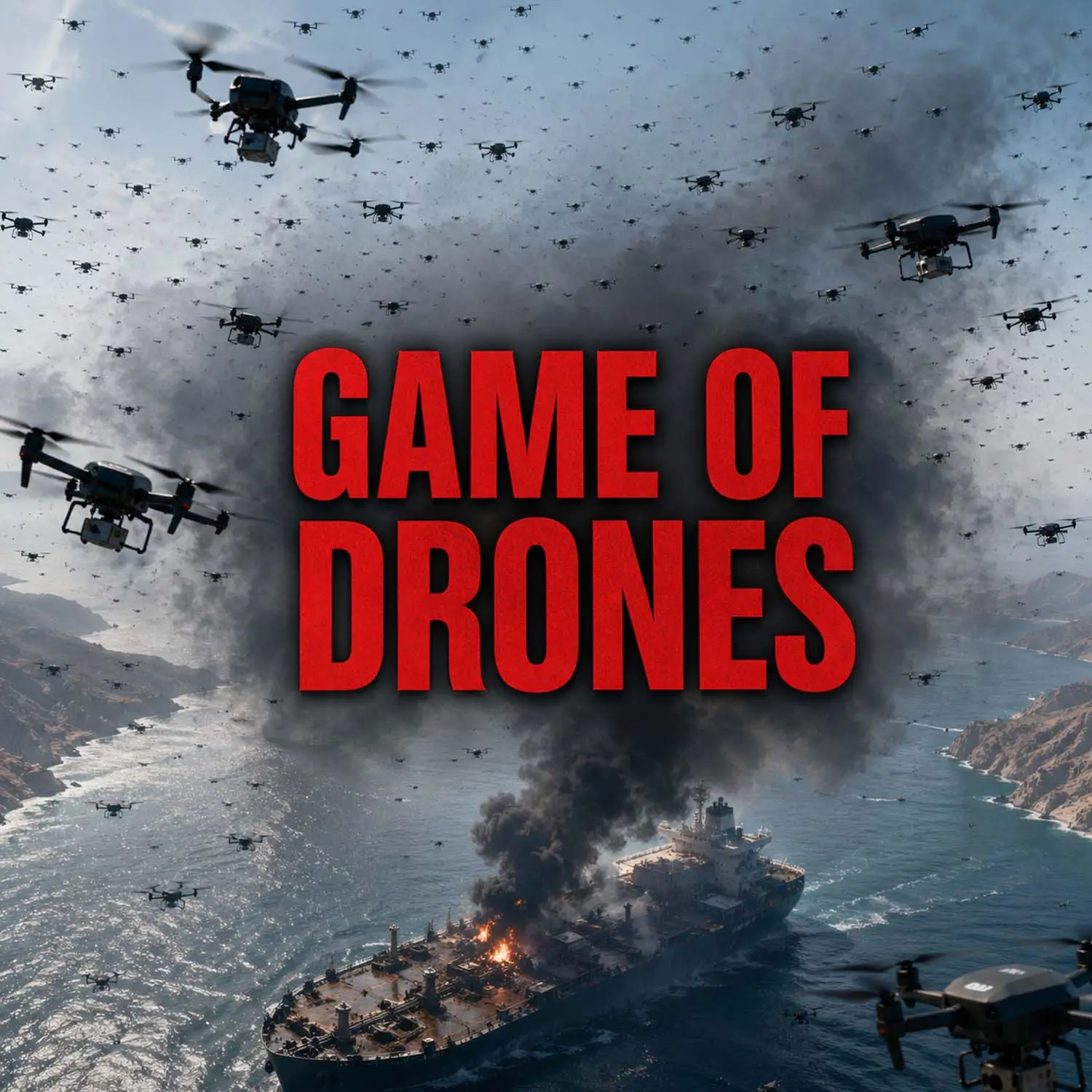
Edited production script for this episode. Assessments and predictions reflect the interview at the time of recording.
Robert Riggs
This episode is about the standoff with Iran in the Strait of Hormuz and the threat of its drone attack to the global economy.
And I know what you are thinking.
What does Iran have to do with a true crime podcast?
My answer is simple.
For more than forty years, the Iranian regime has been linked to the killing of Americans, sometimes directly, sometimes through proxies, and often with little lasting consequence.
This is not an abstract foreign policy debate for me.
During my thirty years in television news, I saw the human cost of the Iranian shadow war up close.
I covered the bombing of the Marine barracks in Beirut, Lebanon, where 241 American service members were killed in 1983.
Federal court records have described Hezbollah as the perpetrator and Iran as a source of political, financial, and operational support tied to the attack.
I was an embedded reporter during the invasion of Iraq, where American troops faced roadside bombs and armor-piercing explosives supplied or supported by Iranian networks.
In more than a dozen attacks, Iran has killed Americans without putting Iranian soldiers in the fight.
It has used terror groups, militias, mines, missiles, and now drones.
When a regime uses proxies to kill Americans and destabilize the world, that is not merely geopolitics. It is state-sponsored crime.
The world is focused on the Strait of Hormuz, a narrow strip of water off Iran’s coast where the global oil supply and American military power now face one of the most dangerous choke points on earth.
Robert Riggs
To help understand what this conflict means now, I turned to retired Army Colonel John Antal, a 30-year veteran soldier, historian, leadership expert, and best-selling author.
Antal joins me to help us see the battlefield more clearly.
John Antal
Now, for 47 plus years, we have been opposed by the Islamic Revolutionary Guards of the Islamic Republic of Iran. Now our war is not against the Iranian people, but against the Islamic Revolutionary Guard Corps and the Islamic Republic, they have sworn since they took power back in 1979 that America is their enemy. And they have chanted, of course, as you're well aware, of death to Israel and death to America since then.
And they have killed thousands of Americans in different acts of violence and terrorism since then, and we have basically put up with them and kept them kind of tamped down a bit, but never really exerted our full power against them. I can remember in 1980 talking to people about how we were going to go into Iran and make sure that Iran wasn't going to block the Straits of Hormuz and stop the free flow of oil, which was much more important then to the United States of America than it is today, but is still important to the world.
Many countries get most of their energy through countries that supply oil that have ships that transit the Arabian Sea and come through the Strait of Hormuz. So the Strait of Hormuz is a very narrow waterway, as you know, 21 miles basically in width. And within that space, you can do a tremendous amount with drones and missiles to be able to stop shipping and impede the commerce that goes through there.
So when you look at these choke points, the United States must do several things. One, it must become the oil producer and energy producer for the world, and in all sorts of energies, but particularly oil and LNG. And then second, it must do everything it can to control those choke points and not allow another power to control those choke points that is not friendly to us.
So, for instance, the Straits of Gibraltar is a choke point. It's the tip between Spain and Africa. We don't have to worry about that one because it is, it is controlled by the British. And the British, of course, understood that the area there was critical to their ability to get into the Mediterranean Sea. And for the United Kingdom, that's important.
And for commerce, that's important. So that one is a benign choke point. But if, for some reason, a terrorist group was to take over Gibraltar, which I think would be pretty hard, we would be very involved trying to get that going, because we're not going to allow these choke points to come under the hands of our enemies. Yeah.
Robert Riggs
So now we basically have got a standoff in the Persian Gulf and the Strait of Hormuz, right? Is that a correct assessment?
John Antal
I think it's important for everyone to understand what's happened at the Strait of Hormuz. So for instance, the Iranians believe that if they cut off commerce through the Strait of Hormuz and are able to charge a fee, a tariff like the Barbary pirates did in the Mediterranean in the 1790s and early 1800s if they're able to do that, they can earn money by basically using the Strait as a toll gate.
Now we claim, and the world claims, that this is open water, and no one should be able to charge a toll for going through that any more than any other of the choke points. And those choke points become really important, because if everyone starts charging for those, the price of everything starts to go up. And then pretty soon you get to the point where it's ridiculous, because they can change the prices they wish.
So freedom of navigation of the Seas is vital. The Strait of Hormuz right now, the Iranians say they're going to close it. Well, they can't really close the Strait of Hormuz, except for with fear. They have laid mines in the channel area. We don't know how many mines they've laid. And what's very interesting is that those mines, many of them, are made in China, so the Chinese have supplied them with mines, and supplied them with some of the most sophisticated mines.
I think the EM 52 is their most powerful one, which basically sits on the bottom of the channel, in this shallow water of the channel between the Strait of Hormuz and it waits for a ship to come up. It has a sensor on it. When it senses a ship, it can either hit the first one, or it can have a program that makes it hit the third or the fourth, and then it will, it will go to a certain depth, explode, and then when that explosion happens with the water pressure.
It just takes the ship apart. And these big oil ships would be broken into 1,000 pieces with oil everywhere, and this is what China has supplied Iran. So China is not our friend. And so what we have to do is we have to clear the Strait of these mines, which is not an insignificant task. One of the problems we have with the undersea mines that I just explained are that they're very quiet and they're difficult to find.
They're not impossible to find. And we've captured some, and we know how to check them out to find out what their weaknesses are. And so that's what we'll be doing. We'll be taking those mines down. But in the meantime, you can also shoot drones and ballistic missiles at ships, little harder to hit, but nonetheless, the Iranians are still capable of doing that, even though they're degraded tremendously in their amount of drones, the Shaheed 136, drone in particular, and their ballistic missiles, they're getting their firing data from China and Chinese satellites.
So people need to understand that China is an aggressor in this war against us, and we need to think appropriately about that, because the Chinese want the United States to be tied up in a war with Iran for as long as possible, because that gives them more options with Taiwan. And if the dictator of China Z decides that he wants to attack Taiwan, it only takes one guy to decide.
Now, whether they'll win or not depends on a lot of things. They would want surprise. They would want America tied down. They would want America's magazine pretty much exhausted, you know, in other words, shoot all our missiles at Iran, not have enough to help defend Taiwan. They would want the Taiwanese fractured and confused, which they're doing right now.
They have the opposition leader of the kumin Tong in Taiwan in China, wooing her to surrender the country. And so there's lots going on right now in the world that people need to understand. And when we look at the Strait of Hormuz, and we look at Iran, you must always realize that it's not about Iran.
John Antal
It's about China. Our focus as a strategy should always be on China, our primary adversary. And if you say, Well, if you say that China is our primary adversary, they're going to be an enemy. Trust me, China is at war with us. They know this. They've been at war with us for a very long time, a very quiet, gray zone war. They've been stealing our stuff.
They've been ripping us off. They've been finding ways to shore up their capabilities because their idea is that they want to dislodge us as the primary power in the world. And so the way to do that, number one for them, is to get us involved in wars other places. They were pretty happy with what we did for 20 years, you know, in Afghanistan and all, because we were totally consumed there.
And then they thought we would kind of go away, because after we left Afghanistan so ignominiously, you know, retreated from Kabul and ran and lost all those people and left all that gear, they thought, woo hoo. You know, we're on, we're on the way to win. And of course, Russia felt the same way. So they attacked Ukraine, because they thought they could get away with it.
The Ukrainians turned out to be tougher than the Russians ever thought. And God bless Ukraine. You know, Slava, Ukraine, her William, Slava, these guys are fighting like no one ever has fought against tremendous odds, so there's a lot to be said for the Ukrainians, but that's tying Russia down in a war. Russia can't even beat Ukraine, so their chances of taking over NATO are greatly limited.
And so what we have to do is we have to look at the other places in the world, like the Strait of Hormuz, get this war over with quickly so that we can end the conflict, and we have to be able to make sure that Iran doesn't have the ability to do anything. And that's what's going to happen in the next week. Unless they agree to our demands.
We're going to turn off their power. We're going to turn off their ability to maneuver. They're going to be finished. And we're going to then replenish our magazine, and we're going to focus on the Pacific.
Robert Riggs
Well, drone warfare has come into the public consciousness, first with Ukraine and Russia, but especially now that we're involved with Iran and you've talked about their drones. Give us a little peek at the history of drone warfare and where it's going.
John Antal
Today you can now have air power, you can have air superiority. You can have air supremacy, which is our highest form of air capability, where the enemy has no ability to meet you with air but even though you have air supremacy, they can still have drone superiority, and that's why drones are so different. Drones operate in the area above the ground and below, basically high-speed aircraft, and that area is called the land-air littoral.
Over the sea is called the sea-air-subsurface littoral. So the LAL or the SASL, that LAL area, that area is now the new high ground of war. Getting our military to understand this is taking some time. We have to think differently. Some people still think in the terms of two dimensions, where, if you're a soldier or a tanker, you're just looking straight ahead, or you're looking to the flanks, but you're not looking up.
But now, majority of the casualties in the Ukraine war, and the majority of the casualties actually in the Gaza fighting, have happened by top attack munitions, artillery, top attack munitions, missiles, but a lot of drones.
John Antal
Then you have FPV drones, first person view drones. These are the Kamikaze drones you've heard about. These have explosives on them with a detonation capability where they fly into a target and explode. And small drones are able to destroy expensive pieces of equipment, like large missile launchers, s3 hundreds, Patriot missile batteries, or tanks, even tanks, which are very heavily armored, can be destroyed by these because the pilots are able to fly them as if they were the bird, as if they were the FPV.
They fly it right into the right spot. That's precision warfare, democratized in a way that's never been done before, and that's why it's so different in the battle space. Then you have bomber drones that fly over and drop grenades and mines and other things on positions and vehicles and everything else. And then you have loitering munitions, which are higher end drones, more expensive, have more developed packages of control that loiter over a position, sometimes, for, you know, six to 12 hours, looking for a target.
And then, once they see the target, according to their targeting parameters, they attack. And that can be done with less human control. So you can have what is called human on the loop where the human is basically deciding what's going to happen, like an FPV drone, where the human pilot flies it. You can have human out of the loop, where the human just turns it on and it hunts on its own.
John Antal
And so the dominant condition of war today is he who controls the land-air littoral, or the sea-air-subsurface littoral, with these robotic systems, wins the tactical fight. And if you win the tactical fight, you can have all the airplanes and missiles and satellites in the air you want. But it doesn't matter if you can't move, because if the enemy owns the land-air littoral and has it full of drones that these high speed aircraft have trouble shooting down, then they will stop you from being able to maneuver, and you will be out trying to survive.
So the decisive high ground of modern warfare now lies in the contested airspace immediately above the maneuver forces.
Robert Riggs
And then are drones the ace in the hole for Iran and the Persian Gulf Strait of Hormuz?
John Antal
Well, drones are certainly a tool in the toolbox. We've taken away most of their tools and most of the toolbox. So will they have some drones always, you know, will those drones be decisive? No, they could have been earlier, had they used them differently and been prepared and not been taken out by us so effectively. The point of drone warfare is that the difference between what 20th century warfare forces provided and what these now 21st Century warfare forces provide with drones and robotic systems, not just drones, but all robotic systems, and also precision guided weaponry, linked together in that what they do is they provide a persistence.
You see aircraft fly over an area and then fly away. They come in and they bomb and they wreak havoc, and then they fly away. Missiles come in and hit, artillery comes in and hits, but it stops. Drones persist. Drones can persist as long as you can put drones up in the area. So when you're a soldier and you're on the ground and you have the persistent fear of being hit by a drone every day, the human factor there is absolutely demoralizing.
It changes everything. And when they start hitting with precision, your logistics, your command posts, anything driving down the road, your military forces, like your tanks, your artillery, your soldiers in trenches. I mean, I've watched thousands of videos in my research of Ukrainians and Russians hunting each other with robotic systems, with drones, and also the Israelis.
Now, the best in the world right now are the Ukrainians and the Israelis. They have integrated drones into their forces in a way that no other armies have, no other militaries have, and they're able to fight, in many cases, in real time. This is huge. To be able to fight in real time is something that armies have never really been able to do.
Now you say, wait a minute, what are you talking about? We always fight in real time. I got a sword. You got a sword? It's real time. Well, that's one on one combat. I got it. But imagine this. They're able to now coordinate their combined arms, effort, artillery, drones, infantry, tanks, and they're able to see the enemy from on high with an ISR intelligence surveillance reconnaissance drone and see everything below it in such a way they have the sort of bird's-eye view that they know exactly where to maneuver forces and tell people what to do, and that feed comes straight down to the tactical edge.
So it comes straight down to the tactical leader. So now, as a platoon leader, you're not guessing. You know where they are. As a Platoon Leader, you're not just guessing. You got drones attacking them before you even get a chance to shoot your rifle. So 80 to 90% of the casualties among the Russians in the last few months have all been to drones, robotic systems.
So Ukraine is replacing soldiers with drones. And when you use those drones in combination with maneuver forces, you can fight in real time. And this is the difference between a 20th century army and a 21st Century army.
Robert Riggs
Well, you know, there's a movie, Fallen Angel, I don't know if you've seen it, where Morgan Freeman is playing the president and is hit by a drone swarm, right? How real is that?
John Antal
Well, that was Hollywood, but that is very, very likely, very possible. That kind of drone swarm right now we have, and what we're moving toward is the ability to do just that, to have one controller with dozens, hundreds, thousands of drones. So the Chinese just recently did it with 7,500 drones. So imagine 7,500 drones that are all first person view drones, and they're all kamikaze drones, and they're all armed with explosives, like you saw in that movie.
But now you've got 7,500 in a cloud, and they also may be connected to drones on the ground that are rolling or slithering or moving on the ground, and precision weaponry that is flying through the air. This is now what you call a kill web, where you actually have AI-enabled kill chain. So we're used to a Kill Chain, which says, basically, I see a target, let's get some fires on it.
Here's where it is, go ahead and fire up. You missed. Move to the left. Fire again. That's kind of a kill chain. That's how you fire mortars and artillery and other things. Now you can have a more precise kill chain and a rapid kill chain, and that's very good. We're down to now minutes in our kill chains, in some cases, rather than, you know, 25 minutes or 30 minutes, or whatever, to get some of these things done.
But a kill web is a little different. Imagine like an Excel spreadsheet where you had all of the targets that were sensed by satellites, balloons, aircraft, ISR drones, and you could see all those targets, and you knew their precise location. And then another column with all of the shooters that can hit those targets. And those shooters are linked to the target by range capability and time.
So for instance, you have a shooter that can reach the target, a weapon on that shooter is firing, that can destroy the target, and they can hit the target first. So if you have those two columns and now you have artificial intelligence linking them automatically, so there's no confusion as to who shoots what when, and then you just had the execution fire.
You can fire all of your systems against all of their targets at the same second. That's a kill web. So if you imagine a cloud of 7,500 or 10,000 of these drones, loitering munitions, first person view drones, bomber drones, ISR drones, flying over a location, they would kill everything underneath it according to their targeting parameters and create a breakthrough that you could then maneuver through.
And this is where warfare is heading. We're using non nuclear application of what I call a weapon of mass precision.
Robert Riggs
You've written about an Internet of weapons, which brings to mind, just recently, the AI company Anthropic, got in a big dust up with the Pentagon, apparently, because it did not want its language models used for autonomous weapons. But what you're describing here seems so massive and so fast that you are going to have to have autonomous weapons.
Am I right or wrong here?
John Antal
We already have autonomous weapons, their argument is almost archaic. Now they can decide to do whatever they want as a private company, you know, God bless them. But weaponry is now AI enabled. What we're doing in Iran has an AI-enabled kill chain. We're able to take all the data from satellites all the way down through all the sensors that go through the entire layer, from the stratosphere all the way down, we're able to take that data and we're able to link it very rapidly to shooters, and then humans decide to do all this.
Now we haven't moved to the kill web yet, but we're closer to a kill web than ever before. And if any nation has a kill web, it's the Israelis. They're closer to a kill web than anyone, because they have their intelligence information so locked and loaded with their shooters, and they're in such a small region. I mean, they have the advantage of, if you want to call it that, of being surrounded by enemies who are nearby.
So they're able to use all their systems, you know, to destroy the known targets. And what we have to do is we have to think through how we're going to fight this and make sure that we're able to fight it more effectively than the enemy.
Robert Riggs
You know, back in the early 2000s I was reporting on issues at the Pentagon, and I heard a story from a good source, that Secretary of Defense, Donald Rumsfeld, called all the joint chiefs to his office, I don't know if you were there then, and expressed concern that he wanted us to be the lead in artificial intelligence, but he was concerned about autonomous weapons.
Would they decide not to follow what we wanted them to do? Would they turn on us? Would an adversary get into the network? And he just was pressing, we've got to have humans in the kill chain. But do you think we're coming to a day that'll be impossible to have a human in the kill chain?
John Antal
Well, there are many weapons right now that work autonomously because there's not enough time. War is going beyond the speed of human cognition. Even the Patriot missile batteries, which you're well aware of, they have automatic mode, because once they get incoming missiles, they don't have time for humans to sit back and say, “Well, should I fire or not?”
A phalanx close defense system on a ship, which is a Gatling gun-like capability, is automatic. Once it's turned on, it looks for targets and then shoots them down.
John Antal
Now we have the ability with these robotic systems to direct them and to get them to go in the right way, and we just need to change our thinking as to how we go about doing it, because we are capable of commanding them, not controlling them. Their control is going to be released to automation. Their command is going to be under us, so we should be able to turn them on and turn them off, but once they get into the fight, we can't control them because it happens too fast.
That would be kind of like saying you're going to control someone in a pistol fight. You know, autonomously, you can't react faster than the person, and the same thing happens in a situation with the drones. And if you hesitate, you lose them. So you've got to create a weapon that can move brilliantly fast.
John Antal
We see drones now being used on a vast scale in Ukraine and also by the Israelis. So I mean, in the Israelis case, people don't realize, if you listen and watch their combat footage, the hum of robotic systems is constant. You just listen and you'll see the sky is full of drones and also robotic systems on the ground. So we're going to go into a system very soon right now, where I call the theory, the concept Bots Before Boots.
You always send a robot first. I mean, when you think about, for instance, our science fiction stories, it's kind of silly, you know, Star Trek, which was the original Star Trek, which was, you know, iconic. They would beam down to a planet. What are they crazy? What are they insane? You would never beam down to a planet. You'd send a robot first, right?
I mean, you'd send a robot. And if they don't have robots, which they did, if you don't have robots, then you kind of, you know, you're not advanced. So we need to send robots first. We need to have the robots embedded in our formations, but they need to be commanded by humans, not necessarily controlled.
Robert Riggs
What do you see on the horizon? Has the Pentagon changed its mindset? Are they thinking about this? Or might we have a 9/11…
John Antal
Since January 2021, I've given nearly 800 presentations, and almost every one of them at no charge.
John Antal
So I've been trying to get people to think about this. And many people are thinking and moving in the right direction. Institutional change is hard.
John Antal
We have to think faster. We can't take a generation to fix things. We can't change things in 20 years. We have to change things in days or weeks or at least months, and we've got to think differently.
John Antal
We're five or 10 years behind, and we're trying to catch up rapidly. And there's a lot of smart people working hard on it. I don't want to give you the idea that they're not. They certainly are. But our industrial base isn't set up to make the drones we need. Our mindset isn't set to fight the way we need to fight, and we need to change both the mindset and the industrial base to make all that happen.