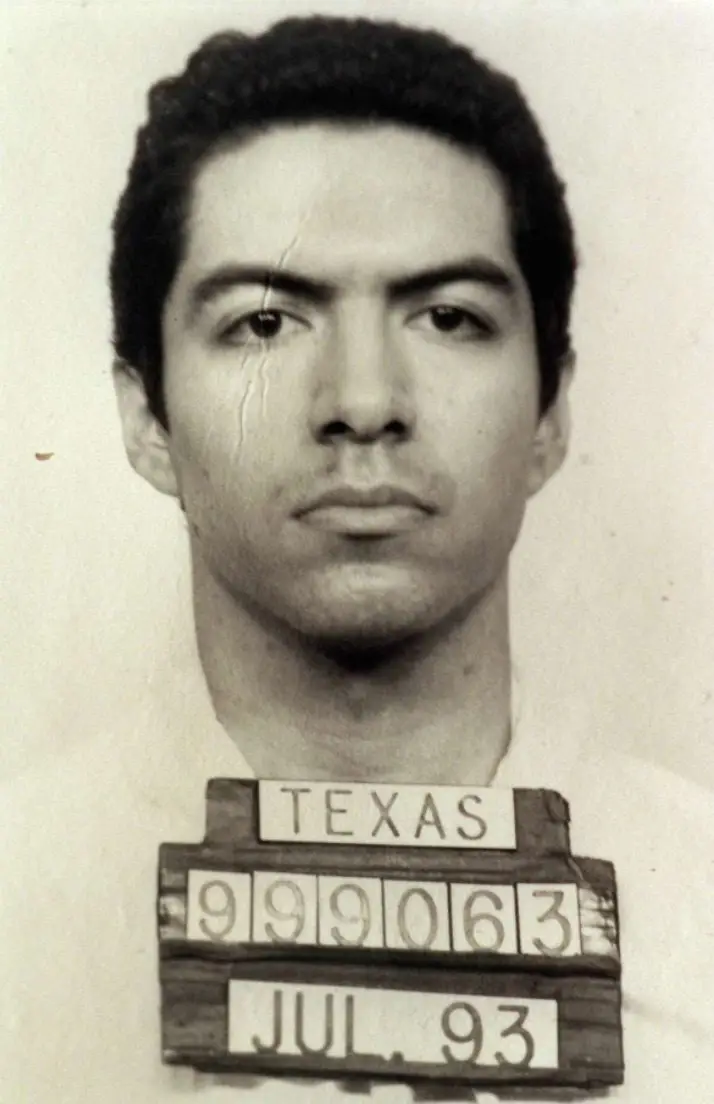
29-year-old Martin Gurule, a cold-blooded killer from Corpus Christi in South Texas, made it over the prison’s fence on a foggy Thanksgiving night under a hail of rifle fire from guard towers.
The last time condemned killers had broken out of prison in Texas was in 1934 when two members of the notorious Bonnie and Clyde gang made a daring escape.
Prison guards were killed by machine gunfire.
That set off a manhunt led by legendary Texas Ranger Frank Hammer that ended in the deadly ambush of Bonnie and Clyde.
Sixty-four years later, hundreds of officers scoured thousands of acres around the Ellis Prison Unit near Huntsville, Texas, looking for Martin Gurule.
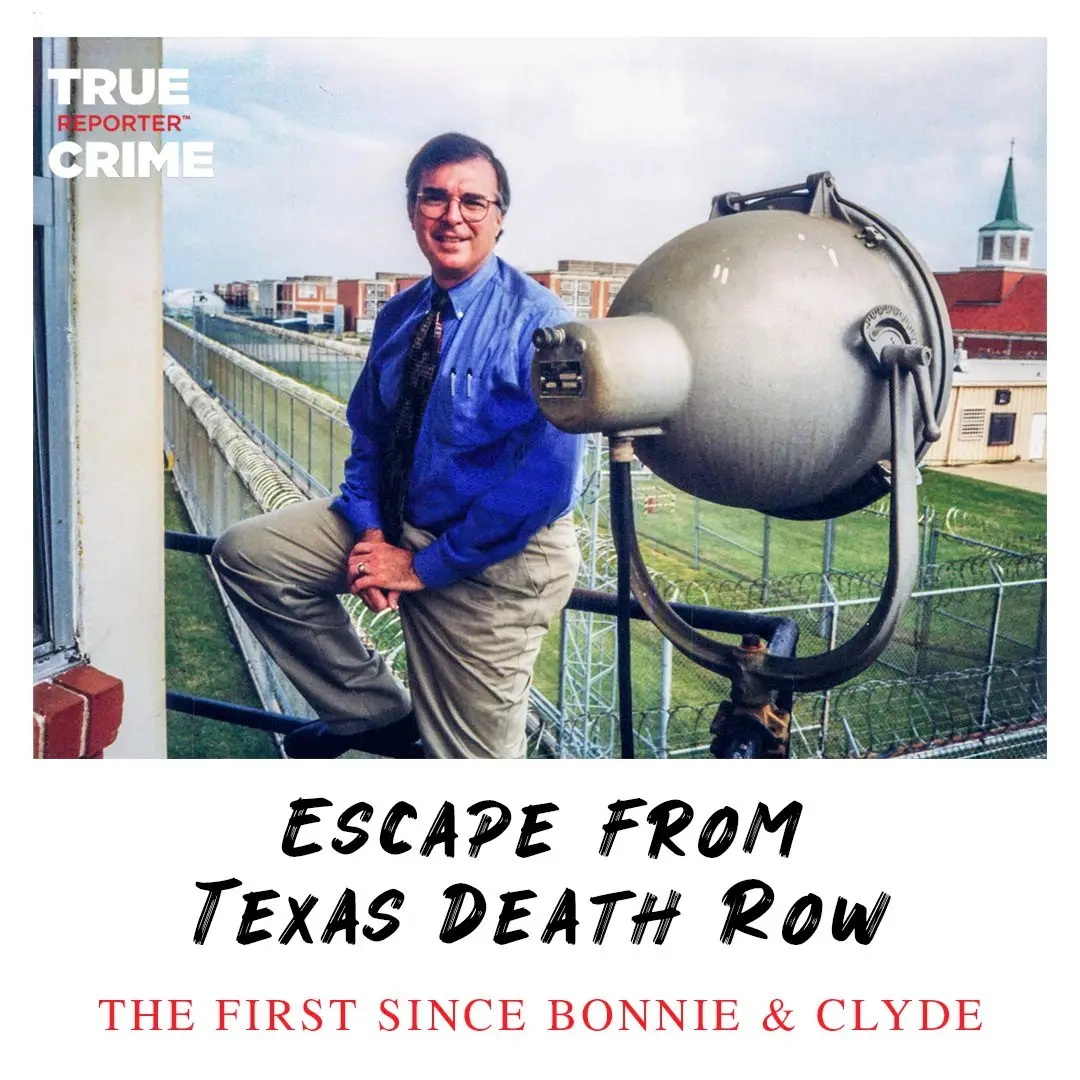
Robert Riggs was there until the very end.
In this episode of the True Crime Reporter® Podcast, Riggs dusts off an old reporter’s notebook about this sensational escape from Texas Death Row.
The death penalty in Texas dates back to 1819 when hanging by the neck until dead was the method of execution by individual counties until 1923.
It was then that state lawmakers authorized the use of the electric chair which came to be known as “old sparky.”
The electrocutions were ordered to be carried out in Huntsville, Texas at the Walls Unit.
Opened in 1849, it is the oldest prison in Texas. Massive red brick walls surround the 55-acre prison in downtown Huntsville. Guards armed with rifles stand watch in sentry towers at each corner.
It is everything you would imagine prison to look like. Ominous. Medieval. A bit like the Tower of London where Henry the 8th chopped off his wives' heads.
The Huntsville Unit still houses the Death Chamber where executions for Capital Murder are administered by lethal injection.
During a forty-year period, a total of 361 inmates were electrocuted here. A prison chaplain who witnessed fourteen electrocutions observed that once the condemned men were strapped down to the electric chair a frightened, scared look would come over their faces.
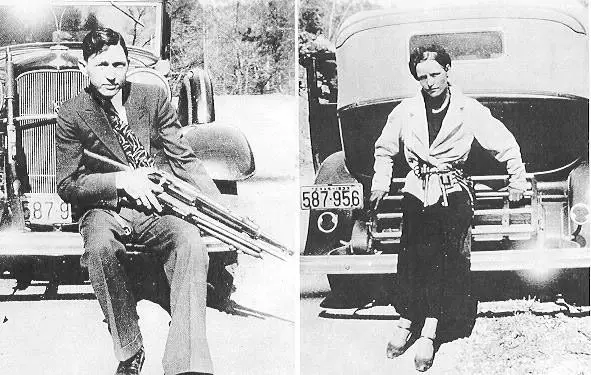
One of the most notorious was Raymond Hamilton, a member of the “Bonnie and Clyde” gang during the 1930s.
In a blaze of machine-gun, fire Clyde Barrow a childhood friend and Bonnie Parker broke Hamilton and four other convicts out of the Eastham prison farm in 1934.
Two prison guards were killed during the escape.
The prison break prompted the system’s chief to issue a shoot-to-kill order against Bonnie and Clyde.
The legendary ex-Texas Ranger Captain, Frank Hamer (Hay-mer) who had been in dozens of gunfights and killed at least 53 people was hired to hunt down the gangsters.
By the way, the portrayal of Hamer in the classic 1967 hit film “Bonnie and Clyde” as a bumbling idiot who gets captured by the pair is not accurate.
Hamer’s widow sued Warner Brothers for defamation and the studio settled out of court.
Hamer and Louisana officers shot Bonnie and Clyde to death in an ambush on May 23rd of 1934.
A month later, Clyde’s cousin Raymond Hamilton, escaped again - along with two other prisoners - from the Walls Unit in downtown Huntsville when another prisoner smuggled in a gun. But he was soon recaptured.
Hamilton died a year later in the Texas electric chair.
The last Texas execution using the electric chair occurred in 1964.
Old Sparky was later retired to the Texas Prison Musuem in Huntsville where it draws curious crowds.
When the U.S. Supreme Court ruled that the death penalty was cruel and unusual punishment in 1972, the sentences of more than fifty inmates on Texas death row were commuted to life.
That meant that they would become eligible for parole someday, but no one imagined that such brutal killers would ever be set free.
If you’ve listened to our earlier series about serial killer Kenneth McDuff, known as the “Broomstick Killer,” that’s exactly what happened with deadly consequences.
My latest episode about McDuff, titled CBS News Anchor Bob Schieffer Shocked By the Broomstick Killer’s Brutality was published on March 21st of 2022.
To learn more about McDuff, please go back to the beginning of my True Crime Reporter® podcast or watch our five-part television series titled Freed To Kill.
I have placed links in our show notes.
The State of Texas adopted lethal injection in 1977 and conducted its first execution using it in 1982.
I have been inside the Texas death house and my McDuff series contains an episode about the serial killer's execution. It gives a very detailed description of how his lethal injection was conducted.
Between 1965 and 1999, McDuff and other killers convicted of Capital Murder were kept on Texas Death Row at the maximum-security Ellis Prison Unit.
Built-in 1963, located ten miles north of Huntsville, the eleven thousand acre prison farm also holds more than two thousand other inmates.
I first reported from the Ellis Unit in November of 1993 in a series of stories about Texas’ prison industries.
The Ellis Prison Unit was surrounded by two, twelve-foot-tall fences, spaced eight feet apart, topped with large coils of razor-sharp concertina wire.
Inmates raised cows, egg-laying hens, crops, security horses, bloodhounds, and pigs.
They also grew cotton, picked the cotton, milled the cotton, spun the cotton, and wove the cotton into enough prison inmate uniforms to clothe a small town of 45-thousand people.
Seven years before my visit, the prison system opened the Death Row garment factory.
I reported how 113 condemned killers made 300 pairs of pants for guards' uniforms every day.
It was the most productive of Texas’ 34-prison factories.
When I went inside, it was unsettling to discover that some of Texas' most notorious killers were armed with scissors and razor blades to cut cloth with.
Ricky Lee Green of Fort Worth caught my eye. Three years earlier, I had covered Green’s capital murder trial.
Green stabbed a topless dancer 17 times and mutilated her breasts.
During two separate murders of men, Green stabbed and castrated them.
When our eyes met, Ricky Lee Green was slicing through material with a razor blade in his hand.
A fellow death row inmate tried to reassure me that there was a daily count of the razor blades and scissors. “We’ve never lost a pair,” he proclaimed. “We’re not monsters out here. I would rather be around these people right here,” he said, motioning to the death row inmates working around him, “than be around most of the people out in the free world these days and times.”
I wasn’t convinced. Most of the violent hardened inmates that I met were always scheming.
Shortly after my news report Martin Gurule arrived on Death Row.
Five years later, on Thanksgiving of 1998 Gurule made the first successful escape from Texas’ death row since the 1934 escape staged by the notorious Bonnie and Clyde gang that I told you about earlier.
The escape made international news. I arrived with our satellite truck in tow to file update after update about the sensational escape.
Gurule, was a 23-year old convicted bank robber, when he was sentenced to death in 1993 for murdering the owner of the popular U&I Greek diner in Corpus Christi, Texas during an armed robbery.
His girlfriend 23-year old Malisa Smith a divorcee and high school dropout had briefly worked at the restaurant before being fired.
350-dollars had turned up missing from her cash register drawer.
While Smith waited outside the diner in her car, Gurule cut the phone lines, forced the 46-year old owner and a 31-year old cook at gunpoint into a backroom, stole 9-thousand dollars from the safe, then shot both men execution-style with a bullet to the back of their heads.
Less than a week later, police found the murder weapon, a 10mm Colt Delta Elite handgun, in a room at the home where Gurule lived with his 72-year old grandmother.
Ballistic tests showed that a bullet and two shell casings found at the restaurant had been fired from the gun, as had a bullet recovered from the slain cook’s body.
At his capital murder trial, Gurule insisted on testifying on his own behalf.
Throughout the trial, he acted happy and casual.
He spun a wild story that the killings were accidental but the jury considered it flim-flam.
Afterward, his defense attorney conceded that both the physical and circumstantial evidence against Gurule was overwhelming,”
A few months later his 23-year old girlfriend Malisa Smith stood trial for murder.
When police searched her apartment, they found bundles of cash hidden in a sombrero hanging on the wall plus seven hundred dollars in recently purchased merchandise with the price tags still attached.
The trial was briefly interrupted when Smith’s four year old daughter began calling to her mother from the courtroom gallery.
Prosecutors complained that it was a calculated emotional plea to the jury.
Smith was convicted of murder and sentenced to 25 years in prison for her part in the crime.
When Gurule arrived on Death Row at the Ellis Unit he was locked inside his cell for 23 hours each day.
He was allowed out only to shower and exercise and was always escorted in handcuffs and leg shackles by guards.
A few years later Gurule was granted “work privilege” for good behavior and was allowed to work in the air-conditioned death row garment factory.
Gurule could freely walk with no supervision around cellblock H-17, coming and going between his cell, the dayroom where inmates watched tv, and the fenced-in recreation yard as he pleased.
He learned from a convicted murderer in a neighboring cell how he had used a hacksaw blade to cut through a prison recreation yard chain-link fence to try to escape. But he was caught.
In 1997, an appeals court denied Gurule’s motion for a new trial. He wrote to a fellow inmate, “Nobody gets strapped down and lives to tell. As far as one gets is the death house. I’ve not yet received a date for execution . . . but I have been affirmed and I can tell you of one emotion that comes strongly to mind. Desperation.”
Shortly after Thanksgiving dinner on the evening of November 26, 1998, the 29-year-old Gurule and six other condemned killers staged their escape at the Ellis I Unit that held 454 death row inmates.
Note that Thanksgiving seems to be the chosen date for prison escapes in Texas.
In an earlier episode, I explained how Dennis Wayne Hope turned off the power to a maximum-security prison to make his getaway.
It’s one of my favorites, titled Don’t Fence Me In, published on October 14th of 2001.
After this break for our sponsors, I will continue the story about Gurule’s sensational escape from Texas Death Row.
(commercial break)
In an elaborate plan, Martin Gurule and six other condemned killers on Texas Death Row cellblock H-17 stuffed their beds with makeshift dummies after Thanksgiving Dinner in 1998. It fooled guards for hours. A count was supposed to take place every 30 minutes.
The prison was running on skeleton staff because of the holiday.
At about 8:15 PM, Gurule and his fellow escapees strolled into the recreation yard about half the size of a basketball court, which was covered on top and on all sides by chain-link fencing.
The yard was located next to their three-story cell block – one of three that housed death row convicts.
They had used felt-tip markers to dye their white prison-issue long underwear black, almost like ninja warriors.
They used a hacksaw blade to cut a hole into a corner at the top of the chain-link enclosure.
They squeezed through the hole and leaped onto the flat prison roof, partially obscured by a low retaining wall running along its perimeter.
During the night, they made their way a quarter mile across the rooftops of the prison units to a one-story prison chapel.
Fog rolled in, reducing the visibility for guards watching from six towers.
At a quarter past midnight, they slid down the chapel’s sloped roof to the ground.
Gurule, followed by the six other death row inmates, sprinted 75 yards to the perimeter fences midway between two guard towers.
The inmates had wrapped their torsos and legs with cardboard and bundles of magazines to protect them from getting cut or tangled up in the razor wire.
18 rifle shots rang out. Six of the inmates dropped to the ground. They gave up.
The wiry, five-foot-7, 130-pound Gurule made it to the top of the outside fence. He dropped to the ground outside the prison.
Guards found blood there and thought they might have hit him.
Gurule disappeared into a heavy morning fog and headed toward a swamp.
I arrived on the scene with my camera crew and a satellite truck for live broadcasts as more than 500 law enforcement officers launched a massive manhunt around the prison.
Two helicopters circled the prison for miles.
Officers mounted roadblocks and conducted door-to-door searches.
The prison locked down Death Row, meaning that all 454 condemned killers were confined to their cells.
Embarrassed prison officials were at a loss to explain how so many high-risk convicted killers were missing undetected for so long.
Here’s a rundown of the capital murder convictions of Gurule’s six accomplices.
Kidnap and murder of a Houston woman.
Kidnap and murder of an elementary school teacher. Her body was found wrapped in a blanket off the side of a rural road. Her hands and ankles were bound with a telephone cord, and she had been shot in the head, neck, and shoulder with a rifle.
Kidnap and murder of a man who was singled out because he was gay and shot nine times.
Robbery and shotgun murder of a clerk at a beverage warehouse.
Hired as a hitman by a former police officer to kill the officer’s wife.
Robbery and murder of a Houston jewelry store owner.
Like we say, everything is bigger in Texas. Especially violent crimes.
I learned from sources at the time that some of the inmates planned to flee to sunny Florida, robbing banks along the way.
And I discovered that one of the six murderers who had attempted to flee had tried to escape from death row a few years earlier using, yes, you guessed right, a hacksaw blade.
A death row guard interviewed me in silhouette, his voice altered to protect his identity. He revealed that every recreation yard had dozens of patches in the fence where inmates had tried to saw their way to freedom.
He said death row inmates routinely obtained the hacksaws taken from prison workshops by inmates from the general population. They traded drugs, cigarettes, and other contraband as well as commissary items for the hacksaw blades.
Plus, he revealed that death row inmates who were given work privileges had way too much freedom to move about unescorted by guards.
In response to my reports, Allan Polunsky, the chairman of the Texas Board of Criminal Justice, suspended the death row work program.
The escape shook up the prosecutors who had sent Gurule to death row. They worried he was headed back to exact revenge, and they beefed up their personal security.
The lead prosecutor described Gurule as, “a sneaky, wily man" who had tried to break out of a holding cell during his murder trial back in 1993.
The Nueces County District Attorney told reporters he was not surprised that Gurule was the first man to escape from death row since 1934. "I always thought that there was no way they could escape from death row. But if I were to put money on it, I'd think Gurule would escape. He's very deceptive. If anyone could talk his way out of something, it's him.’
Gurule’s incarcerated girlfriend told reporters that he was deathly afraid of needles and did not want to die by lethal injection.
A Corpus Christi woman who dated Gurule for three years and testified for the prosecution during his trial stated, "He probably wants to go out in a blaze of glory. He's not one to sit and take it. I think he'd rather die being shot in the back running away than on a death chamber gurney."
By nightfall on the third day, 500 searchers had found no clue. Despite a dogged manhunt scouring the rugged 17,000-acre terrain around the prison, Gurule appeared to have vanished. Even the prison system’s 70 bloodhounds were getting tired of the chase.
Officers stood watch every 25 yards along six miles of farm roads and state highways that ran near the prison. They checked every passing vehicle and opened every trunk lid.
Bold news headlines posed the question “Where’s Gurule?”
He became a hero for inmates who wanted a taste of freedom.
Prison officials flew in a Texas National Guard Helicopter equipped with heat-seeking gear to help.
They speculated that Gurule must be hungry, sleep-deprived, bitten by insects or, worse yet, snakes, and was just one mistake away from getting caught.
False reports of Gurule sightings at a roadside park, drinking in a beer joint, and in a church where the congregation prayed for him came in from across Texas.
Polunsky, the prison board chairman, vowed that Gurule would be captured “dead or alive.”
Then Governor George W. Bush with presidential aspirations and back from a trip to the Middle East angrily demanded to know how Gurule had escaped and called in the Texas Rangers to investigate.
Pickup
The Governor’s office posted wanted posters across the state offering a $5,000 reward.
The escape was a political hot potato.
A week into it, Texas announced that they were preparing to execute Gurule’s death row comrades.
And then two prison workers fishing on their day off discovered a bloated body floating in a river about a mile away from death row.
Condemned killer Martin Gurule did not get far.
He was still wrapped in a makeshift cardboard vest with magazines strapped to his arms and legs with elastic bandages to protect himself from razor wire while scaling the prison fence.
Gurule had a superficial bullet wound that had creased his back.
An autopsy revealed that Gurule had drowned shortly after his escape.
His waterlogged cardboard and magazine shield apparently dragged Gurule underwater as he stumbled into the swamp beside the prison in the dark.
Later, an investigation blamed the death row escape on negligent guards and poor security.
Guards who failed to use flashlights to check sleeping death row convicts mistook the makeshift dummies for humans.
Too many guards took the night off or left early for Thanksgiving, leaving recreation yards and cellblocks improperly supervised.
Neither a special motion-detector fence nor security cameras worked, the latter because someone forgot to put a tape into the VCR.
And when one tower guard spotted the convicts running toward the perimeter fence, he stopped to put out a cigarette in a commode before opening fire.
Demotions and terminations followed.
In the wake of the escape, a year later, death row was moved to the wing of a newly built maximum security prison.
The death row work program was abolished.
And the name of the prison was changed to the Polunsky Unit after the man who pledged that Martin Gurule would be caught dead or alive.